Buildium vs AppFolio: Price, Support, Fit (2026)
Buildium's live phone line starts at Growth, $202/month — Essential has no phone support at any price. AppFolio publishes no tier gate and no service level. Prices at 10, 20, 50 and 100 units, support checked 17 Nov 2026.

Buildium wins below 50 units, and it isn’t close — AppFolio won’t sell to you. Above 50 the answer flips faster than either vendor admits: once Buildium’s per-payment fees are counted, AppFolio Core stops being the expensive option somewhere around 100 units. The question isn’t which platform is better. It’s which one you can actually buy, and what the invoice says.
Disclosure: Landlord Method earns a commission if you sign up through links on this page. It doesn’t change the prices or the verdicts below.
Quick answer: the two platforms at a glance
| Buildium | AppFolio | |
|---|---|---|
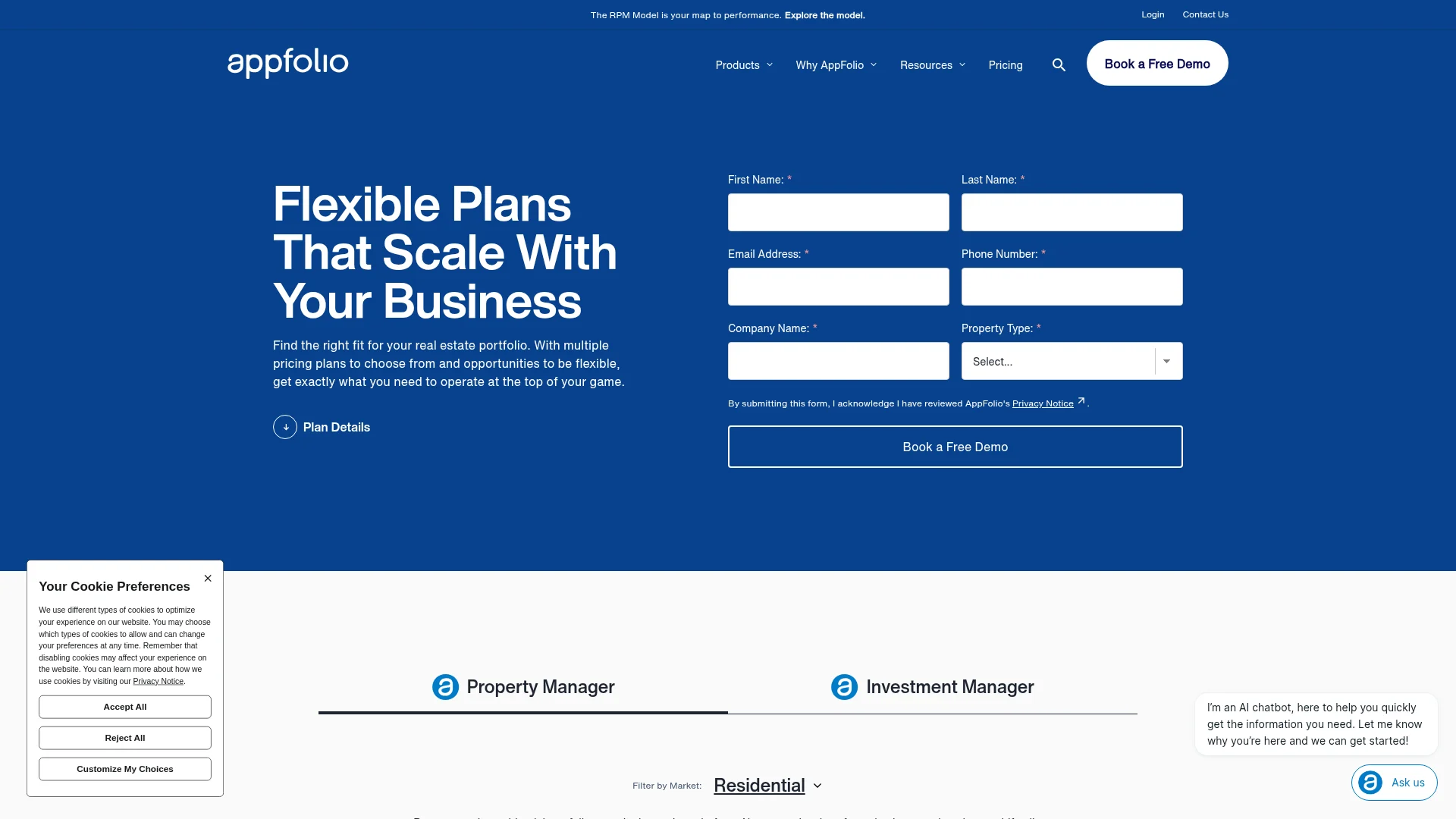
| Published entry price (verified 2 Nov 2026) | $65/mo Essential, 1–20 units | $1.49/unit/mo Core, 50-unit minimum |
| 10 units | $65/mo; $88.50 with bank fees | Not sold |
| 20 units | $65/mo; $112 with bank fees | Not sold |
| 50 units | $202/mo Growth; $269.50 with bank fees | $280–298/mo reported minimum |
| 100 units | $265/mo Growth; $400 with bank fees | $280–298/mo — still minimum-bound |
| Unit floor | None; Essential caps at 40 units | 50 units on Core |
| Onboarding fee | None on Essential; required and unpriced on Growth | Reported $400 Core, $1,000+ Plus, non-refundable |
| Accounting depth | Full general ledger, trust accounting, owner statements, 1099 e-filing | Full general ledger, trust accounting; corporate books on Plus |
| Support | 24/7 tickets on every plan; live phone from Growth ($202/mo), Mon–Fri 9–8 ET | 24/7 Help Center, chat and tickets; phone call bookable in-app |
| Built for | The 10–40 unit self-manager and small PM shop | The 50+ unit management company |
“Bank fees” means every tenant paying by ACH at the published per-transaction rate — $2.35 on Essential, $1.35 on Growth. Whether that lands on you or your tenant is a configuration choice, and it’s the line that changes this comparison most.
Buildium’s figures come from its own calculator, read at each unit count on 2 November 2026. AppFolio publishes per-unit rates and the 50-unit minimum but no dollar floor, so its minimum-spend and onboarding numbers are operator-reported.
Pricing at your portfolio size
10 units: $88.50 a month against a platform that won’t quote you
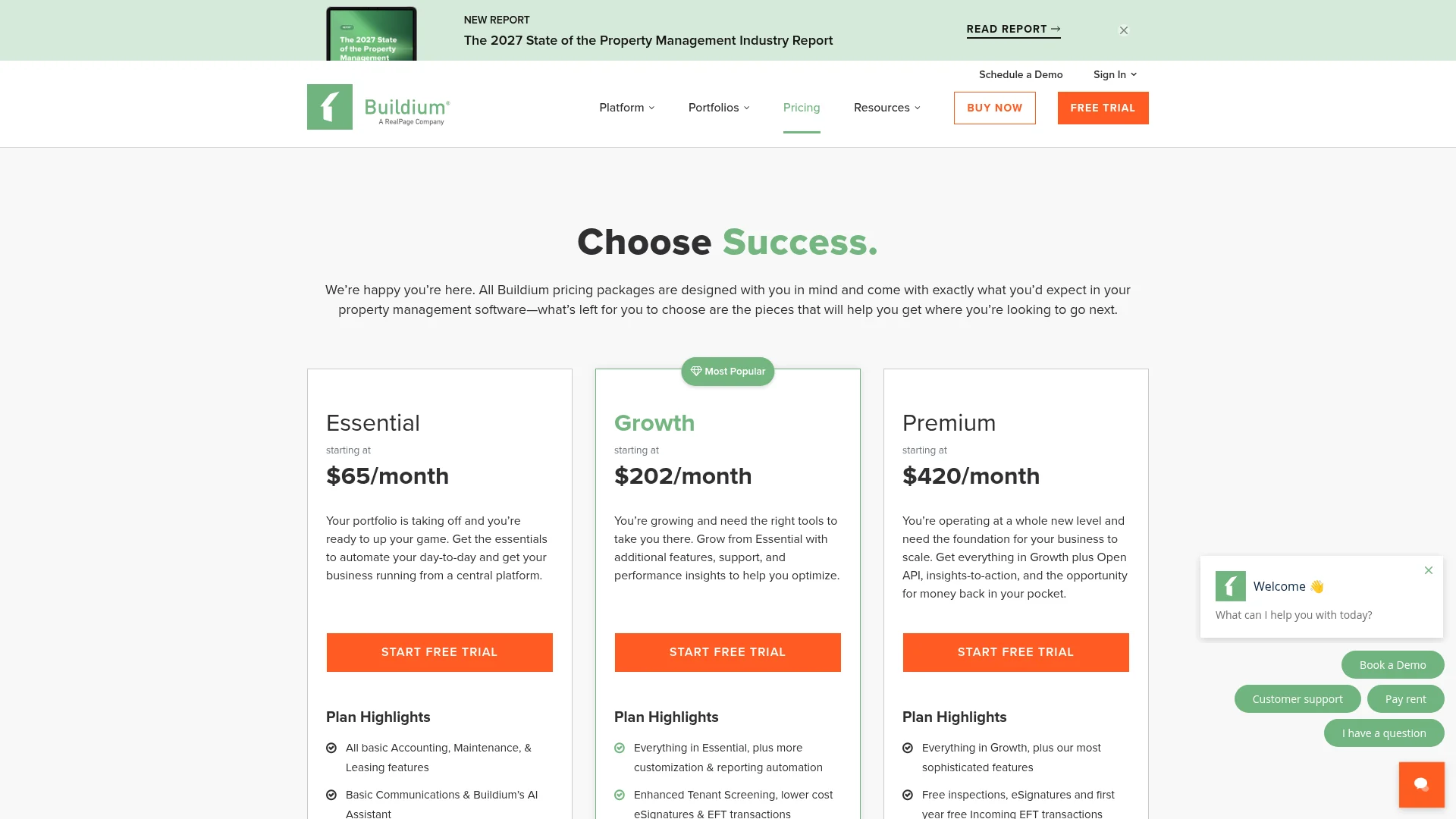
Buildium Essential is $65 a month to 20 units, read off Buildium’s own calculator on 2 November 2026. Ten tenants paying by bank add $23.50, so the real monthly number is $88.50 — $1,062 a year. Nothing else is mandatory: Essential skips onboarding, and there’s no unit minimum.
AppFolio’s 50-unit minimum means a ten-unit landlord can’t buy Core at list. The Reddit workaround — tell them you have 50 units — buys a quote for ten doors at a 50-unit spend: $28 to $29.80 per door.
20 units: the cheapest competent platform in the category
Buildium Essential still costs $65 at 20 units — $3.25 a door before payment fees, $112 a month all-in. Paying $5.60 a door for a full general ledger is, in this category, a deal. AppFolio remains unavailable: the 50-unit minimum is a sales qualification rule, and 20 units doesn’t qualify.
50 units: they finally meet, and Buildium is still slightly ahead
At 41 units Buildium’s Essential plan ends and Growth begins at $202 a month. At 50 units that’s $4.04 a door on subscription, or $5.39 once $1.35 per incoming payment is counted — $269.50 a month, $3,234 a year.
AppFolio Core at 50 units is $74.50 by unit math, but the minimum spend sets the bill: operators report $280 to $298 a month. So the two subscriptions land within $30 of each other, Buildium nominally cheaper.
Then onboarding enters. Buildium requires paid onboarding on Growth — its FAQ says every new Growth and Premium customer “must use our customized Onboarding service” — and doesn’t publish the price. AppFolio’s runs a reported $400 on Core, non-refundable. Both are unquoted first-year costs, so the 50-unit comparison gets decided in a sales call, not a table.
100 units: the crossover, and it points the other way
Buildium Growth is $265 a month at 100 units, plus $135 in payment fees if all 100 tenants pay by bank: $400 a month, $4,800 a year.
AppFolio Core at 100 units is still governed by the minimum — $149 by unit math, $280 to $298 reported on the invoice. At the top of that range AppFolio is roughly $100 a month cheaper, before you count that its resident pays the $2.49 eCheck rather than you.
That inversion is what vendor-owned pages bury. Buildium is cheaper small because you can buy it and its subscription is flat; AppFolio gets cheaper near 100 because its per-unit rate starts working and its payment fees sit on the tenant’s side. The break-even sits between 50 and 100 doors.
Run your own number before treating any of this as settled — the cost calculator prices ten platforms at your exact unit count, minimums and tier caps included.
Accounting and reporting: the real difference
Both keep a genuine general ledger. There’s no version of this where AppFolio’s books are thin — it runs trust accounting, automated reconciliation, owner statements and 1099s. The distinction is what kind of books each is built to produce.
Buildium treats the property and the owner as the accounting unit. Trust accounting is native and not tier-gated, and the model is exactly what owner statements need: money tracked by property, with funds moved between properties inside one owner’s portfolio to cover shortfalls before a draw.
AppFolio also requires a property on every transaction, but the corporate layer is where it pulls ahead at scale. Corporate Accounting, a Plus feature, consolidates the management company’s own books alongside property books. Portfolio Accounting is newer — it pays bills against an owner’s whole portfolio with automatic true-up on distributions — and because it arrived after the current plan cards were written, whether you get it is a question for the quote. On Core you’re running property accounting with owner reporting, and the company’s own books live elsewhere, usually QuickBooks.
Two things neither platform does:
No Schedule E. Both produce the ledger, property-level P&L and transaction detail a Schedule E is built from; you or your CPA maps it. A review promising one-click Schedule E from either vendor is describing an export, not a tax return.
1099s, differently. Buildium e-files through Nelco at $50 per batch plus $4.50 per recipient — and since 1099-MISC and 1099-NEC now file as separate batches, both means two batch fees. AppFolio generates the forms and a FIRE file, but you supply the Transmitter Control Code and do the filing. One charges you to file for you; the other hands you the job.
Customer support: which one you can actually reach
AppFolio has the better support model on paper, and it’s the one difference here that doesn’t move with unit count: Buildium’s live phone line starts at Growth, which is $202 a month. On Essential — the plan a 10- or 20-unit landlord is actually buying — there is no phone support at any price.
Buildium’s own help documentation sets that ladder. Every plan gets the Help Center, Buildium Academy, ticket submission open 24 hours a day with replies by email (“Buildium doesn’t have a customer portal for cases,” the article notes), and the system status page. Live phone support, Monday to Friday 9am to 8pm Eastern, arrives with Growth and Premium. Priority Support — a fast-track queue — is a paid add-on on Growth and included on Premium.
Buildium does publish service numbers on its pricing page: 95% customer support satisfaction, 85% of calls resolved on the first call, and an average Priority Support phone wait under a minute against under 30 minutes for tickets. Those are vendor claims, not results measured here, but they’re specific enough to hold the vendor to — and the status page makes the phone desk observable, because phone support is a monitored component you can subscribe to alerts for.
AppFolio’s published model is broader at the entry point and vaguer about everything else. Its contact page tells logged-in customers they can get help “24/7 in the AppFolio Knowledge Base via our smart search tool, start a chat, or submit a support ticket,” and in-app messaging can surface an article, put you with a product expert, book a phone call, or file a ticket. It publishes no tier gate on those channels — and no hold time, resolution rate or satisfaction figure either.
What reviewers describe is messier than either page. Capterra reviewers of Buildium split on the same question: one lists the wait to reach a person as a dislike, another writes that “you have to create a support ticket. However, the response time is very quick.” On Trustpilot the recurring complaint is hold times and callbacks that don’t arrive (both read 17 Nov 2026). Treat that as a report pattern rather than a measurement — and note it’s the entry-tier experience being described, which is exactly what the pricing page predicts.
The decision this turns into is arithmetic. On a 21–40 unit portfolio, moving from Essential to Growth to get the phone line costs $118 a month more — $1,416 a year — for the same software, plus the mandatory paid onboarding that comes with Growth. If you’re running twenty doors alone and a phone call is how you get unstuck, that’s the real price of Buildium’s support. If your questions are homework you can batch into tickets, it isn’t. AppFolio’s version of that trade can’t be priced from published information, because you can’t buy a plan below 50 units to find out.
Which is easier to use?
The review data does not support the folklore here, and the folklore runs both ways depending on who wrote the comparison.
Capterra, read today with 2,236 Buildium reviews against 1,892 for AppFolio, scores ease of use at AppFolio 4.5, Buildium 4.3 — while rating overall satisfaction identically at 4.5 apiece. Buildium leads on customer service (4.4 against 4.2) and value for money (4.4 against 4.3).
AppFolio’s own comparison, built on G2 usability data, reaches the same conclusion and goes further: 92% ease of use against Buildium’s 90%, and an 88% user-adoption rate against 82%. That’s a vendor’s reading of a third party’s numbers, so weight it as directional — but it points the same direction as Capterra’s independent one.
What that measures is the running experience, not the first month, and the first month is where these two diverge sharply:
- Buildium you can start alone. Published tiers, a 14-day trial on sample data with no card, and no compulsory onboarding below Growth. A solo landlord can be collecting rent inside a week.
- AppFolio is an implementation. No published price, no quote below 50 units, and its depth sits at the accounting and reporting end — which is exactly where practitioner comparisons say the learning curve lives. That’s fine when someone else on the team owns it. It’s a worse use of a solo landlord’s evenings.
The distinction that survives both the scores and the anecdotes: ease of use is a property of the software; ease of adoption is a property of your team. One person doing the books and the calls gets further, faster on Buildium. Two or more people with defined roles — leasing, maintenance, bookkeeping — get more out of AppFolio’s role-based permissions and its stronger mobile app, which consultant comparisons consistently credit and which Buildium’s own reviewers do not.
A 0.2 gap on a five-point scale does not decide a purchase. Staff count and who touches the accounting do.
The hidden costs on both sides
List prices lie by omission on both platforms, just about different omissions.
Buildium’s fee stack, verified 2 November 2026: incoming EFT $2.35 on Essential, $1.35 on Growth, $0.60 on Premium (first year free on Premium); outgoing EFT $0.99 on every tier, which is what owner draws and vendor payments cost; cards 2.99%; eSignature $5 per document on Essential, $1 on Growth, unlimited on Premium; bank account setup $99 each on Essential, 10 free on Growth; screening $17, or $35 applicant-paid, $20 enhanced on Growth and Premium; inspections $99 setup plus $40–$95 a month on Essential, included on Growth.
The one that catches small landlords is the bank account fee. Trust accounting done right often means separate accounts per owner, and on Essential each is $99 before you’ve collected rent — three owner clients and you’re $300 down in month one on an $84 subscription.
AppFolio’s, to the extent any of it is published:
AppFolio publishes the per-unit rate, the 50-unit minimum, and that a minimum spend applies — but not the spend. Reported figures put Core’s floor at $280 to $298 a month and onboarding at $400 and up. Payment costs are structured differently: resident eCheck $2.49, $1.00 if the manager absorbs it; cards 2.99%; debit $9.99 flat. That $2.49 is the subject of a class action alleging it wasn’t disclosed in residential leases — worth knowing both as a landlord and as the person who’ll have to answer a tenant asking about it.
Either way, month one of a 50-unit migration costs more than a month’s subscription, and neither vendor names the number until you’re in a demo.
What Reddit actually says
The pattern on Reddit isn’t a platform preference. It’s a door-count split.
“Buildium tends to be the sweet spot at 10-100 units.” That line, from a mid-size landlord thread on r/PptyMgmtSoftware, sits beside its other half: “AppFolio will likely price you out with their 50-unit minimum.” The same commenter rated AppFolio higher on interface, lower on reporting flexibility, and still picked Buildium for the band.
The 70-unit switcher. A landlord three years into Buildium asked r/USPropertyManagement whether moving to AppFolio at 70 units was worth it. The replies were unanimous and unglamorous: at 70 units both tools are overkill and you’re bumping into AppFolio’s minimums anyway. “Stick with Buildium,” one wrote, “or if you must switch consider something like Rentec Direct.”
The one that should worry AppFolio. From an r/PropertyManagement thread on exporting data out of Buildium: “I think appfolio has lost a fair amount of business by having a minimum threshold. I would have paid the minimum to avoid the turnover cost. Now I am established on buildium and may never make the switch.” That’s the real cost of a 50-unit floor: not the customers turned away, but the ones who sign elsewhere and never revisit.
And the counter-current. In an r/PropertyManagement thread titled “Do not use Buildium!”, a manager who migrated from AppFolio called it a big mistake; a long-tenured Buildium user replied that AppFolio is “really better, especially when it comes to the ledgers and reports.” AppFolio’s Trustpilot score sits at about 2 out of 5 across roughly 790 reviews, against Buildium’s 4.3 across 823 (both 5 Nov 2026) — but most of that gap is tenant complaints about payment fees, not manager complaints about the software.
Which is why the migration story from our own ICP research matters more than any feature table. A landlord who moved DoorLoop to AppFolio at 65 units said the only thing they’d change is doing it sooner. “Switch while you’re small” really means “don’t pay for a migration you’ll repeat.” Pick the platform you’ll still be on at 150 units, or accept you’re buying a two-year tool.
FAQ
Which is easier to use, Buildium or AppFolio?
AppFolio, by a small margin, on the running experience: Capterra scores its ease of use 4.5 against Buildium’s 4.3 across 1,892 and 2,236 reviews respectively (read 17 Nov 2026), and G2 usability data cited by AppFolio puts it 92% to 90%. Starting out is a different question — Buildium publishes its prices, offers a 14-day trial with no card, and needs no paid implementation, so a solo landlord can be live in days where AppFolio is an assisted setup with no published price and no quote below 50 units. One person: Buildium. A staffed team with defined roles: AppFolio.
Which has better customer support, Buildium or AppFolio?
On published terms, AppFolio — its support channels aren’t tier-gated, so a 20-unit customer gets the same 24/7 Help Center, chat and ticket access as a 500-unit one, with a phone call bookable in-app. Buildium reserves live phone support for Growth ($202/mo) and Premium, so an Essential customer is on email tickets only, and Priority Support can’t be bought without Growth. What Buildium publishes and AppFolio doesn’t is a service level: 95% satisfaction, 85% first-call resolution, under a minute of hold on Priority. If you need a human voice at 20 units, the honest alternative is DoorLoop at $199 or Buildium Growth at $202-plus.
Is Buildium or AppFolio better for 20 units?
Buildium, and it isn’t a close call. AppFolio Core requires a 50-unit minimum, so at 20 units it isn’t on the table at list pricing. Buildium Essential is $65 a month to 20 units — $3.25 a door — and includes a full general ledger, trust accounting and owner statements. Budget $2.35 per incoming bank payment on top: at 20 tenants paying by ACH, that’s $112 a month all-in.
What’s AppFolio’s minimum?
50 units on the Core plan, plus a minimum monthly spend that AppFolio confirms applies but does not publish. Operators report the spend floor at $280 to $298 a month. Because the minimum spend binds until unit math exceeds it, AppFolio’s real cost per door falls as you grow: $5.60 to $5.96 a door at 50 units, $2.80 to $2.98 at 100, and the published $1.49 rate only takes over around 200 units. Plus and Max carry unit minimums and spend minimums AppFolio also doesn’t publish.
Does Buildium or AppFolio handle 1099s?
Both prepare them; they file differently. Buildium e-files 1099-MISC for owners and 1099-NEC for vendors through Nelco at $50 per batch plus $4.50 per recipient — and as of the 2026 tax year the IRS requires MISC and NEC as separate batches, so budget for two batch fees. AppFolio generates both forms and a FIRE file, but you need your own Transmitter Control Code and you do the submission. Neither platform produces a Schedule E — both give you the ledger and the property-level detail, and the mapping is yours.
How hard is it to switch later?
Harder than the sales call suggests, and the cost is your time more than the migration fee. Every transaction in both platforms posts against a property, so a portfolio’s history arrives as a stack of property ledgers to rebuild on the other side. Operators describe weeks of cleanup, not days. The rule from landlords who’ve done it twice: migrate at a year boundary so each tax year’s books come from one system.
The verdict
Under 50 units: Buildium. Not because it’s better software — AppFolio has the nicer interface and most operators say so — but because you can buy Buildium, its price is published, and Essential covers up to 40 units at $65 to $84 a month with a real general ledger. Budget $2.35 per bank payment and expect the gates: $5 eSignatures, $99 bank accounts, ticket-only support. If the learning curve is the objection, the full pricing breakdown covers every platform at your unit count.
50 units: a toss-up decided by quotes. Buildium Growth at $202 plus $1.35 per payment lands close to AppFolio Core’s reported minimum. Buildium’s Growth onboarding is mandatory and unpriced; AppFolio’s is non-refundable, reported near $400. Get both in writing.
Approaching 100 units: open the AppFolio evaluation. At 100 units Buildium Growth runs about $400 a month with payment fees counted, against a reported $280–$298 for AppFolio Core, eSignatures included and the resident carrying the $2.49 eCheck. That’s where AppFolio’s minimum stops being a wall and starts being a price. Start at 80 units, not 150 — migration only gets more expensive.
Below 10 units: neither. Our small-landlord property management software comparison prices the free tier — TurboTenant, Innago, Rentec Starter at $25 flat — and at five doors that’s the honest answer. Buy software when the accounting is the problem, not the rent collection.