DoorLoop vs Buildium: Cost, Small Teams, Mobile Home Parks
DoorLoop's last published minimum is $199; Buildium bills lot rent and ratio utility allocation on the resident ledger, DoorLoop posts a typed lease charge. Costs at 20–60 lots, the small-team support trade, checked 17 Nov 2026.

DoorLoop wins on price past 40 doors and on experience everywhere; Buildium wins on the books at every size that can still buy its cheap plan. The honest version of this comparison isn’t feature counts — it’s that DoorLoop’s $199 minimum is the whole bill below 80 units, Buildium’s $65 teaser grows a fee stack, and the crossover between them sits exactly at Buildium’s plan cliff. What follows is both invoices, fees counted, read off each vendor’s own pages on 3 November 2026.
Disclosure: Landlord Method earns a commission if you sign up through links on this page. It doesn’t change the prices or the verdict below.
Quick answer: the two platforms at a glance
| DoorLoop | Buildium | |
|---|---|---|
| Published entry price (verified 3 Nov 2026) | One: $2.50/unit/mo annual, $199/mo minimum | Essential: $65/mo to 20 units, $84 from 21 |
| 10 units | $199 flat — $19.90/door | $65 + $23.50 ACH = $88.50 |
| 20 units | $199 flat — $9.95/door | $65 + $47 ACH = $112 |
| 50 units | $199 flat — $3.98/door | Growth $202 + $67.50 ACH = $269.50 |
| Where the rate is real | $2.50/unit only from 80 units ($200 at 80, $250 at 100, $325 at 150) | $65 holds to 20 units; Growth starts at 41 |
| Incoming ACH | $1.50 on One — paid by the tenant | $2.35 Essential / $1.35 Growth — landlord pays by default |
| Cards | 3.25% ($3.50 minimum), tenant-paid | 2.99% |
| eSignature | Included on current plans | $5/doc Essential, $1 Growth |
| Accounting depth | Property reports built on expense categories | Full general ledger, trust accounting, 1099 e-filing |
| Learning curve | Fast onboarding; support-after-sale gripes | Steep; phone support gated to Growth and above |
The line that decides most doors: count the subscription plus incoming ACH and Buildium is cheaper at every unit count below 41 — $88.50 against $199 at ten doors — and DoorLoop is cheaper the moment Buildium’s Growth plan starts at $202. The crossover isn’t gradual. It’s the cliff.
Real pricing at your portfolio size
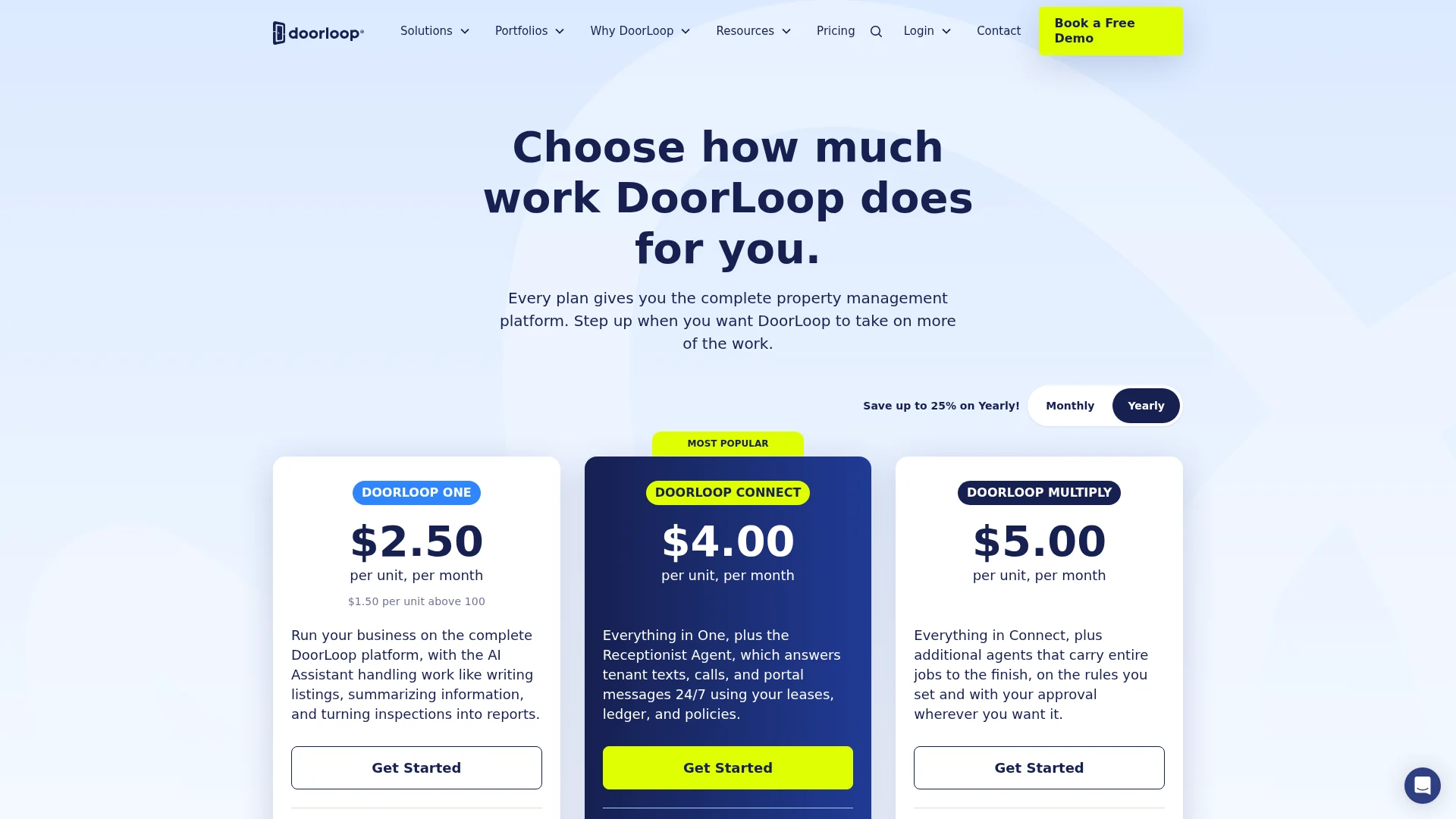
DoorLoop sells One, Connect and Multiply, all priced per unit with monthly minimums. One is $2.50 per unit on annual billing ($3.00 month-to-month) with a $199 monthly minimum — $239 billed monthly. Connect is $4.00 a unit on a $299 minimum; Multiply $5.00 on $399. Do the division and the minimum is the story: $39.80 a door at five units, $19.90 at ten, $9.95 at twenty. The $2.50 headline rate only becomes your actual rate at 80 units, where 80 × $2.50 finally outruns the floor. At 100 units the bill is $250; above that each unit is $1.50 — $325 at 150. The full DoorLoop pricing breakdown prices every band, the monthly-billing column and the fee wall if you want the line items.
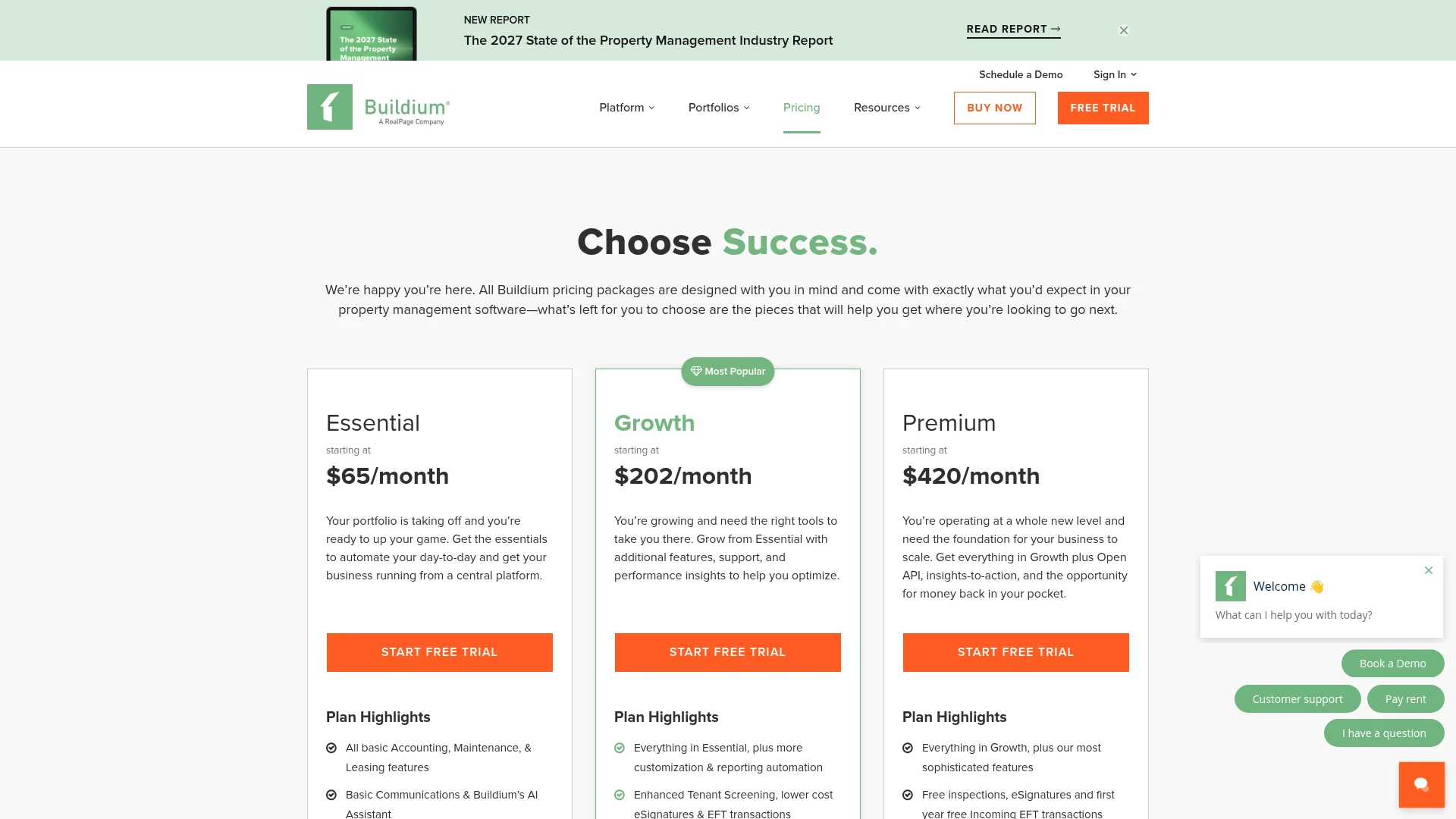
Buildium publishes banded tiers: Essential $65 to 20 units and $84 from 21 to 40, then Growth at $202 to 50, $265 to 100, $306 to 150 — read off Buildium’s own calculator on 3 November 2026, matching our cost calculator to the dollar. The subscription is the small number. Essential charges $2.35 per incoming bank payment, so ten ACH-paying tenants add $23.50 — $88.50 all-in, $1,062 a year. Cards run 2.99%, e-signatures $5 a document, and Essential’s support is tickets only.
Side by side, with every tenant paying by bank:
| Units | DoorLoop One | Buildium (sub + incoming ACH) | Cheaper |
|---|---|---|---|
| 10 | $199 | $88.50 | Buildium by $110.50 |
| 20 | $199 | $112.00 | Buildium by $87 |
| 40 | $199 | $178.00 | Buildium by $21 |
| 50 | $199 | $269.50 | DoorLoop by $70.50 |
| 100 | $250 | $400.00 | DoorLoop by $150 |
Two honest adjustments to that table. First, Buildium lets you pass the $2.35/$1.35 incoming EFT to tenants as a configuration choice — do that and Buildium costs $65–$84 flat below 41 units, and the gap widens. Second, DoorLoop’s $1.50 ACH fee is charged to the tenant by design, not choice; you can add a convenience fee on top and keep it as income. So the real question isn’t only what you pay — it’s whose bank statement the payment fees come out of, and whether your tenants are the ones financing the software.
The hidden-fee breakdown
DoorLoop’s fee history is the most-cited complaint corpus in this category, so it deserves the uncut version — what the complaints said, and what the 2026 repricing actually changed.
The merchant account. To collect rent through DoorLoop you need a merchant account, and older plans charged for the application — $49 on Starter, $25 on Pro. A verified Capterra reviewer: “I was also not informed about the additional fee for a merchant account necessary for rent collection, which was one of the primary reasons I purchased the software.” On the current One/Connect/Multiply plans the application fee is gone — DoorLoop’s help center lists merchant account applications as included (verified 3 Nov 2026). What isn’t gone is the dependency: payments still run through DoorLoop’s processor, and Trustpilot reviews describe tenant bank accounts blocked by Stripe with weeks of support loops to unwed them.
Per-text charges. The old plans sold messaging credit bundles; the complaint that stuck is a Trustpilot reviewer’s: “I was just informed for the first time that there is a charge for text messaging. After 3 sales pitch conversations where they never mentioned it.” Current plans include 5 credits per unit per month on One (10 on Connect, 20 on Multiply) and charge $0.02 per credit beyond that on One. More generous, not free — a 20-unit portfolio that texts heavily still sees overage charges, just smaller and itemized ones.
eSignature. The “$1 per eSignature” complaint is real and also old: $1 was the Pro-plan rate ($3 on Starter). Current plans include eSignature requests. If you’re comparing against reviews written in 2024 or early 2025 — and most of the top-ranking ones are — you’re reading the old fee schedule.
What still bites on the current plans. Card payments carry a 3.25% fee with a $3.50 minimum — on a $100 rent payment that minimum is 3.5% — charged to the tenant, which is why a share of DoorLoop’s one-star Trustpilot reviews are written by tenants, not landlords. Returned payments cost $40. Annual subscriptions auto-renew: a BBB complaint from December 2025 documents a renewal jumping from $1,622 to $2,388 — precisely what the current $199 minimum costs across a year — with the complainant describing three weeks of unresolved support issues before the charge. Refunds on prepaid annual plans are routinely refused in the complaint corpus, including from an owner who closed their business mid-term. And cancellation is not self-service: reviewers across BBB and Capterra describe emailing a representative and waiting for a callback.
Buildium’s stack, for balance, verified 2 November 2026: incoming EFT $2.35 on Essential, $1.35 on Growth; outgoing EFT $0.99; cards 2.99%; eSignature $5 per document on Essential; $99 per bank account on Essential; screening $17 landlord-paid or $35 applicant-paid. It’s the more expensive list per line item — and the more honest one. Every fee is published on one page before you talk to sales. DoorLoop’s current fee schedule is cleaner than its reputation; the residual risk isn’t the fees, it’s the billing behavior around them: auto-renewal, no pro-rated refunds, offboarding that starts with an email.
Accounting and Schedule E
This is the gap no price closes. Buildium runs a full general ledger — double-entry books, native trust accounting that isn’t tier-gated, bank reconciliation, owner statements, and 1099 e-filing through Nelco ($50 per batch plus $4.50 per recipient, and since the 2026 tax year MISC and NEC file as separate batches, so two batch fees). It’s the only platform under $100 a month with real books rather than expense categories, which is why CPAs ask for it by name and why the learning curve exists.
DoorLoop’s accounting is property reports built on expense categories. For a single-entity landlord tracking income and expenses per door, that’s genuinely enough. Where it thins out is the edges: a property-management reviewer on Trustpilot describes owner disbursements as manual — “you have to go in and manually process them and figure out the calculations for management fees each month. It was not simple” — and a Capterra reviewer flags charges posting to the owner when they should route to the management company. Neither platform produces a Schedule E return: both give you the ledger and property-level detail, and the mapping is yours or your CPA’s. The difference is what the export looks like when it arrives — a reconciled general ledger, or reports that may need recategorizing first. That’s the difference between a CPA bill and a CPA bill plus your February.
Mobile home parks: lot rent and utility billing
Buildium, if residents are billed for utilities. The two platforms handle a park’s two unusual charges very differently, and only one of them has a utility-billing workflow at all.
Lot rent is the easy part. Both tools bill per unit, so a lot is a unit and lot rent is that unit’s recurring rent charge — set the amount and schedule and both collect it online with autopay and late fees. Where neither is built for a park is the ownership split: a resident who owns the home on your lot is a tenant paying lot rent, while a park-owned home is an asset you rent, sell or finance. Both can record those as charges and leases. Neither tracks home inventory, home sales or financing as a first-class object, and a park where those are central workflows should shortlist manufactured-housing software rather than argue with either platform.
Utility billing is where they separate. Buildium documents two methods, and both post to the resident ledger. Meter readings are recorded per unit by type — electric, oil, gas, sewer, water — and billed with a base charge plus a usage rate; you enter the readings yourself, Buildium doesn’t import them from the meter. For a master-metered park, its Ratio Utility Billing System allocates a shared bill across units through a common expense allocation — split automatically by unit size or evenly, then posted as a bulk charge. It’s a monthly loop you run: record and pay the utility bill, allocate it, post the charges.
DoorLoop documents utilities as a lease charge: a recurring charge with the amount and description you type in, or a one-time charge for a variable month. There’s no published meter-reading or ratio-allocation workflow in its help center, so on a sub-metered or RUBS park you work out each lot’s number outside DoorLoop and post it. For a park charging one flat utility fee per lot, that difference disappears — both post a fixed recurring charge equally well.
| Lots (annual billing) | Buildium, sub + incoming ACH | DoorLoop One |
|---|---|---|
| 20 | $65 + $47 = $112 | $199 subscription |
| 40 | $84 + $94 = $178 | $199 subscription |
| 60 | Growth $202 + $81 = $283 | $199 + $90 of tenant-paid ACH |
Buildium’s row assumes every lot pays by bank transfer and the landlord absorbs the fee at $2.35 on Essential and $1.35 on Growth — pass it to the resident and the bill drops to the subscription alone. DoorLoop’s $1.50 ACH is tenant-paid by design, so its subscription is the landlord’s number. Rates read from each vendor on 7 and 17 November 2026. Buildium’s Essential plan stops at 40 units, so a 60-lot park is on Growth whether or not it wants Growth’s features — which is the same cliff that decides this comparison at every other property type.
Note on the DoorLoop figure: $199 is the last minimum it published. Since 9 November 2026 its plan cards say only “minimum spend and units apply — contact us for details”, so treat $199 as the floor to confirm in a quote, not a bill you can read off the page. Every other DoorLoop number in this section comes from the published per-unit rate, which is still there.
What to test before you buy either. Ask the vendor to build one park with five lots and show a full billing cycle on it: lot rent, a metered water charge, a shared sewer charge, a late fee and a delinquency report. That demo answers more than any feature list, and it’s the single request where Buildium’s and DoorLoop’s published capabilities actually diverge.
Ease of use and setup
DoorLoop wins this on every scorecard that measures it: 4.8/5 across 719 Capterra reviews (2 Nov 2026), a clean interface, working mobile apps, and onboarding measured in days. Buildium sits at 4.5/5 across 2,234 Capterra reviews with a learning curve that’s the most-cited objection in every corpus — “it’s clunky but it works for us and you get used to the clunky-ness,” as one r/PropertyManagement landlord put it. Setup in Buildium means configuring a chart of accounts, bank feeds and trust ledgers — hours, not sessions — and Growth-plan onboarding is mandatory and unpriced.
Then support inverts it. Buildium’s Essential is ticket-only — phone is gated to Growth and above — but the support that exists is human and generally responsive. DoorLoop’s support is the subject of its worst reviews: 3.7/5 across 277 Trustpilot reviews (3 Nov 2026), the critical cluster describing an AI chat that loops and long waits for a person, against Buildium’s 4.3 across 823 (5 Nov 2026). Read those two scores as one trade: DoorLoop is easier to start and harder to get unstuck in; Buildium is harder to start and easier to stay on. If you already know property accounting, DoorLoop’s UX advantage is worth real money. If you’re learning the accounting itself, the software teaching you is worth more than the software being pretty.
Automation: what moving to DoorLoop actually changes
If manual work rather than price is why you’re looking past Buildium, the plan you’re on decides more than the vendor does — because both companies now sell automation as an upgrade tier, not as a feature.
Buildium’s ladder, from its pricing page today:
- Essential ($65) includes Buildium’s AI Assistant — answering questions, processing invoices, building reports — but no automation suite.
- Growth ($202) adds reporting automation and AI-enhanced communications and analytics.
- Premium ($420) is where “full AI and automations suite” plus the Open API actually sit.
DoorLoop rebuilt itself into the same shape. Its three tiers, read today:
| DoorLoop One | DoorLoop Connect | DoorLoop Multiply | |
|---|---|---|---|
| Per unit, annual billing | $2.50 | $4.00 | $5.00 |
| At 50 units | $125 (floor applies) | $200 | $250 |
| AI Assistant | included | included | included |
| Receptionist Agent — answers tenant texts, calls and portal messages, 24/7 | — | included | included |
| Free incoming ACH | — | included | included |
| Maintenance Ops Agent — work order through vendor, completion and bill | — | — | included |
| Lease Renewal Agent — builds the offer from payment history and lease terms, runs outreach, carries it to signature | — | — | included |
| Availability | anyone | anyone | invite only |
Two things follow, and neither is in the vendor comparison pages.
The automation you’re asking about is the tier DoorLoop won’t sell you off the site. Receptionist, maintenance and renewal agents live on Multiply, which DoorLoop labels invite-only. At 50 units that’s $250 a month on annual billing before any minimum — but “minimum spend and units apply, contact us for details” is the only published pricing language on all three tiers today, so the number you’re quoted may not be the rate on the card.
The honest price comparison is Multiply against Premium, not One against Growth. Buildium Growth at $202 a month has no agent layer at all; the full automation suite is Premium at $420 a month, or $4,536 a year on annual billing. DoorLoop Multiply at 50 units is $250 a month — $3,000 a year — for a smaller platform whose agents launched recently and have no independent track record yet. At 50 units that’s roughly $1,500–$2,000 a year cheaper for less software maturity; at 200 units the difference compounds.
Three things we could not verify, and you should ask on a demo:
- Whether the agents do what the pages claim. DoorLoop’s own framing — every action logged, each agent’s supervision level set by you, approval-first by default — is a design description, not a measured result.
- What the minimum spend actually is on each tier. It was published as $199 a month until early November and is not published now.
- Whether the invitation to Multiply is a capacity limit or a sales filter. Nobody says.
The cheaper answer may also be the one that doesn’t involve switching: if you’re on Essential and want automation, growth inside Buildium costs $137 a month; if you’re on Growth and want the automation suite, Premium is $218 more — both cheaper than a migration at small unit counts, and both of which you can price today without a sales call.
Small property teams: 2–5 people, no per-seat bill
Neither platform charges per user, which surprises people budgeting for seats. Buildium’s help center states it flatly — “your Buildium subscription includes an unlimited number of staff members” — and DoorLoop lists unlimited users on every plan. Three logins cost the same as one on both. So the team question reduces to two things: what support you can reach when the person who knows the answer is away, and what the plan costs at your unit count.
At 25 units with three logins, all tenants paying by bank transfer:
| 25 units, 3 logins | Landlord’s monthly bill | Phone support |
|---|---|---|
| Buildium Essential | $84 + $58.75 ACH = $142.75 | No — tickets only |
| Buildium Growth | $202 + $33.75 ACH = $235.75 | Yes, Mon–Fri 9–8 ET |
| DoorLoop One | $199 (last published minimum) + $37.50 ACH, tenant-paid | Yes — priority queue on Connect |
The first row is the whole argument. Buildium Essential is $93 a month cheaper than either alternative and does everything Growth does except answer the phone — and for a two- or three-person team, “the person who knows this is out today” is exactly the scenario that decides whether the software gets used or abandoned. If your team can live on tickets, Essential is the cheapest competent platform at this size by a wide margin. If it can’t, Buildium Growth and DoorLoop One land within a dollar of each other at 25 units, and the choice moves to accounting depth against interface.
DoorLoop’s answer to a small team is the AI layer rather than more logins: Connect at $4.00 a unit on a $299 minimum adds a receptionist agent that answers resident calls, texts and portal messages around the clock, and Multiply at $5.00 on $399 adds maintenance and renewal agents. At 25 units those are $299 and $399 a month — more than doubling the software bill to absorb a share of the work a part-time person would otherwise do. That trade is worth running on your own hours, not on the marketing.
Two things to test in a demo regardless of which you pick. First, ask what phone support you get on the exact plan you’re quoted, because both vendors describe support in terms of their top tiers. Second, have the manager app do the job your second and third logins will actually do — acknowledge a work order, chase a failed payment, approve a bill — rather than watching the dashboard tour both vendors demo.
What Reddit says
Both names carry scar tissue. r/PropertyManagement’s “NO to BUILDIUM” thread — which ranks #2 on Google for “buildium review” — is mostly price increases and the learning curve; “Buildium is trash” appears as its own thread title. DoorLoop’s are blunter: “Property Manager BEWARE: Doorloop is hot garbage!”, and a follow-up from the same poster, “For those looking at Doorloop - BEWARE! Continues to be hot garbage,” describing support that never pins down an answer and mid-year feature changes that “messed up all my categorization and workflows.” In one day-to-day-tooling thread, DoorLoop’s entire contribution was four words: “Do not use door loop.”
The counter-current is just as real. DoorLoop gets recommended in 10–50 door threads for exactly the reasons its Capterra score says — modern interface, fast setup — and gets “immediately contested” when the fee stories surface. Buildium survives its own hate threads on the accounting: in a mid-size landlord thread, “Buildium tends to be the sweet spot at 10-100 units,” with the same commenter conceding the interface while sticking with it. The pattern underneath both: nobody on Reddit complains about DoorLoop’s books or Buildium’s interface. Each platform’s haters are describing the other one’s strength.
FAQ
I’m on Buildium and I need better automation. Is DoorLoop the upgrade?
Only if you’re comparing against the right tiers. Buildium’s full automation suite is Premium ($420/month, $4,536 a year on annual billing) — Growth at $202 has reporting automation and AI communications but no agent layer, and Essential has only the AI Assistant. DoorLoop’s agents sit on Multiply at $5/unit on annual billing, which is $250/month at 50 units and invite-only; Connect at $4/unit adds just the receptionist agent. At 50 units Multiply runs roughly $1,500–$2,000 a year less than Buildium Premium for a younger platform whose agents have no independent track record. If you’re on Essential or Growth, moving up inside Buildium costs $137 or $218 a month and requires no migration.
Is DoorLoop better than Buildium?
For the books, Buildium, at every size — the general ledger and trust accounting have no DoorLoop equivalent. For price above 40 units, DoorLoop: the Growth cliff puts Buildium at $202+ where DoorLoop is still $199. For the experience of using it daily, most reviewers side with DoorLoop. Pick by which failure hurts you more: outgrowing your books (Buildium’s failure mode is your time) or outgrowing your patience (DoorLoop’s is your support queue).
How much does DoorLoop really charge?
The subscription is $199 a month minimum on annual billing for One — the actual bill at 5 through 50 units, since 50 × $2.50 is only $125. It stays $199 until the per-unit rate catches the floor at 80 units ($200), then $250 at 100 and $325 at 150. Monthly billing raises the minimum to $239. On current plans, eSignature, merchant applications, outgoing payments and a website are included; tenants pay $1.50 per ACH on One or 3.25% per card ($3.50 minimum), and returned payments cost $40. Watch the annual auto-renewal — the BBB corpus documents a jump to $2,388 with no notice.
Which is better for 20 units?
Buildium on the math: Essential at $65 plus $47 in incoming ACH across 20 tenants is $112 a month against DoorLoop’s $199 — $9.95 of DoorLoop per door is the minimum talking, not the rate. Buildium’s verdict holds unless support is the deciding weight: at 20 units on Essential you get ticket-only support, and if you’d rather text a human than file a ticket, that’s DoorLoop’s $87 premium, spent on patience rather than plumbing.
Can you cancel DoorLoop easily?
Not by the public record. There is no self-serve cancellation: reviewers on BBB, Capterra and Trustpilot describe emailing a representative and waiting for a callback, and multiple complainants call the process deliberately slow. Annual prepayments are routinely non-refundable — including mid-year closures — and the December 2025 BBB complaint documents an auto-renewal charge arriving without advance notice. The practical hedges: pay monthly for your first quarter, calendar the renewal date, and don’t prepay a year to a platform you haven’t run a full rent cycle in.
Does Buildium run background checks?
Yes — Buildium’s tenant screening is TransUnion-powered, with credit, criminal and eviction reports at $17 landlord-paid or $35 applicant-paid, and a $20 enhanced report on Growth and Premium (verified 2 Nov 2026). It’s cheaper than DoorLoop’s equivalent, which runs $35 to the applicant plus $10 for income verification on every plan.
Is DoorLoop better than Buildium for a small property team?
Not on seats — both include unlimited users on every plan, so three logins cost the same as one. It comes down to price against phone support. At 25 units Buildium Essential is $142.75 all-in with tickets only, Buildium Growth is $235.75 with phone support and the deeper ledger, and DoorLoop One is $199 on the last minimum it published, with phone support and the better interface. If a human on the phone is a requirement, Growth and DoorLoop One are a dollar apart at this size; if it isn’t, Essential wins on price and neither alternative comes close.
Which handles mobile home park lot rent and utility billing better?
Buildium, on the billing side. It records per-unit meter readings and bills them with a base charge plus usage rate, and its RUBS workflow allocates a master-metered bill across lots by unit size or evenly before posting bulk charges. DoorLoop documents utilities as lease charges whose amount you calculate yourself, with no published meter-reading or ratio-allocation workflow. On price Buildium is cheaper below 40 lots; from 51 lots DoorLoop’s $199 minimum is roughly level with Buildium Growth. Neither is manufactured-housing software — a park where lot delinquency, home sales or park-level reporting is central should evaluate Rent Manager and Yardi Breeze instead.
The verdict
Budget-conscious or growth-stage, 10–50 units: DoorLoop, with eyes open on fees. The $199 minimum is a real price for a genuinely good product once you stop comparing it to the $65 teaser and start comparing it to Buildium’s loaded stack — at 41 doors the math flips and stays flipped. Read the fee page before the sales call, pay monthly for a quarter, and don’t prepay annually. If you intend to hand clean books to a CPA rather than maintain them yourself, reread the accounting section first.
Accounting-first or trust-compliance: Buildium. General ledger, native trust accounting, 1099 e-filing, owner statements — the moat is real and DoorLoop doesn’t have it. Budget $2.35 per incoming payment, $5 e-signatures, ticket-only support below Growth, and expect the interface to fight you for the first month. It’s the pick for landlords whose books are the product.
Under 10 units: ask whether either is overkill. At five doors, the small-landlord property software comparison prices the honest alternatives — free tiers and Rentec Starter at $25 flat — and $199 a month to manage five units is where comparison shopping usually ends. Buy software when the accounting breaks, not when the marketing is good.
And if you’re comparing DoorLoop against the other incumbent instead, Buildium vs AppFolio covers the 50-plus-unit end, where AppFolio’s minimums change the math again. The ten-unit case — where these same two platforms’ per-door fee math bites hardest — gets its own head-to-head soon.
Run your own numbers before deciding — the cost calculator prices both platforms at your exact unit count, minimums and tier caps included.