DoorLoop Review: What Small Landlords Actually Pay (2026)
DoorLoop One carries a $199 monthly minimum — $39.80 a door at 5 units. Real costs at 5 to 150 units, which limits survive the new plans, and who should skip it. Verified Nov 2026.

DoorLoop is real software wearing the wrong price tag for most small landlords. The platform is genuine all-in-one territory — accounting with trust accounting, leasing, maintenance, tenant and owner portals, unlimited users, an API. The obstacle is arithmetic, not quality: One, the entry plan, carries a $199 monthly minimum, so a five-unit landlord pays $39.80 per door while an 80-unit manager pays $2.50. This review prices that trade from 5 to 150 units. Every number below was read from DoorLoop’s own pricing page and help center on 4 November 2026.
Disclosure: Landlord Method doesn’t earn a commission from DoorLoop — its affiliate program is not live on this site. Pricing comes from DoorLoop’s own pages.
Quick answer
| The deal (verified 4 Nov 2026) | |
|---|---|
| Plans | One $2.50/unit/mo annual ($199/mo minimum, $239 monthly); Connect $4.00/unit ($299 min); Multiply $5.00/unit ($399 min) |
| What the minimum means | One costs $199/mo flat from 1 to 79 units. The $2.50 headline rate only becomes your real rate at 80 units |
| Strongest features | Full platform on every plan: accounting and reports, leasing, maintenance, tenant/owner portals, unlimited users, API, eSignatures |
| Main tradeoffs | A minimum priced for portfolios, not rentals; a management company’s own P&L takes workarounds per user reports; support ranked below the product |
| Who it fits | Landlords and managers at roughly 50–150+ units, or anyone who values one system over a stack and can carry the floor |
| Who should skip it | Under ~10 units, where the same floor is $20–$40 a door for features a $0–$25 tool already covers |
What DoorLoop actually costs
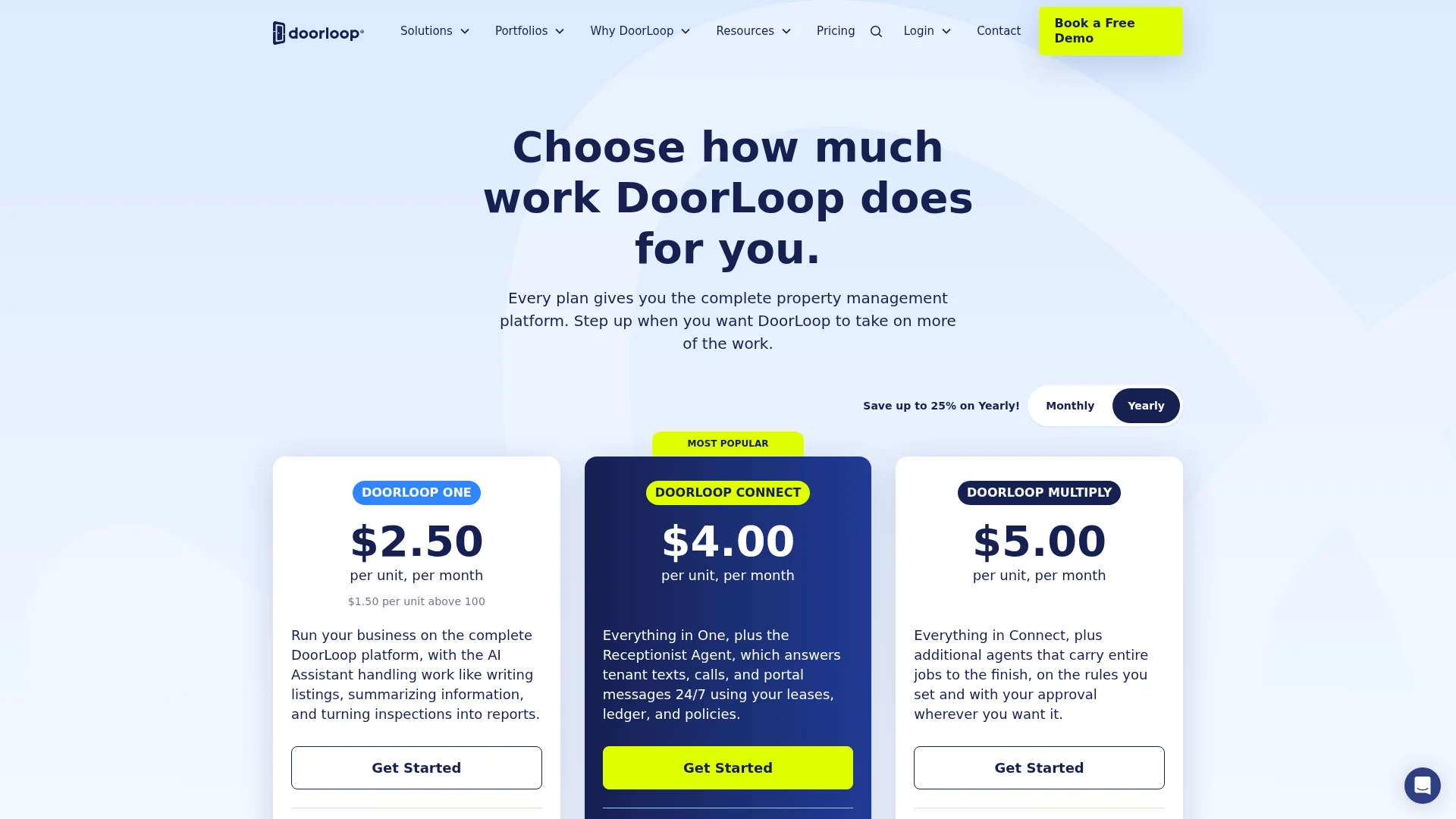
DoorLoop retired its Starter/Pro/Premium tiers and now sells three plans, each priced per unit with a monthly minimum (doorloop.com/pricing, 4 Nov 2026):
- DoorLoop One — $2.50 per unit per month billed annually ($3.00 month-to-month), $199 monthly minimum ($239 monthly), $1.50 per unit above 100. The full platform: accounting, leasing, maintenance, payments, portals, unlimited users and storage, API, the AI Assistant.
- Connect — $4.00 per unit ($299 minimum; $4.80/$359 monthly). Adds the Receptionist Agent for tenant calls and messages, free incoming ACH, the ability to keep convenience fees as income, VIP support.
- Multiply — $5.00 per unit ($399 minimum; $6.00/$479 monthly). Adds the Maintenance Ops and Lease Renewal agents, with new agents included as they launch.
The minimum is the story below 80 units:
| Units | One, annual billing | Effective per unit | One, monthly billing | Connect, annual | Multiply, annual |
|---|---|---|---|---|---|
| 5 | $199 | $39.80 | $239 | $299 | $399 |
| 10 | $199 | $19.90 | $239 | $299 | $399 |
| 20 | $199 | $9.95 | $239 | $299 | $399 |
| 50 | $199 | $3.98 | $239 | $299 | $399 |
| 80 | $200 | $2.50 | $240 | $320 | $400 |
| 100 | $250 | $2.50 | $300 | $400 | $500 |
| 150 | $325 | $2.17 | $390 | $600 | $750 |
At five through 79 units the bill is the minimum, full stop; 80 × $2.50 = $200 is the first count where the rate outruns the floor, and above 100 units each marginal unit costs $1.50 — $250 at 100, $325 at 150. The floor is an annual commitment: $199 a month is $2,388 a year before payment fees. Annual billing runs 17% cheaper per unit but is a 12-month commitment, and while DoorLoop’s signup page says you can “cancel at any time,” the record below shows cancellation is not self-service — so paying $239 month-to-month, $480 more per year, is cheap insurance for a first quarter.
Every band from 5 to 150 units, the monthly-billing column and the add-on fees are laid out in the DoorLoop pricing breakdown. This review is about what you get for the money.
Fees beyond the subscription
DoorLoop’s fee reputation was built on its retired plans, and much of it is stale. The current schedule, from the help center’s “Understanding Additional Fees on DoorLoop One, Connect, and Multiply” (4 Nov 2026):
| Fee | Amount | Who pays | Notes |
|---|---|---|---|
| Incoming ACH (tenant rent payment) | $1.50 per transaction on One | Tenant | Free on Connect and Multiply |
| Credit/debit card payment | 3.25% (minimum $3.50) | Tenant | Every plan; 3.5% on a $100 rent payment |
| Communication credits (SMS, voice, AI messages) | Included monthly — One 5/unit, Connect 10, Multiply 20; overage $0.02 on One, $0.01 on Connect/Multiply | Landlord | Allowance resets monthly; carrier fees sit behind it |
| Returned payment (NSF) | $40 | — | Every plan |
| Tenant screening | $35 per report | Applicant | Credit, criminal and eviction; +$10 income verification |
| eSignature requests | Included | — | The old $1–$3 per-signature fees died with Starter/Pro |
| Merchant account application | Included | — | The old $49/$25 setup fees died with Starter/Pro |
| Outgoing payments to vendors/owners | Free | — | Old plans charged $0.99 per outgoing EFT |
Two footnotes. The $1.50 ACH is the platform fee on One, and the tenant pays it; DoorLoop also lets you add a convenience fee and keep it as income — that fee is separate and stacks on top, so a tenant’s cost can run higher than $1.50, never lower. Payments run through Stripe — one Trustpilot reviewer waited four months for a merchant account amid blame routed between DoorLoop, Stripe and the bank. On applications, the Comprehensive screening plan is a flat $49.90 paid by the applicant.
What DoorLoop does well
The all-in-one claim is real. Every current plan carries the complete platform — accounting, online applications and screening, leases and eSignature, maintenance work orders, listings syndication, tenant and owner portals, unlimited users, API. Old Premium was the only tier with this depth; now it is the floor.
Accounting runs deep, trust accounting included. DoorLoop produces balance sheets per property, reconciles bank feeds via Plaid, automates management-fee deduction from owner distributions, and e-files 1099s. Its help center documents trust accounting (19 Aug 2026): owner and tenant funds in designated trust accounts, multiple accounts supported, cash tracked by property — a complete books stack for a single-entity landlord. The friction users report sits at the edges: a r/PropertyManagement landlord running a management company calls tracking the company’s own P&L “hacky at best,” requiring a fake “property” for business expenses — a workflow complaint, not a missing feature.
Portals and payments work day to day. Tenants pay by ACH or card, set autopay, submit maintenance requests with photos; owners get a real portal with financials. A landlord who started at six doors called it “a better starting point for full management” — “great until we got to 50+.”
Where it falls short
The minimum prices out the people searching for it. “DoorLoop review” is searched mostly by small landlords, and the product answers with a $2,388 annual floor — $39.80 a door at five units for software whose next-best alternative costs $0. A September 2026 Capterra reviewer (“I feel like I’ve been robbed of the time and money I spent”) is the extreme version of that ordinary complaint.
The books complaints that survive are workflow ones. DoorLoop documents trust accounting (19 Aug 2026), so the feature-gap criticism in older reviews no longer matches the product. What remains is friction: owner disbursements a Trustpilot property manager calls manual — “you have to go in and manually process them and figure out the calculations for management fees each month. It was not simple” — and the management-company P&L workaround above.
Support after onboarding is the recurring complaint. Trustpilot sits at 3.7/5 across 277 reviews (4 Nov 2026) against Capterra’s 4.8, the critical cluster describing an AI chatbot that loops and long waits for a human: “I’ve been dealing with an issue for the past few months and have gotten nowhere with the stupid chatbot.” A landlord who demoed every major platform in 2026, on r/PropertyManagement: “user adoption around 79%, lowest of the group… Support is good when you get it but wait times keep growing as they scale.”
Migration and cancellation are one-way doors. DoorLoop’s help article (29 Jun 2026) routes the account owner through the in-app chatbot or a Customer Success Manager call, an agent chat, and a cancellation form — no self-service option. Export reports first: account access ends at cancellation, though data is retained six months for reactivation. A June 2026 Trustpilot reviewer who closed mid-year was refused a prorated refund — not stated policy. One r/PropertyManagement switcher: “I switched to rentvine from DoorLoop… when I had a lease end or start it was a headache.”
DoorLoop by portfolio size
1–10 units: skip it, and don’t feel bad about it
At five units DoorLoop One is $39.80 a door; at ten, $19.90 — more per door than Buildium Essential charges at 20 units ($3.25). The honest alternatives are free or nearly free: TurboTenant’s free tier handles listings, screening, leases and rent collection at $0 with tenant-paid fees; Innago is free with cheaper tenant-side costs; Rentec Direct’s Starter is $25 flat for ten properties, real double-entry accounting. DoorLoop here is a splurge, not an investment — our roundup of the best property management software for small landlords prices the alternatives at your unit count.
10–50 units: the decision zone, and Buildium usually wins the math
Reddit recommends DoorLoop in 10–50 door threads for the modern interface and fast setup — this is where arithmetic earns its keep, each fee’s scope labeled. At 20 units, DoorLoop One is $199 ($9.95/door), its $1.50 per-payment ACH fee paid by tenants. Buildium Essential is $65 plus $47 in ACH processing ($2.35 × 20) if you absorb it — $112 against your books, an $87 monthly gap, about $1,044 a year. Both platforms support trust accounting; DoorLoop includes eSignatures and unlimited users on every plan, and wins on price only above 40 units, where Buildium’s Growth cliff lands at $202+. DoorLoop vs Buildium runs the crossover table; Buildium vs AppFolio takes the band above.
50–150 units: DoorLoop’s home ground
Past 50 doors the minimum fades ($3.98/door at 50, $2.50 at 80, $1.50 per unit above 100) and DoorLoop becomes what its fans say it is: a modern all-in-one without Buildium’s implementation project. The 2026 demo-thread verdict for this band — “good for smaller portfolios under 100 units where modern UX matters and operations aren’t complex yet” — matches that pattern. At 150 units, One runs $325 against Buildium Growth’s $306; Multiply’s $750 buys AI agents that run maintenance and renewals end to end, which either pencils out against a coordinator’s salary or doesn’t. Verify your QuickBooks chart of accounts during onboarding — the record includes revenue not carrying over from a misconfigured sync.
What Reddit and review sites actually say
The review scores disagree more than usual: Capterra 4.8/5 (719, 21 Oct 2026), G2 4.8/5 (253), Trustpilot 3.7/5 (277, 4 Nov 2026). Same product, a full point apart.
The gap has a shape. Capterra’s corpus skews to management companies onboarded recently with a human guiding setup — positives cluster on ease of use and implementation support. Trustpilot’s skews to landlords and tenants whose problems arrive after onboarding rolls off: payment rails, bank verification, billing disputes.
The praise, attributed: a 3–5-year Capterra user (October 2026): “Amazing support and service!” An owner: “DoorLoop provided the best value and most intuitive user interface for both tenants and employees.” On Reddit, a 28-unit landlord’s “Found the golden ticket” post credits DoorLoop with automating nearly everything and dropping QuickBooks — contested by replies (“Must be a different DoorLoop than everyone else uses…”).
The complaints, attributed and dated: the r/PropertyManagement threads “Property Manager BEWARE: Doorloop is hot garbage!” and ”…Continues to be hot garbage” describe support reachable only through an AI bot, mid-year AI updates that “messed up all my categorization and workflows,” and a late fee that “ballooned to $70.” Those are 2025 threads, before the repricing — but June–October 2026 Trustpilot reviews raise the same themes (chatbot loops, bank-verification stalls, no refunds on prepaid years). What did change: the per-eSignature, merchant-setup and per-text fee complaints dominating 2024 reviews describe plans that no longer exist — a pre-2026 review is reading the old fee schedule.
On stale data: “best of” lists still quote Starter at $69–$99 and Pro at $149–$189 — pricing that died in October 2026. If a source doesn’t mention the $199 minimum, it isn’t current.
The verdict
50–150+ units, or any size where one-system consolidation is worth $199+: buy DoorLoop One, annually billed, with two hedges. The platform depth is real, eSignatures and merchant setup and outgoing payments are included now, and past 80 units the per-unit rate works in your favor. The hedges: pay monthly the first quarter, calendar your renewal date.
10–50 units: run the Buildium comparison before you sign. DoorLoop is a good product in the wrong price band — $87+ a month more than the cheaper alternative at 20 units. The exception: portfolios that weight daily usability over the monthly gap — a defensible premium, not a default.
Under 10 units: skip it. Rentec Starter at $25 flat, TurboTenant free, or Innago free cover the actual jobs at this size. If you want DoorLoop anyway, you’re buying the interface, not the math.
Whatever you choose, our cost calculator prices DoorLoop One, Connect and Multiply at your exact unit count against every competitor, minimums applied.
FAQ
Is DoorLoop legitimate?
Yes — a Miami-based company with a working product used by thousands of property managers, a 4.8/5 Capterra rating across 719 reviews, and a published fee schedule. “Legitimate” isn’t the right question; “right-sized” is. The real concerns are business-practice ones: annual auto-renewal without pro-rated refunds, a cancellation process that requires speaking with an agent, and support that degrades after onboarding.
How much does DoorLoop charge?
One is $2.50 per unit per month on annual billing with a $199 monthly minimum — the actual bill from 1 to 79 units — $3.00/$239 month-to-month, $1.50 per unit above 100. Connect is $4.00 per unit ($299 minimum); Multiply is $5.00 ($399 minimum). All verified on doorloop.com/pricing on 4 November 2026. At five units that’s $39.80 per door; at 80, $2.50. The floor commitment is $2,388/year before payment and screening fees.
Does DoorLoop charge a fee?
Not to you at signup: eSignature requests, merchant account applications and outgoing payments are all included now — the $49/$25 merchant-setup and $1–$3 eSignature fees belong to the retired Starter/Pro plans. What still carries fees: tenants pay $1.50 per ACH payment on One (free on Connect and Multiply) and 3.25% on cards with a $3.50 minimum; returned payments cost $40; screening is $35 plus $10 for income verification; and each plan includes monthly communication credits for SMS, voice and AI messages — 5 per unit on One, 10 on Connect, 20 on Multiply, overage $0.02 on One, $0.01 on Connect/Multiply. Onboarding is listed on the pricing page with no fee published.
Is DoorLoop better than Buildium?
It splits. On price, DoorLoop wins above 40 units, where Buildium’s Growth plan starts at $202 and DoorLoop is still $199; below 41 units Buildium is cheaper at every count — at 20 units, $65 plus $47 in landlord-paid ACH if you absorb processing, against DoorLoop’s $199 with tenant-paid ACH. On the books, both support trust accounting (DoorLoop documents it as of August 2026). On daily usability, DoorLoop wins on most scorecards. Our full comparison prices both with every fee counted.
Can you cancel DoorLoop?
Eventually — there is no self-service cancellation. DoorLoop’s help article “Cancel Your DoorLoop Subscription” (29 Jun 2026): the account owner requests it via the in-app chatbot or a Customer Success Manager call, speaks with an agent, and completes a form; refunds for unused time are “not standard” — refused prorated refunds are individual reviewer reports. Export reports first: you lose full account access afterward, and data is retained six months for reactivation. If you sign up: pay monthly the first quarter and calendar the renewal date.