Hemlane vs TurboTenant: What Each Costs at 2, 5, 10 and 25 Units (2026)
TurboTenant's landlord bill is $0 at any size; Hemlane's is $30 a month at one unit on annual billing. Both invoices and all-in cost at 2, 5, 10 and 25 units.

TurboTenant suits a hands-on landlord with one to four units who wants a $0 subscription. Hemlane suits five or more units spread across states, where paying per door buys a repair coordinator. On the invoice alone TurboTenant wins at every count. Counting the fees your tenants pay, Hemlane Basic’s all-in cost overtakes TurboTenant Free at 38 units if you pay Hemlane annually and 136 units paying monthly. Basic is $2 a unit plus a $28 platform fee billed annually, or $2.50 plus $34 billed monthly. Prices were read from both vendors on 10 November 2026.
Disclosure: Landlord Method doesn’t earn a commission from Hemlane or TurboTenant — neither affiliate program is live on this site. Every price below comes from the vendors’ own pages, read on 10 November 2026.
Quick comparison
| Hemlane | TurboTenant | |
|---|---|---|
| Landlord’s bill (10 Nov 2026) | Starter free. Basic $2/unit + $28 platform annual, $2.50 + $34 monthly. Essential $20/$24, Complete $58/$65 | Free $0. Essentials $149–349/yr, Pro $199–999/yr, by unit band |
| Free tier | Starter: ads, screening, accounting — no rent collection | Listings, screening, rent collection, maintenance, expenses |
| Maintenance coordination | Essential: 24/7 repair coordinator, your vendors, no markup. Complete adds vetted trades | Ticket tracking free. Human coordination only via Autopilot, at a flat fee |
| Listings and screening | 9 sites free; 7 premium sites $89/30 days. Screening $40 | 25+ sites free. Screening $55 (Free), $45 (Essentials, Pro) |
| Accounting | Bank sync, income statement, Schedule E, QuickBooks across the platform | Import manual (Essentials), automatic (Pro); Schedule E/8825, loan tracking Pro-only. Owner Statement report, no portal |
| Tenant portal | $0 ACH, 3% cards | $2 ACH (waived on Pro), 3.49% cards, $4.99/mo credit reporting |
Pricing and the crossover point
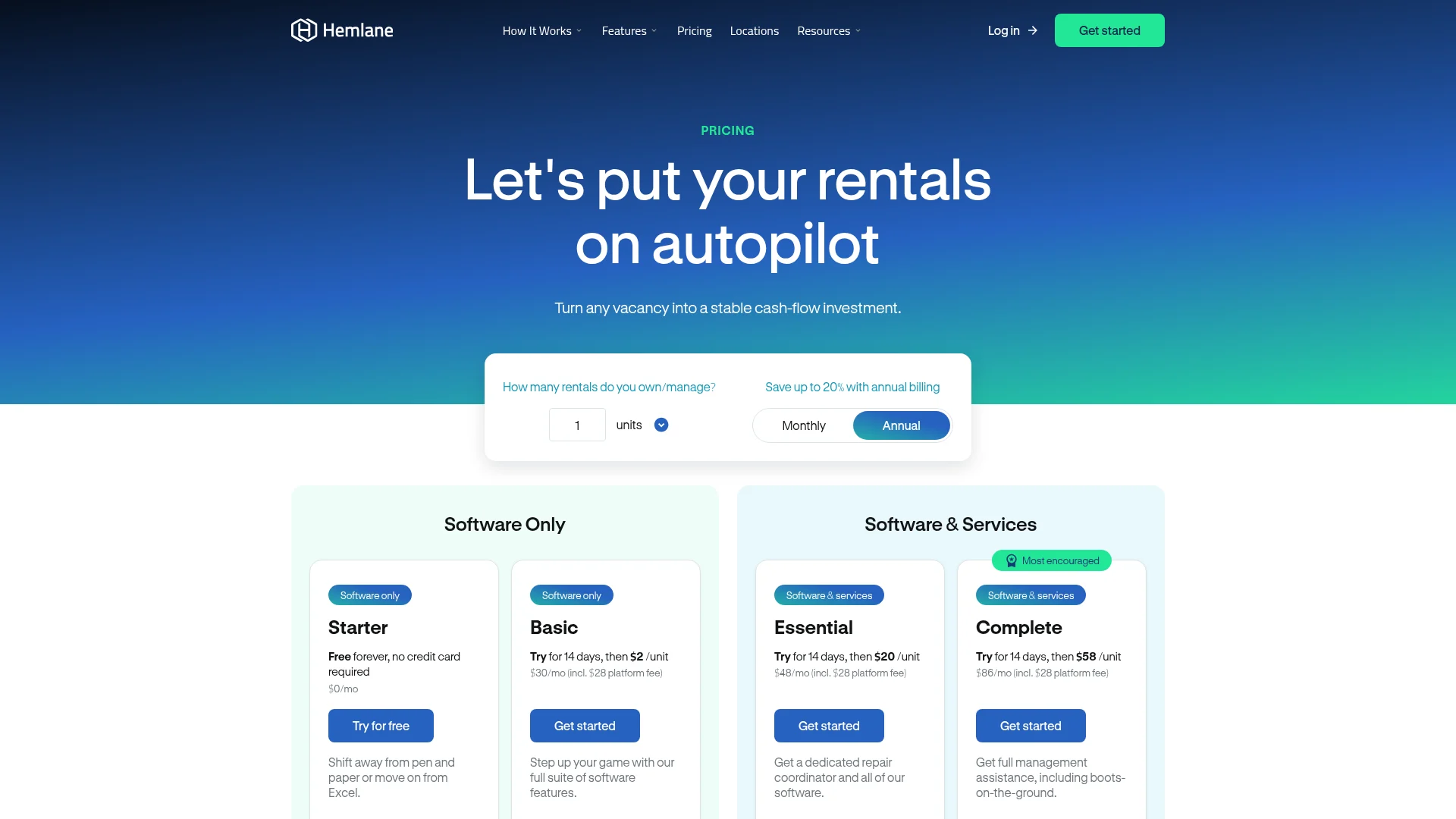
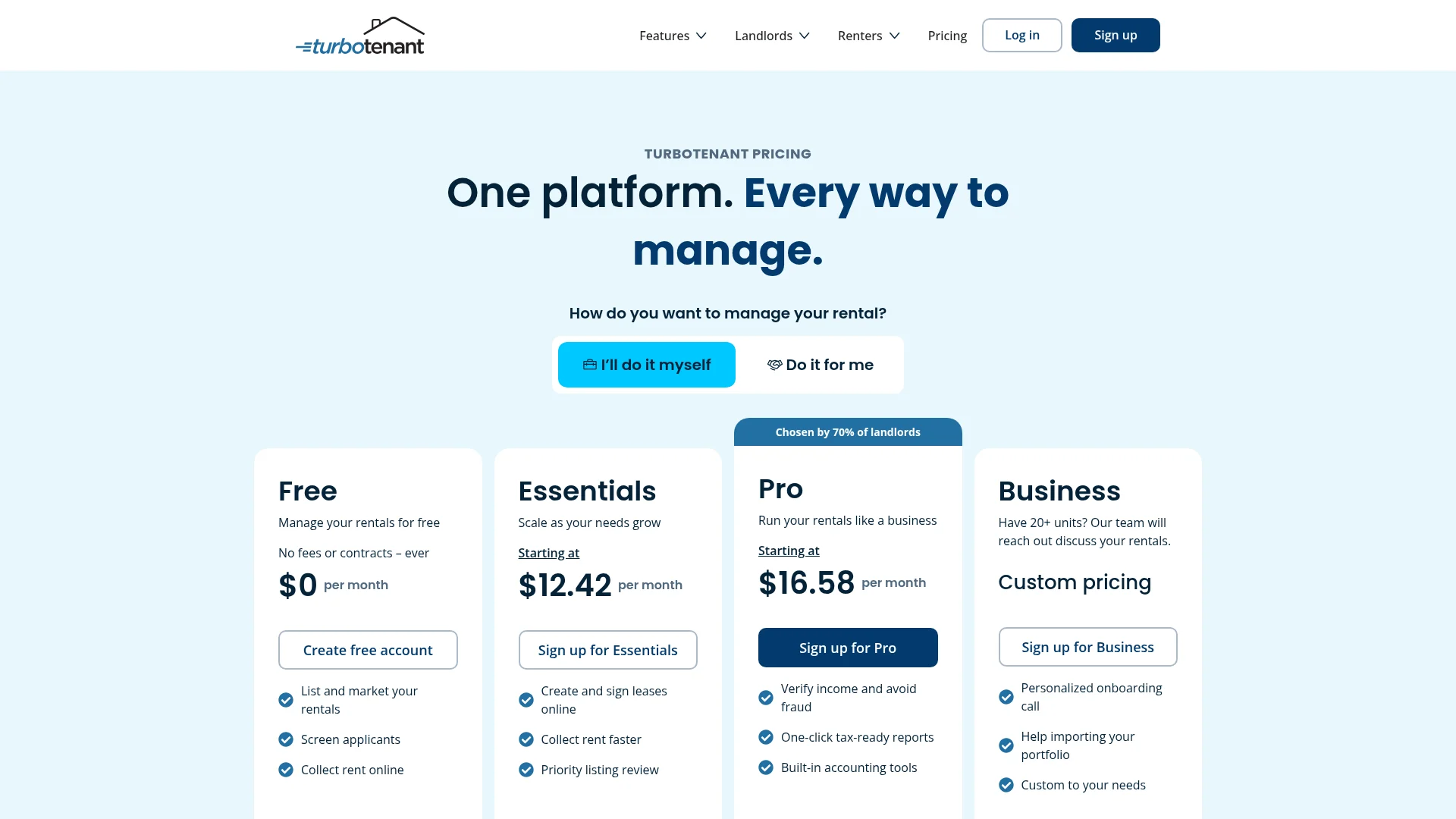
TurboTenant bills by unit band, once a year: Essentials runs $149 up to 10 units, $199 at 11–30, $299 at 31–60 and $349 past 61. Pro runs $199, $399, $699 and $999 across the same bands and waives the tenant’s $2 ACH fee.
Hemlane ignores bands. One platform fee, then a per-unit rate, and the fee differs by billing term: Basic is $2 a unit over $28 a month if you prepay the year, or $2.50 over $34 paying month to month. Essential is $20 a unit annually or $24 monthly, Complete $58 or $65. Hemlane’s pricing page opens on the annual toggle and advertises “Save up to 20% with annual billing” — that gap between the two columns is the discount, not a third price, and it is the biggest number in this comparison.
| Landlord’s bill, per year | 2 units | 5 units | 10 units | 25 units |
|---|---|---|---|---|
| TurboTenant Free | $0 | $0 | $0 | $0 |
| TurboTenant Essentials | $149 | $149 | $149 | $199 |
| TurboTenant Pro | $199 | $199 | $199 | $399 |
| Hemlane Basic, annual billing | $384 | $456 | $576 | $936 |
| Hemlane Basic, monthly billing | $468 | $558 | $708 | $1,158 |
| Hemlane Essential, annual billing | $816 | $1,536 | $2,736 | $6,336 |
| Hemlane Essential, monthly billing | $984 | $1,848 | $3,288 | $7,608 |
TurboTenant Pro, the tier with real accounting and no tenant ACH fees, undercuts Hemlane Basic at every count on either basis. Hemlane’s platform fee is the other problem: a fixed floor of $336 a year on annual billing, $408 paying monthly, that no unit count dilutes. At 2 units it is the whole product. At 25 units it is a rounding error.
Why one toggle moves the crossover 98 units
TurboTenant charges tenants $2 per bank payment, $24 per tenant a year. Hemlane charges the landlord $2 per unit per month, $24 a unit a year. Add the applicant fees both sides shift to renters — $55 at TurboTenant on its free plan, $40 at Hemlane, three applicants on a fifth of the units turning over — and Hemlane Basic costs a landlord $48 a unit a year on annual billing, or $54 paying monthly, against TurboTenant Free’s $57.
That leaves a gap of $9 a unit on annual billing, $3 on monthly. Against a fixed floor of $336 or $408, $3 a unit takes a long time to pay off.
| Total annual cash, both sides of the receipt | 2 units | 5 units | 10 units | 25 units |
|---|---|---|---|---|
| TurboTenant Free | $114 | $285 | $570 | $1,425 |
| TurboTenant Essentials | $251 | $404 | $659 | $1,474 |
| TurboTenant Pro | $253 | $334 | $469 | $1,074 |
| Hemlane Basic, annual billing | $432 | $576 | $816 | $1,536 |
| Hemlane Basic, monthly billing | $516 | $678 | $948 | $1,758 |
| Hemlane Essential, annual billing | $864 | $1,656 | $2,976 | $6,936 |
| Hemlane Essential, monthly billing | $1,032 | $1,968 | $3,528 | $8,208 |
On annual billing the lines cross at 38 units, where Hemlane Basic’s $2,160 edges TurboTenant Free’s $2,166. On monthly billing the same model does not cross until 136 units, with both at $7,752. Same software, same tenants, same rent — the billing term alone moves the answer by 98 doors.
Payment method moves it further. Cards cost the payer 3.49% at TurboTenant and 3% at Hemlane, $628 against $540 a year for one card-paying tenant, $88.20 in Hemlane’s favour. If every tenant pays by card, Hemlane Basic is cheaper from 5 units on annual billing and 7 units paying monthly; at 10 units it takes four card payers on annual billing, six on monthly. None of those fees is the landlord’s, but they change your renter’s receipt, and a $55 application fee on the free plan costs you applicants.
The crossover that actually decides it
Hemlane’s paid tiers are not really competing with TurboTenant’s invoice. Essential at $20 a unit is priced against the phone call when the water heater goes, and the real comparison is a property manager at 8–12% of collected rent — $1,440 to $2,160 per unit a year on $1,500 rent. Hemlane Essential at 25 units bills $6,336 on annual billing, $7,608 paying monthly: $253 a unit or $304, 5.7 to 8.5 times cheaper than the manager and sixteen times TurboTenant Pro’s $399 for the same 25 doors. Whether that middle ground is worth $253 a unit is the whole decision.
One TurboTenant wrinkle: you cannot finalize or send a lease on the Free plan — the help centre states that TurboTenant “does not offer a one-time purchase for individual lease agreements” — so a TurboTenant lease requires Essentials or Pro. For anyone who needs the lease built in, the free-plan crossover never applies: Essentials starts at $149.
Maintenance coordination compared
TurboTenant’s maintenance story is a form and a status field. Tenants submit requests with photos, you track them, you call the plumber. That is free at every tier and it is all the software does; the queue has nobody behind it. The human version is Autopilot, TurboTenant’s full-service arm, which sells itself as flat-fee property management — its own comparison table puts 8–12% of monthly rent in the traditional-manager column, not its own — with vendor sourcing and repair coordination at no markup, and tenant placement sold separately at a flat $1,500.
Hemlane sells the middle of that range by the unit. Essential puts a repair coordinator between the tenant and the problem: 24/7 emergency support, automatic diagnosis, work orders raised against your own service professionals, invoicing at cost. Complete adds people on the ground — a management assistant who fields all tenant communication, Hemlane’s vetted network for handiwork, electrical, plumbing, appliance and HVAC work, and spending thresholds that hold a repair until you approve it.
Buying coordination as a separate line item is the market norm, not the exception: RentRedi resells Latchel to landlords who want the calls answered, priced as a monthly base fee plus a per-unit charge. Hemlane is the only product here that folds it into the per-unit rate. Essential at $20 a unit on annual billing puts software and coordination on one line; Complete at $58 is the expensive end, and the only tier with the vetted network.
Two limits. Complete only works where Hemlane has vetted trades: its pricing FAQ says towns under 100,000 people, or more than 20 miles from a metro, usually don’t clear the bar, and those get steered to Essential. And coordination means Hemlane talks to your tenants for you — if you want to control every message, that is the feature you are paying to give up.
Listings and screening
TurboTenant’s front door is wider. Syndication to 25-plus listing sites is free at every tier, applications and automatic pre-screeners ride along, and the applicant pays $55 for a TransUnion credit, criminal and eviction package on the free plan, or $45 on either paid tier. Employer verification and custom screening questions wait for Pro too. The screening toll is the priciest in the category and non-refundable, so three applicants cost your applicants $165 on Free, $135 on a paid tier.
Hemlane lists to Apartments.com, Zillow and seven more sites on the free Starter plan; pushing to seven exclusive premium sites costs $89 for 30 days. Its $40 screening is applicant-paid and non-refundable, bundles credit, criminal, eviction and income reporting, and the comparison table adds tenant risk analysis. An accept-or-decline recommendation engine is claimed on Hemlane’s own comparison page; treat that as marketing, but the $40 price and report contents are printed on the pricing page.
For a multi-state portfolio the screening line matters more than the listing line. Hemlane wins it on price ($40 against $55 on the free plan, $45 on either paid tier) and coverage (income verification included). TurboTenant wins on reach: 25 free sites beat 9 when the vacancy is in a market where you have no local network.
Where each one breaks
Hemlane at 1–2 units is paying a staff tax. Basic runs $384 a year for two units on annual billing, $468 paying monthly, for software that still makes you supply the lease — state-specific templates start at Essential. Starter is not TurboTenant’s free tier either: advertising, screening and accounting, but no rent collection, so the first month a tenant owes you money you are on a paid plan. Below four units, Hemlane is a luxury good.
TurboTenant at 20-plus units is a fee treadmill. Pro doubles from $199 to $399 the day you buy property eleven, hits $699 at 31 and $999 past 61, for identical software. The tenant-side drag scales with doors: 25 bank-paying tenants fork over $600 a year in ACH fees on Free or Essentials, the 3.49% card fee is unwaivable on every tier, and every turnover brings three applicants at $45 a head on Essentials or Pro, $55 on Free. The operational ceiling compounds faster than the invoice. TurboTenant can print an Owner Statement report, but nothing goes to an owner on its own and there is no owner portal. Its answer to the vendor-call problem is Autopilot, which is full-service management — TurboTenant’s pricing FAQ warns that some self-service tools are unavailable while Autopilot runs a property. Hemlane keeps you the operator and sells the coordination only.
Verdict by landlord type
One to four units, hands-on: TurboTenant Free, full stop. Nothing justifies a per-unit invoice at that size, and our TurboTenant review maps what the free plan costs in fees and when it stops being enough.
Five to ten units, want software not staffing: TurboTenant Pro at $199 a year. It undercuts Hemlane Basic across the band, adds the accounting suite, and waives tenant ACH fees — which covers the $50 premium over Essentials at three bank-paying tenants. What each TurboTenant line costs works that upgrade properly.
Five-plus units, out-of-state markets, done calling plumbers: Hemlane Essential, billed annually. At 10 units that is $2,736 a year, or $3,288 paying monthly — real money against $149, and a fraction of the $14,400 to $21,600 a property manager would charge on the same rent. Pay annually here; the monthly price is where Hemlane stops making sense at small counts.
Applicants paying by card, or a market where screening fees cost you applicants: Hemlane. A 3% card rate beats 3.49%, and $40 screening beats TurboTenant’s $45–55, on the two lines where your applicant feels the difference.
For the flat-fee alternative to both, see RentRedi vs TurboTenant, and for the wider field by unit count, our guide to the best property management software for small landlords.
FAQ
How much does Hemlane cost per unit?
Basic is $2 per unit per month plus a $28 platform fee if you pay annually, or $2.50 plus $34 paying monthly. That is $30 a month at one unit on annual billing and $36.50 monthly, rising to $78 at 25 units annually. Essential is $20 a unit annual or $24 monthly; Complete $58 or $65. Read from hemlane.com/pricing on 10 November 2026.
Is TurboTenant still free?
Yes. TurboTenant’s own FAQ says you can “really access all of TurboTenant for $0, forever,” and the landlord’s invoice is zero. The company earns from your applicants and tenants instead: $55 screening on Free, $45 on a paid tier, $2 per bank payment, 3.49% on cards. Paid tiers are annual-only, Essentials from $149 and Pro from $199 for 1–10 units.
Which platform is better for a multi-state portfolio?
Hemlane. Per-unit pricing never reprices when you buy in a new state, Essential and Complete put a coordinator on the repairs so you are not chasing vendors across time zones, and tenant placement starting at $695 covers showings in places you have never visited. TurboTenant works across states as software, but those human tasks stay with you.
At what point does TurboTenant stop being enough?
At the first month you cannot answer a tenant or produce a ledger. The subscription never becomes expensive — Pro is $999 even past 61 units — so what runs out is your time, not your budget. The triggers are an owner or lender who wants statements sent without you pulling them, or a repair you cannot reach a plumber for.
What are the cheaper alternatives to both?
RentRedi is a flat $144 a year for unlimited units, Innago runs a free model with cheaper screening ($30–35) and lower card fees, and TenantCloud starts at $15 a month billed annually with a 10-lease cap. TurboTenant is already the cheapest subscription here, so alternatives compete on fees rather than sticker price.