RentRedi vs TurboTenant: Flat $144 or Free (2026)
RentRedi is $144 a year flat for unlimited units; TurboTenant is $0 with tenant-paid fees. Both invoices at 1 to 50 units, verified on vendor pages 4 Nov 2026.

TurboTenant stays free to the landlord; RentRedi charges $144 a year and includes everything. That split decides most portfolios under 50 doors. If your problem is filling a vacancy, TurboTenant’s free tier is still the strongest $0 front office in the category. If your problem is running the whole operation — rent, leases, maintenance, tax reports — without a price that grows with your unit count, RentRedi’s flat rate is the better invoice at 5, 10, or 50 units, and its tenant ACH fee runs half of TurboTenant’s, with lower card rates and screening fees too. Every number below is read off each vendor’s own pricing and help-center pages on 4 November 2026, with TurboTenant cross-checked against our full TurboTenant review. RentRedi’s side of the invoice is broken out by plan and portfolio size in RentRedi’s own pricing by unit count.
Disclosure: Landlord Method earns a commission if you sign up for some products through links on our site. It doesn’t change the prices or the verdict below, and every figure here comes from the vendors’ own published pages.
Quick answer: the two platforms at a glance
| RentRedi | TurboTenant | |
|---|---|---|
| Landlord’s bill (verified 4 Nov 2026) | One plan: $12/mo annual ($144/yr), $20/mo 6-month, $29.95/mo monthly — flat at any unit count | Free: $0. Paid tiers annual-only: Essentials from $149/yr, Pro from $199/yr (1–10 units) |
| Tenant ACH fee | $1.00 per payment, tenant-paid (landlord can cover it) | $2 on Free and Essentials, waived on Pro |
| Tenant card fee | 3.1% + $0.30, tenant-paid | 3.49%, every plan, unwaivable |
| Applicant screening | $39.99 TransUnion credit/criminal/eviction; $49.99 with Plaid income check | $55 on Free, $45 on paid plans |
| Leases | No native templates: upload your own PDF, unlimited e-signatures | State-specific leases in-product: build and save free; sending one needs Essentials ($149) or Pro |
| Accounting | Included on all plans: P&L, Schedule E summaries, AI receipt capture | Schedule E/Form 8825, auto-import, loan tracking on Pro only |
| Owner statements | No, at any tier | No, at any tier |
| Payout speed | 2–3 business days on all plans | Reported 5–10 business days on Free; expedited on paid |
| Support | 24/7 live chat on all plans | Free: chat and email only; phone starts at Essentials |
The line that decides most portfolios: TurboTenant’s free tier beats RentRedi on price at every unit count — $0 against $144 — until you need what Free doesn’t include: in-product leases, real accounting, or faster payouts. The moment you’re paying either company anything, RentRedi is cheaper at every unit count, and its flat rate never scales.
The true-cost math
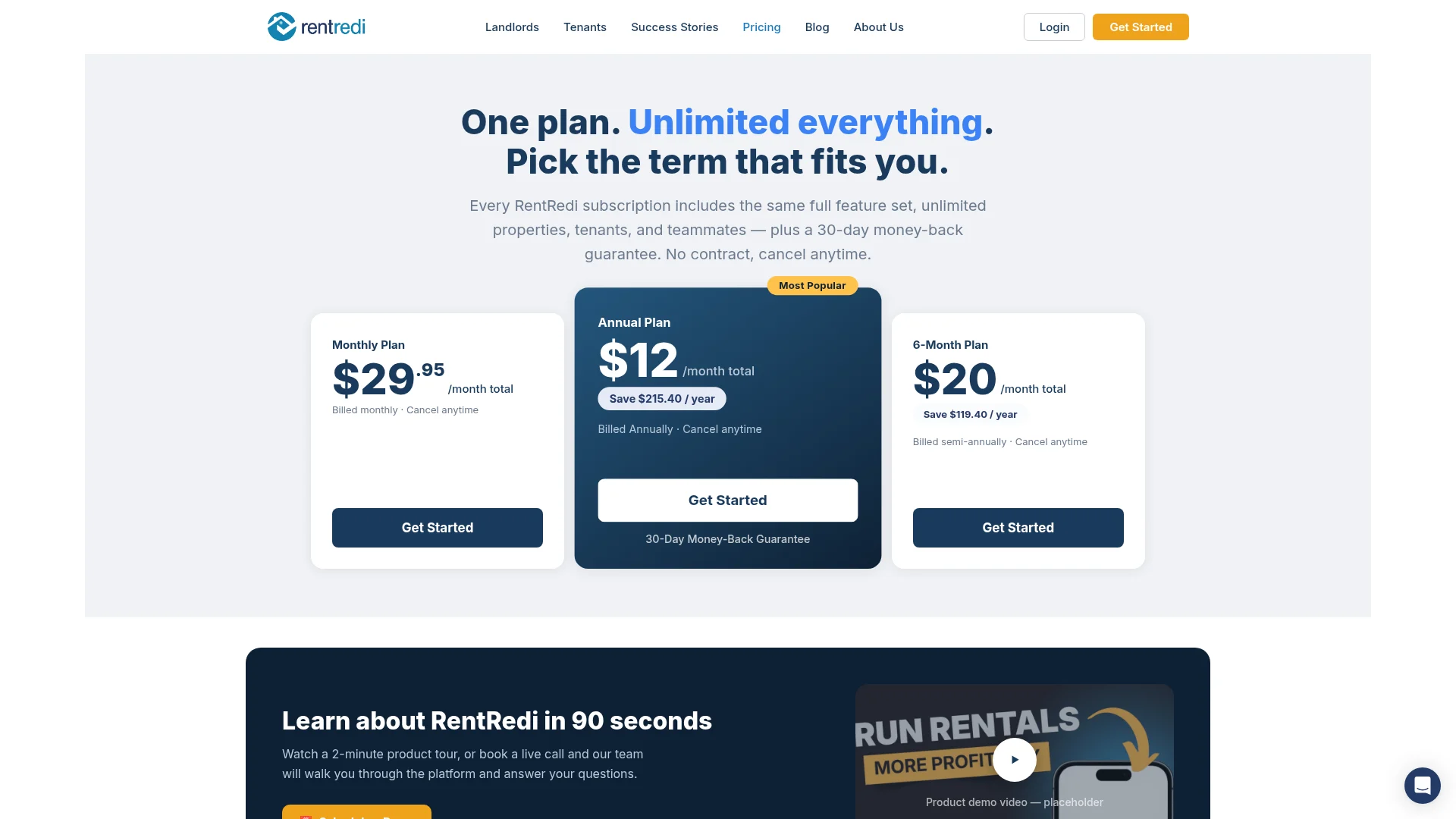
RentRedi collapsed to one plan and now sells the same full feature set on three billing terms: $29.95 monthly, $20 a month on a 6-month term ($240/yr), or $12 a month billed annually — $144 a year, flat whether you have 1 unit or 100 (RentRedi’s pricing page, 4 November 2026). No per-unit fee, no per-bank-account fee, a 30-day money-back guarantee, no contract. The tenant carries the transaction fees: $1.00 per ACH payment, 3.1% plus $0.30 per card payment — $46.80 on a $1,500 card payment — and you can flip either fee onto your own statement in settings, or block cards and go ACH-only.
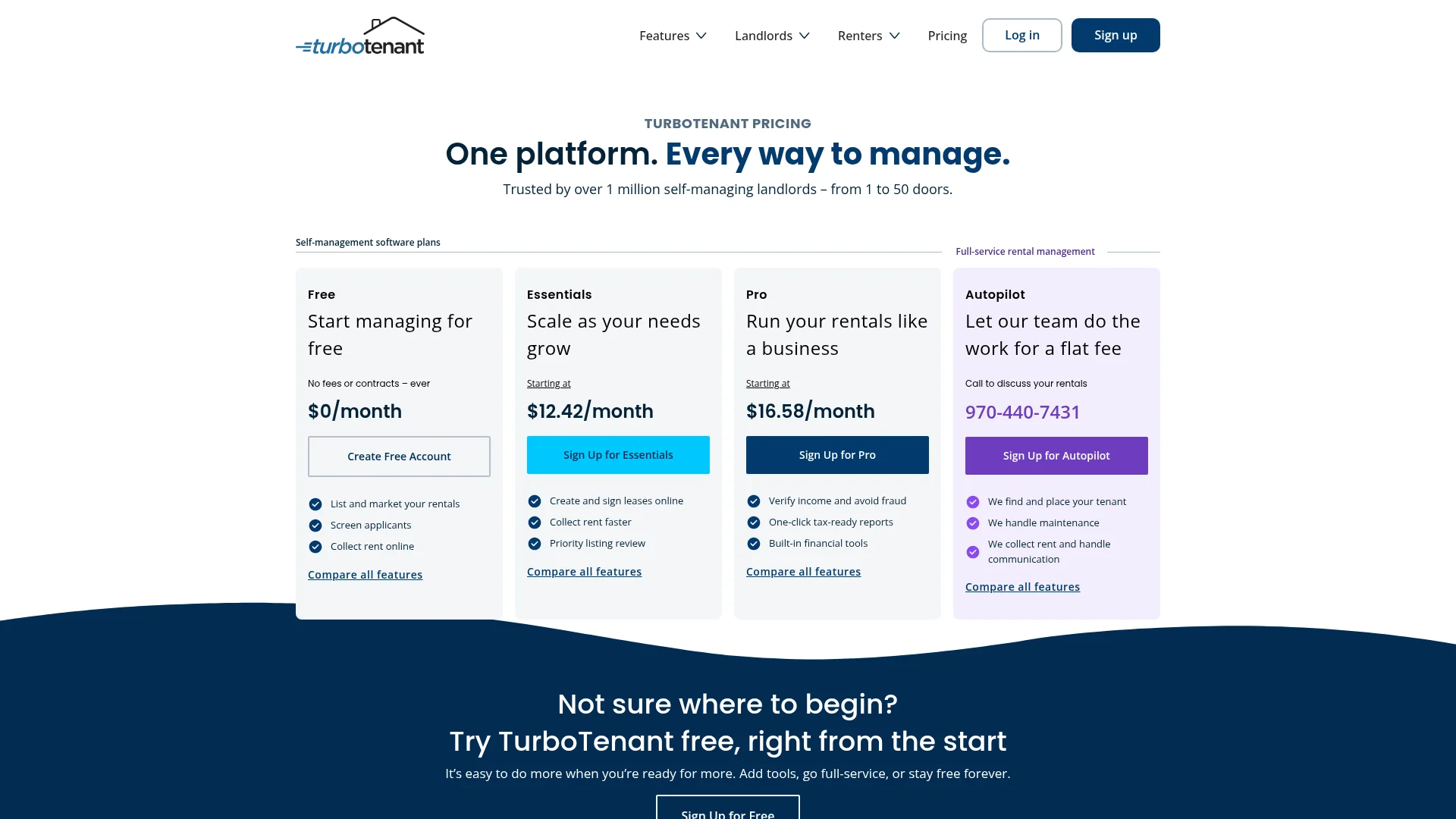
TurboTenant prices the other way around: $0 to the landlord forever, funded by the $55 screening fee your applicants pay on Free ($45 on paid plans) and the $2 per ACH payment your tenants pay on Free and Essentials (3.49% on cards, every plan). Paid tiers bill annually only, in unit bands: Essentials $149 to 10 units, $199 at 11–30, $299 at 31–60, $349 at 61+; Pro $199, $399, $699, $999. Pro is the tier that matters — it unlocks the accounting suite and waives the tenant’s $2 ACH fee.
Landlord subscriptions, annual billing:
| Units | RentRedi (flat) | TurboTenant Free | TurboTenant Essentials | TurboTenant Pro |
|---|---|---|---|---|
| 1 | $144 | $0 | $149 | $199 |
| 5 | $144 | $0 | $149 | $199 |
| 10 | $144 | $0 | $149 | $199 |
| 20 | $144 | $0 | $199 | $399 |
| 50 | $144 | $0 | $299 | $699 |
| 100 | $144 | $0 | $349 | $999 |
Then the tenant-side lines, because both companies price that way. Five tenants paying $1,500 rent by bank, twelve months a year:
| Cost line, 5 tenants paying by ACH | RentRedi | TurboTenant |
|---|---|---|
| Landlord subscription, year one | $144 | $0 |
| Tenant ACH fees, one year | $60 | $120 (waived on Pro) |
| One card payment, $1,500 rent | $46.80 | $52.35 |
| Screening three applicants | $119.97 | $165 (Free) / $135 (paid) |
| One state-specific lease | Your own document + free e-sign | Free to draft; $149 Essentials needed to sign |
| Schedule E summary at tax time | Included | Pro only ($199) |
Read the two tables together: TurboTenant Free is the cheapest thing on the page until the first lease, the first Schedule E request, or the first tenant who complains about a 5–10 day payout. Pay TurboTenant anything and RentRedi undercuts it at every unit count — before the band cliff doubles Pro at eleven units. RentRedi’s tenant fees are lower line by line: $1 against $2 per ACH, and 3.1% + $0.30 beats 3.49% at any rent above roughly $80. RentRedi has its own add-on economy, though: maintenance coordination through Latchel is billed separately, and plans start at $25 a month plus a per-unit fee quoted at setup (RentRedi Help Center, 10 November 2026); tenant credit reporting is $5.99 a month, and Zillow Network listings cost $1.75 per listing per day — a Zillow charge that applies no matter where you post from (RentRedi help center, 4 Nov 2026).
Feature by feature
Rent collection. Both cover autopay, late fees, receipts, reminders, partial payments and offline recording. RentRedi’s edges are the fee controls — cover the $1 ACH fee yourself, go ACH-only, unlimited bank accounts and portfolios — plus 2–3 day payouts on every plan. TurboTenant’s tenant fee can go to zero, but only on Pro; on Free and Essentials tenants pay $2 a payment and wait a reported 5–10 business days for the money to land.
Tenant screening. Both run TransUnion. RentRedi is cheaper for the applicant — $39.99 for credit, criminal and eviction with TransUnion’s rental-specific ResidentScore, $49.99 with Plaid income verification — and covers the fee per unit on request. TurboTenant adds a free pre-screener and fraud detection but charges $55 on Free, $45 on paid, non-refundable once run — three applicants on Free cost $165 for your one decision — $119.97 on RentRedi — as our review details.
Maintenance. RentRedi takes in-app requests with 5-second video, then sells coordination via Latchel — plans start at $25 a month plus a per-unit fee — with your own vendors and spending limits. TurboTenant includes requests and tracking free on every plan, with no dispatch service behind them.
Leases and e-signature. TurboTenant’s clearest win: state-specific leases generated in-product for all 50 states — free to build and save, but finalizing, downloading or sending one for e-signature needs Essentials or Pro, and TurboTenant “does not offer a one-time purchase for individual lease agreements” (help center, 10 November 2026). The $199 Landlord Forms Pack is bundled on paid plans. RentRedi has no native lease builder: upload your own PDF, send it for signature (tenants sign in the mobile app with a selfie-and-ID check), counter-sign. Unlimited e-signature requests are included on every plan. If you reuse an attorney-drafted lease, RentRedi is free and fine; if you need documents produced for you, TurboTenant has them and RentRedi doesn’t.
Accounting. RentRedi’s Accounting Suite (launched December 2025, expanded January 2026) is on all plans: AI receipt capture, bank-feed expense import, mileage tracking, property-level and portfolio P&L, and one-click Schedule E summaries exportable to PDF or spreadsheet. It’s expense-and-report accounting, not double-entry books — no general ledger, no trust accounting, and full double-entry still means an add-on like REI Hub. TurboTenant’s equivalent lives on Pro: Schedule E/Form 8825 export, automatic import, loan tracking; Free logs expenses manually. Neither produces owner statements at any tier — TurboTenant’s own support has said so on the record.
App and support. RentRedi’s 4.8/5 across roughly 15,000 App Store ratings is the strongest mobile signal in the category, but its desktop dashboard draws the opposite critique in 2026 reviews — “over-engineered and difficult to use” is the recurring one-star headline. RentRedi includes 24/7 live chat on every plan, and tenants get phone support 9–5 EST plus the same chat; TurboTenant gates the humans, with phone starting at Essentials. If support is why you’d pay either, RentRedi’s flat price buys it for everyone.
Where each falls short
RentRedi’s complaint cluster in 2025–2026 is money movement. Two widely shared Reddit threads describe rent deposits diverted after an account takeover — one r/PropertyManagement landlord in Chicago reported over $4,000 routed to a fraudulent bank account after someone changed his payout details, saying RentRedi added the new account without notice and eventually pointed him to a CFPB claim; a r/RentalInvesting poster describes $20,000 taken the same way and says the company denied responsibility. Individual accounts, not verified patterns — but they point at the same structural exposure: your money flows through their processor, and payout-account changes are the attack surface. The other current criticisms are about effort: a July 2026 Capterra reviewer calls basic tasks “over-engineered,” reviewers flag late-fee settings that don’t flex to state law (RentRedi says a more flexible late-fee beta is rolling out), and RentRedi’s own Trustpilot replies admit security-deposit return only recently arrived in beta. And the leases gap above is real: no native lease documents at any price.
TurboTenant’s shortfalls are mostly priced ones. Everything worth upgrading for bills annually in one lump — “$12.42/month” on its pricing page is $149 divided by twelve; there is no monthly billing. Crossing eleven units doubles Pro from $199 to $399 for identical software. The $55 applicant toll on Free is the category’s most expensive screening fee, non-refundable, and it lands on people you’re trying to impress. Marketing performance is the recurring Reddit complaint — slow listing reviews and thin lead flow, documented in our review.
Unit-count fit
1–10 units. If the problem is finding and screening tenants, TurboTenant Free: unlimited syndicated listings, applications, TransUnion reports, rent collection and maintenance at $0 to you. If you want lease-signing workflow, Schedule E summaries, faster payouts and 24/7 chat under one subscription, RentRedi at $144 is less than TurboTenant Pro at $199 — but the ACH waiver roughly erases that: Pro waives your tenants’ $2 fee, which saves five bank-paying tenants $60 a year against RentRedi’s $1 fee, so all-in you’re comparing $199 plus $0 in tenant ACH against $144 plus $60 — about $5 apart. Both answers are defensible at ten doors.
10–50 units. RentRedi’s flat $144 is the story in this band. TurboTenant’s bands climb to $399 (Pro, 11–30) and $699 (31–60); RentRedi stays at $144 with unlimited portfolios and sub-accounts, which is how multi-entity landlords keep books separated. Stay on TurboTenant only if you’re still running on Free and the tenant-side fees haven’t started costing you applicants.
50+ units. Both tools thin out. Neither produces owner statements, neither does trust accounting, and neither is built for staff or managing other people’s properties. RentRedi’s $144 holds past a hundred doors — genuinely unique in the category — but at that size the missing ledger is the expensive part. That’s the crossover to paid platforms: our small-landlord software comparison prices what Buildium, Rentec and the rest actually cost per door.
When neither is the answer. If your tenants won’t tolerate any per-payment fee and you won’t pay a subscription, Innago’s free tier runs $30–35 screening with cheaper processing. If your problem is books rather than tenants, Stessa or Baselane are free ledgers that don’t collect rent at all. And if a partner, lender, or CPA needs real statements, both of these are stops, not destinations — RentRedi alternatives covers the swap if RentRedi is the one you’re leaving.
What Reddit and review sites actually say
RentRedi’s Reddit record splits along its pricing model. The flat-price fans: in an r/PropertyManagement thread on rent collection for small landlords, one user reported “I’ve been using RentRedi, and it’s been great. Tenants can set up direct bank transfers, and I can choose to pay the $1 fee or charge it to the tenants” — the landlord-covered fee is a current feature, worth noting because older forum complaints predate it.
The critics concentrate on the interface and the money. The r/RentalInvesting thread titled simply “Rentredi” opens with “I would not recommend RentRedi. I’ve been using it for a while now and find it clunky and not user-friendly,” and a later commenter doubles down: “I hate RentRedi so much… pretty much everything about the interface is confusing. Cannot recommend.” A BiggerPockets thread from August 2026, five months in after fleeing QuickBooks fees, ends with “RentRedi could be free and I would pass” — support by bot and a missing deposit-breakdown report did it. The diverted-funds threads above are the sharpest caution in either direction.
The review-site numbers hold the same shape: Trustpilot sits at 4.0/5 across 292 reviews — 62% five-star, 21% one-star, the critical cluster citing payout delays and support waits — with RentRedi replying in detail to every negative review, and Capterra runs 4.5/5 across roughly 104 reviews. TurboTenant stands at 4.6/5 across roughly 108, with a Reddit record documented in our review: fans treat it as plumbing that works — “the most robust option for the small $100 annual fee they charge,” from a thread when the paid tiers were cheaper than today’s $149–$199 — and critics split into marketing underperformance (“Almost zero leads for any vacancy… the marketing/leasing side blows,” from the r/PropertyManagement thread “Thumbs down for Turbo Tenant”), tenant-side fees, and support that’s a paid feature. The pattern on both: nobody argues TurboTenant’s free plan isn’t free, and nobody argues RentRedi’s price doesn’t hold. The arguments are about who pays the adjacency costs.
FAQ
Is RentRedi cheaper than TurboTenant?
TurboTenant Free is cheaper on the landlord’s invoice — $0 against RentRedi’s $144 a year. On paid terms, RentRedi is cheaper at every unit count: $144 flat against TurboTenant’s $149-to-$999 annual bands. On tenant-side fees, RentRedi wins line by line: $1 per ACH against $2, 3.1% + $0.30 on cards against 3.49%, $39.99 screening against $55 on Free.
Which has better tenant screening, RentRedi or TurboTenant?
Both run TransUnion credit, criminal and eviction reports. RentRedi costs the applicant $39.99, or $49.99 with Plaid income and asset verification, and uses TransUnion’s rental-specific ResidentScore; you can pay the fee for applicants per unit. TurboTenant adds a free pre-screener and fraud detection but charges $55 on the free plan — the category’s priciest toll — dropping to $45 on any paid tier. RentRedi is the better price; TurboTenant is the better-equipped workflow if you’re paying for a plan anyway.
Do tenants pay fees on RentRedi or TurboTenant?
On both, by default. RentRedi tenants pay $1 per ACH payment and 3.1% plus $0.30 on cards; the landlord can absorb either fee or restrict payments to ACH-only. TurboTenant tenants pay $2 per ACH on Free and Essentials — waived on Pro — and 3.49% on cards on every plan, which no upgrade touches. TurboTenant’s applicants also pay the screening fee ($55 Free, $45 paid); RentRedi’s pay $39.99–$49.99 unless you cover it.
Can RentRedi replace TurboTenant for finding tenants?
Partly. RentRedi syndicates to Realtor.com free and to the Zillow Network at $1.75 per listing per day (a Zillow charge that applies everywhere), with prequalification links and custom applications included. What it doesn’t have is TurboTenant’s in-product state-specific lease generation — RentRedi expects you to bring your own lease and signs it with unlimited e-signatures. If your vacancy workflow depends on generated leases and forms, know that before switching.
Does either one do real accounting?
Not double-entry books, on any plan, from either company. RentRedi includes the most for the money — AI receipt capture, bank feeds, property-level P&L and Schedule E summaries on every plan — while TurboTenant locks Schedule E/Form 8825, auto-import and loan tracking behind Pro at $199 a year. Neither produces owner statements or trust accounting. When those become requirements, price the dedicated platforms in our small-landlord comparison rather than waiting for either tool to grow them.
The verdict
Pick TurboTenant if your problem is vacancies and your budget is zero. The free tier remains the best $0 front office in the category: unlimited listings, applications, TransUnion screening, rent collection and maintenance, with the costs landing on tenants and applicants. Upgrade to Pro at $199 when the books matter or the ACH waiver pays for itself — and know the 11-unit cliff is ahead.
Pick RentRedi once you’re paying anything, or past ten doors. $144 a year flat with unlimited units, unlimited e-signing of your own leases, Schedule E summaries, 2–3 day payouts, 24/7 chat, and the lowest tenant-side fees of the two is the better invoice at 5 units and the far better one at 50. Accept its trade-offs knowingly: no native lease documents, a desktop interface that 2026 reviewers call over-engineered, and payment rails that carry real fraud stories worth reading before routing rent through any processor.
Skip both if you need owner statements, trust accounting, or a general ledger — that’s where self-serve landlord software ends and the paid platforms in our small-landlord comparison begin — or if $0 is a hard requirement and your tenants won’t absorb fees, in which case the free alternatives above fit better.
Run your own numbers first — the cost calculator prices both platforms at your exact unit count, tenant fee lines included.