TurboTenant Review: What Free Actually Costs (2026)
TurboTenant is free to landlords because tenants pay: $55 screening, $2 ACH, 3.49% on cards. What $0 gets you, where it breaks, and when to upgrade. Verified Nov 2026.

TurboTenant is free the way a company picnic is free: somebody pays, and this time it’s your applicants and tenants. The landlord’s invoice is genuinely $0 — not a trial, not a card-on-file teaser — while applicants pay $55 to be screened and tenants pay $2 per bank-transfer rent payment and 3.49% on cards. Verdict up front: the right answer until the books matter, and the moment they do, the fix is Pro at $199 a year — annual-only billing, one lump.
Disclosure: Landlord Method earns a commission if you sign up through links on this page. It doesn’t change the numbers or the verdict below.
Quick answer
| The deal (verified 3 Nov 2026) | |
|---|---|
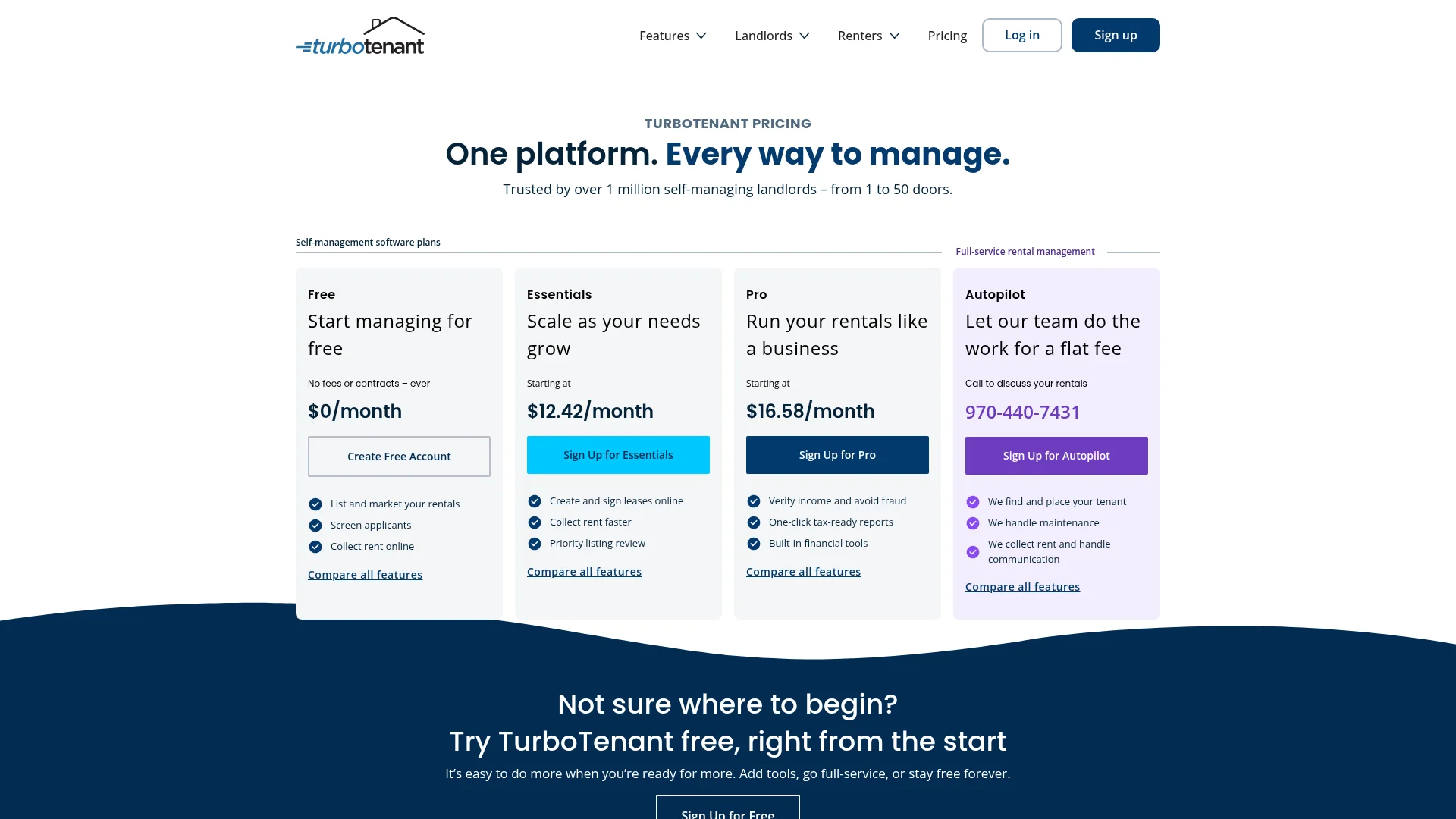
| What the landlord pays | $0 on Free, forever. No trial, no contract. Paid tiers are annual-only: Essentials from $149/yr, Pro from $199/yr (1–10 units) |
| What the applicant pays | $55 per screening on Free ($45 on paid) — TransUnion credit, criminal and eviction, paid at application, non-refundable |
| What the tenant pays | $2 per ACH rent payment on Free and Essentials (waived on Pro); 3.49% on cards on every plan, unwaivable |
| What’s genuinely included free | Unlimited listings and syndication, applications, screening, rent collection, maintenance requests, messaging, expense logging |
| What’s missing | Real accounting — Schedule E/Form 8825 export, auto-import, loan tracking are Pro-only. No owner statements at any tier. Phone support starts at Essentials |
| When you outgrow it | When a CPA asks for a ledger, a partner expects statements, or tenant-paid fees start costing you applicants |
What free actually means
TurboTenant’s own FAQ is refreshingly blunt about the model: “you can really access all of TurboTenant for $0, forever.” And on how the company eats: “TurboTenant makes money by collecting and keeping the screening fee” — reports bought in bulk at a discount, resold to your applicant at full price. Free for you, priced for them. The pricing page even says so, in a Renter Pricing section most review sites never quote.
The tenant-side fee schedule, read off TurboTenant’s pricing page on 3 November 2026 (the “verified 3 Nov 2026” figures throughout this review come from that same pass):
| Fee | Amount | Who pays | Notes |
|---|---|---|---|
| Screening | $55 on Free, $45 on paid plans | Applicant | Paid when they apply; non-refundable once run |
| Rent by bank transfer (ACH) | $2 per payment | Tenant | Waived only when the landlord is on Pro |
| Rent by card | 3.49% | Tenant | Every plan, including Pro — not waivable by any upgrade |
| Rent reporting to bureaus | $4.99/mo | Tenant | Optional credit-building add-on |
| Renters insurance | from $11/mo | Tenant | Optional, via TurboTenant’s partner SURE |
| State-specific lease | Free to build; $149/yr to sign | Landlord | Free to draft and save; finalizing, downloading or sending one needs Essentials ($149/yr) or Pro |
| Landlord Forms Pack | $199 | Landlord | Standalone purchase; included on paid plans |
Two of those numbers do real damage. The card fee on $1,500 rent is $52.35 a month — about $628 a year — and no plan touches it. And screening three applicants for one vacancy on Free costs them $165 for your one decision; on paid plans, $135. Worth knowing before a strong applicant asks why your listing carries a $55 toll while the one down the street charges $45.
The free tier also has a speed problem. Payouts on Free run a reported 5–10 business days; paid plans expedite them, though no tier offers same-day. That delay generates most one-star reviews: rent leaves the tenant on the 1st and lands with you mid-second-week.
One note: our cost calculator prices TurboTenant at $0 to the landlord — it tracks your bill, not your tenant’s. The fees above are the other half of the receipt.
The good: where free genuinely beats paid
Screening is the reason to sign up. TransUnion credit, criminal and eviction reports with a free pre-screener in front of them, and the applicant pays. At $55 on Free it’s the priciest toll in the category (Innago charges $30–35, DoorLoop $35 plus $10 for income verification), but the report is real, it arrives with the application, and you never open your wallet. Employer-verified income waits for Pro.
Listing syndication is the other reason. Unlimited listings pushed to the major rental sites, lead management and showing scheduling at $0. Zillow Rental Manager is the other free route to the same placements, and if filling one vacancy is the entire job, the head-to-head on listings and screening is where to start. The free tier isn’t crippled to sell the upgrade; a first-time landlord can run a vacancy end-to-end — list, pre-screen, application and TransUnion report, autopay — without seeing a paywall, and the lease is the one step that needs a paid plan to finish. One r/Landlord landlord who priced against the tool’s market data listed $200 above their usual rate and drew five applicants in two days.
Rent collection is complete free; leases are complete on a paid plan. State-specific lease templates with e-signature are unlimited on any paid tier. TurboTenant builds and saves a state-specific lease on Free, but finalizing, downloading or sending it for e-signature needs Essentials ($149 a year to ten units) or Pro — the help center states TurboTenant “does not offer a one-time purchase for individual lease agreements” (read 10 November 2026). “lease creation and digital signing [are] just absolutely fabulous, way less odd meetings and trying to work around schedules,” per one r/Landlord landlord. Rent collection covers autopay, automatic late fees, receipts, reminders and offline-payment marking for the check-holding holdout — “It’s honestly been great. I require all my tenants to make payments exclusively thru there.” If you haven’t settled the bigger question of how your tenants should pay at all, the four methods compared puts Zelle, Venmo and paper checks against these fees.
The gaps: the upgrade triggers, priced
There is no real accounting below Pro. Free logs expenses manually; Pro ($199/yr to 10 units) unlocks Schedule E and Form 8825 export, automatic transaction import, loan tracking and the insights dashboard. Between “log expenses” and “hand my CPA something clean” there is nothing — the gap that sends landlords shopping. If a clean Schedule E is why you’re buying software at all, our breakdown of property management software pricing for small landlords prices what Rentec, Buildium and TenantCloud charge for it.
No owner statements or disbursements at any tier. TurboTenant’s own support team confirmed this in a Reddit thread: “there isn’t a built-in owner disbursement feature, so you’d still need to handle that outside the platform.” Irrelevant to a solo landlord; disqualifying the moment a partner or lender expects a monthly statement.
Support is a paid feature. Free gets chat and email; phone support starts at Essentials. The sharpest cautionary tale sits in r/PropertyManagement: a landlord whose listing sat unreviewed for days, who paid $119 for “premium support” to reach a human, then fought a runaround to turn off auto-renewal on a desktop-only screen.
The upgrade ladder has a cliff at 11 units. Both paid tiers bill annually in bands: Essentials $149/yr (1–10 units), $199 (11–30), $299 (31–60), $349 (61+); Pro $199, $399, $699, $999. Cross from ten units to eleven and Pro doubles to $399 for identical software. And “$12.42/month” on the pricing page is $149 divided by twelve — there is no monthly billing; $199 leaves your account in one payment.
The Pro decision, done right: Pro costs $50 a year more than Essentials and waives the tenant’s $2 ACH fee. Five tenants paying by bank saves them $120 a year — the upgrade pays for itself twice over and adds the accounting suite. If you’re paying TurboTenant anything, the sensible first payment is Pro, not Essentials. Essentials’ real draw is unlimited leases plus the $45 screening fee — don’t buy it for the ACH waiver you’re not getting.
What Reddit says
r/Landlord’s relationship with TurboTenant is genuinely two-sided, which makes it more useful than the review sites.
The positive camp treats it as plumbing that works. A “best rent collection software” thread answered “Turbotenant is good” and, from another user, “the most robust option for the small $100 annual fee they charge.” A self-described newbie reported good luck with the full pipeline — advertising, applications, background checks, lease drafting, e-signatures, collection — with payout delays (“a delay in depositing your money that’s a little longer than I’d like, ~5 days”) and interface bugs as the caveats.
The negative camp splits into three recurring complaints. Marketing underperformance: in a r/PropertyManagement thread titled “Thumbs down for Turbo Tenant,” a landlord reported one inquiry in three weeks against steady Zillow and Facebook Marketplace traffic, with a top reply agreeing: “Almost zero leads for any vacancy. I don’t mind it for collecting rent and everything else, but yeah, the marketing/leasing side blows.” Fees landing on the tenant: when the $2 ACH fee arrived in October 2022, the CEO-signed announcement — sent to landlords’ tenants directly — produced a thread of landlords fielding angry renters, several of whom ate the fee themselves. And the applicant side: an Oregon thread saw a rejected applicant’s non-refundable $55 turn into harassment allegations, with TurboTenant’s community manager confirming the $55/$45 split in the replies.
Read together, the pattern matches the fee table: nobody argues the free plan isn’t free. The arguments are about who pays the adjacency costs — tenants in fees, free-plan landlords in support wait-times and payout patience.
FAQ
Is TurboTenant really free?
For the landlord, yes — verified against TurboTenant’s pricing page and FAQ on 3 November 2026: no trial, no contract, no card required, “all of TurboTenant for $0, forever.” The company discloses its own revenue model: it marks up the screening reports your applicants pay for and takes the processing fees your tenants pay. Free describes your invoice, not the transaction.
Who pays the screening fee?
The applicant, by default — $55 on the free plan, $45 on any paid tier, paid at application and non-refundable once run. TurboTenant lets you absorb the fee yourself, which some landlords do in fee-restricted states or for an applicant they’ve already effectively chosen. Three applicants for one vacancy costs them $165 on Free, $135 on paid.
TurboTenant vs Innago vs Avail?
Innago is free with cheaper tenant fees — $30–35 screening, $2 ACH, 2.99% cards, phone support included — but thinner syndication, and you can’t absorb tenants’ fees inside the app the way TurboTenant lets you. Avail’s free tier has the best leases of the three (lawyer-reviewed, state-specific, included — TurboTenant charges $149 a year before it will send one) at $2.50 per ACH and 3.5% cards, with the thinnest accounting. TurboTenant wins reach and screening workflow; Innago wins the tenant’s wallet; Avail wins paperwork. None of the three does real accounting free — that’s a paid-tool decision, and DoorLoop vs Buildium covers the crossover math when you get there.
When should I switch to paid software?
Not at a unit count — at a failure. The honest triggers: a CPA or partner asks for a ledger or owner statements (TurboTenant can’t produce either below Pro, or at all for statements); tenant fee complaints start costing you applicants; payout timing starts messing with your mortgage payments. At that point, price the alternatives — our small-landlord software comparison prices seven platforms at your exact unit count, and if TurboTenant Pro at $199/yr is the answer, buy it knowing the 11-unit cliff ahead.
The verdict
Use TurboTenant free if you have 1–4 units and your problem is finding and screening tenants. It is the best $0 stack in the category for that job, and the tenant-paid fee model is a fair trade at that scale — $2 per rent payment is less than your tenant spends on the drive to drop off a paper check.
Upgrade to Pro ($199/yr, 1–10 units) when the books enter the picture — or when nine or more tenants paying by bank make the ACH waiver worth more than the upgrade ($24 saved per tenant per year doesn’t clear the $199 until the ninth).
Skip to paid software if any of these describe you: you need owner statements for partners or lenders; you want double-entry accounting your CPA will accept without a spreadsheet detour; you’re past 10 units and facing the $199→$399 cliff; you can’t tolerate 5–10-day payouts. Rentec Starter at $25 flat is the sane first paid step.
Run your own numbers first — the cost calculator prices TurboTenant alongside every paid competitor at your exact unit count, fee lines included.