TurboTenant vs Zillow Rental Manager: Where to List and Screen (2026)
Zillow lists free on its own network and charges applicants $40; TurboTenant syndicates 26 sites but needs a paid plan to close a lease. Verified 10 Nov 2026.

Pick Zillow Rental Manager to fill one vacancy in front of the largest rental audience: publishing is free, the listing runs on Zillow, Trulia and HotPads, and your applicant pays $40 for an Experian credit report and a CIC background check usable on participating Zillow listings for 30 days. Pick TurboTenant for a platform around the listing: unlimited ads syndicated to 26 partner sites, Zillow not among them, plus a free pre-screener, rent collection and maintenance. Two asymmetries decide the rest — TurboTenant never publishes directly to Zillow, and its lease needs a paid plan. Prices read 10 November 2026.
Disclosure: Landlord Method doesn’t earn a commission from TurboTenant or Zillow Rental Manager — no affiliate program for either is live on this site. Every price below comes from each vendor’s own published pages, read on 10 November 2026.
Quick comparison
| TurboTenant | Zillow Rental Manager | |
|---|---|---|
| Listing cost | $0, unlimited listings | $0 to publish. Premium: $39.99 one-time, up to 90 days |
| Syndication network | 26 partner sites (Apartments.com, Realtor.com, Redfin, Zumper, Craigslist and more). No direct Zillow publishing | Zillow, Trulia and HotPads only — 30 million visitors a month |
| Applications | Online applications behind a free pre-screener; four custom questions on Pro | One fixed form; portable across participating Zillow listings |
| Screening cost + reports | $55 per applicant on Free, $45 on Essentials and Pro. TransUnion credit, criminal and eviction checks, soft pull | $40 per applicant, applicant pays, landlord can’t cover it. Experian credit + CIC background: criminal, sex-offender, housing court |
| Leases | Free to draft; Essentials or Pro required to finalize or send. No one-time purchase; unlimited on paid plans | Upload your own lease and e-sign at no charge; lease builder in 36 states |
| Ongoing tools | Rent collection ($2 ACH unless Pro; 3.49% cards), tenant maintenance requests, messaging, expenses; accounting on Pro | Rent collection (free ACH, 2.95% credit, $9.95 debit), maintenance log, lead management, tours. No accounting |
Cost to fill one vacancy
Same vacancy, three applicants, both sides.
On Zillow Rental Manager the landlord’s bill is $0. The three applicants pay the $40 themselves — $120 — and anyone who paid on a participating Zillow listing in the last 30 days pays nothing, since the fee buys unlimited applications in that window. Uploading and e-signing your own lease is free; ACH rent collection is free on both sides. The only money you can spend is Premium at $39.99 per listing for up to 90 days.
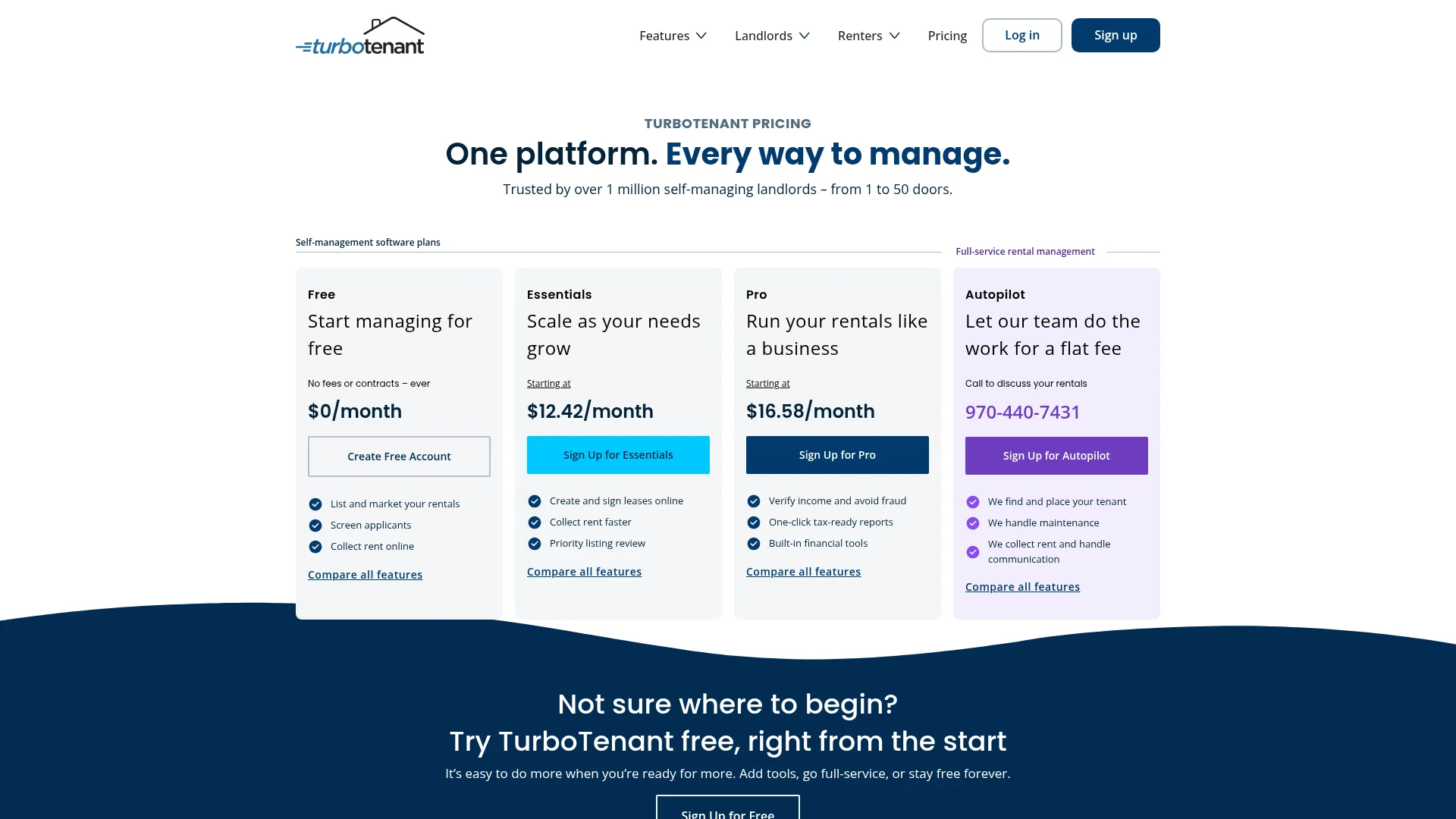
On TurboTenant the listing and the screening are free to you, but the paperwork isn’t. The three applicants pay $55 each on the Free plan — TurboTenant keeps the fee even if you never request the report — and you can cover it yourself through Screen a Tenant if local fee rules push you there. The lease is the catch: TurboTenant drafts a state-specific lease on Free, but finalizing, downloading or sending it for e-signature needs Essentials or Pro, and TurboTenant doesn’t sell a single lease. The cheapest route to a signed lease is Essentials at $149 a year for 1–10 units. Add landlord-paid screening and one vacancy costs $314 in year one; pass the screening to applicants and it costs $149.
| One vacancy, 3 applicants | TurboTenant (Free + Essentials) | Zillow Rental Manager |
|---|---|---|
| Listing | $0 | $0 ($39.99 with Premium) |
| Screening, applicant side | $165 ($55 each) | $120 ($40 each, reusable 30 days) |
| Screening, landlord side | $0, or $165 if you cover it | $0, always |
| Lease | $149/yr Essentials minimum | $0 — upload and e-sign |
| Landlord’s total | $149–$314 | $0–$39.99 |
Zillow’s $40 buys unlimited applications for 30 days; TurboTenant’s $55 is per application, so a renter applying to five TurboTenant units pays $275. Our TurboTenant review covers the rest.
Screening reports compared
TurboTenant screens through TransUnion: a credit report with score and collections; a criminal search across all 50 states plus the national sex-offender registry; and eviction court records. It’s a soft inquiry, so the applicant’s score doesn’t move. Look-back rules vary — Colorado bars most convictions older than five years, New York City allows only recent felonies and misdemeanors, plus registered sex offenses — and dismissed or expunged cases drop off in most states, so a clean report isn’t proof of a clean history. The free pre-screener sits in front of the paid report: renters self-report income, score, pets and eviction history before you invite an application. Pro adds Snappt income verification and fraud detection.
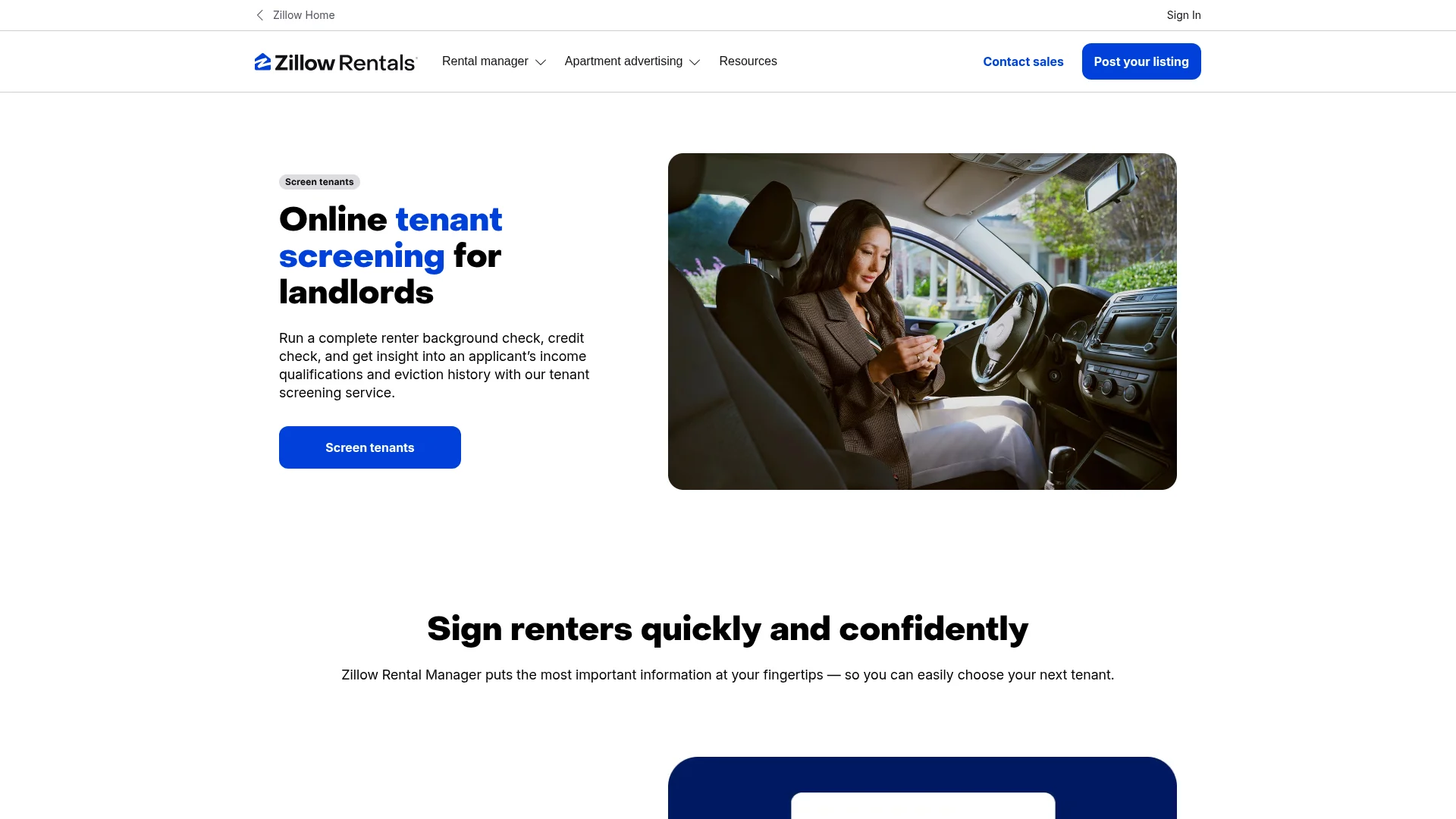
Zillow bundles an Experian credit report and a CIC background check — national criminal search, sex-offender registry, housing court records — into the $40. Income arrives as uploaded documents, up to five, which you read yourself unless you use the Income Verification feature Zillow now markets as a replacement for manual review. CIC’s help article says it doesn’t verify employment or rental history. No pre-screener, and no way to pay the fee yourself. The $40 covers 30 days of applications; renewing costs another $40.
Practical read: TurboTenant’s report is the deeper file and its pre-screener saves you reading obvious mismatches; Zillow’s is $15 cheaper and attached to a far bigger audience.
Beyond the listing
Zillow Rental Manager keeps more than it did: rent collection (free ACH, payouts in as little as two business days with Fast Payments), lead management, tour booking and a maintenance log for tasks and repair costs. What you don’t get is a tenant-facing maintenance portal (renters can’t submit requests), any bookkeeping or Schedule E reporting at any price, or a self-serve path at scale — Zillow routes multifamily buildings of 25 or more units to its advertising team. The one tax document it produces is the 1099-K Stripe files on rent collected through Zillow once you clear its reporting threshold (the help FAQ puts that at more than $5,000 in 2024), sent to you, the IRS and some states. For the vacancy-and-collect job it’s complete; for running the books it stops.
TurboTenant is the other shape: a management platform that also lists. Tenants open maintenance requests, message you and pay rent inside it; expenses and documents sit in the same account. Accounting is Pro-only — Schedule E and Form 8825 exports, transaction import, loan tracking — and Pro also waives the tenant’s $2 ACH fee, worth $24 per bank-paying tenant a year, which pays for the $199 plan at nine tenants.
Verdict by landlord type
One vacancy, right now, best applicant pool: Zillow Rental Manager. Free publishing, the biggest network, the cheapest portable screening here, a free lease and free ACH. The trade is everything after the tenant signs.
Rentals running continuously: TurboTenant. Free syndication to 26 sites Zillow won’t reach, a pre-screener, tenant-facing maintenance and a path to real accounting. Budget for Essentials at $149 a year before you count on a lease, and remember the $2 ACH your tenants pay until you’re on Pro. See our Avail review for the other free platform here.
Running both is the normal answer and costs nothing extra. List the unit on Zillow Rental Manager for its network and publish the same unit through TurboTenant for Apartments.com, Realtor.com, Redfin and the rest — the networks don’t overlap. The cost is two lead inboxes, and an applicant who applies on both pays both fees. If Avail is the second name on your shortlist instead of Zillow, our TurboTenant vs Avail comparison runs the same listing, screening and lease questions.
FAQ
How much does it cost to list a rental on Zillow?
Nothing. Zillow has published Rental Manager listings free since May 2022, as its listing help article states (last edited 29 April 2026). The only charge is optional Premium: $39.99 one-time per listing for up to 90 days of higher placement, a tracking number, pricing insights and priority support. It doesn’t auto-renew and isn’t refunded if you pull the listing early.
How much is TurboTenant tenant screening?
$55 per applicant on the Free plan and $45 on Essentials or Pro. The applicant pays by default; you can cover it through Screen a Tenant, which buys a screening report without a full application. TurboTenant sets the fee and charges it at application even if you never request the report. Each adult applicant, co-signer included, pays separately.
Does TurboTenant list on Zillow?
No — not directly. TurboTenant publishes to 26 partner sites including Apartments.com, Realtor.com, Redfin, Zumper and Craigslist, and its help center says it doesn’t directly publish self-managed listings to Zillow. They can surface on HotPads or Trulia through partner distribution, but placement isn’t guaranteed. Apartments.com distribution is limited to properties under five units and eight active listings per account.
Can I use TurboTenant and Zillow Rental Manager at the same time?
Yes, and many landlords do. Post on Zillow Rental Manager for its network and run the same unit through TurboTenant for the partner sites. Screening doesn’t travel: an applicant who applies on both pays $40 on Zillow and $55 on TurboTenant Free.
Can I get a lease on TurboTenant’s free plan?
You can build and save a state-specific lease, but you can’t finalize it, download it or send it for e-signature without Essentials or Pro. TurboTenant sells no single lease, so the cheapest way to close a vacancy inside the platform is Essentials at $149 a year for 1–10 units.
How does TurboTenant make its money?
Four: the screening fee your applicant pays ($55 on Free, $45 on paid), the $2 ACH and 3.49% card fees your tenant pays, subscriptions from $149 to $999 a year by tier, and Autopilot, its $1,500 placement service.