Avail Review: The $0 Landlord Plan, Priced Per Unit (2026)
Avail is free for landlords at any unit count, but Unlimited Plus costs $9 per unit a month — $1,080 a year at 10 units. Where free breaks. Verified Nov 2026.

Avail is free for landlords at any unit count, and that is the whole pitch: listings on 20 rental sites, state-specific leases with e-signing, TransUnion screening and online rent collection for $0 a month. The catch is on the other side of the invoice. Tenants pay $2.50 per bank transfer unless you buy Unlimited Plus at $9 per unit per month — $1,080 a year at ten units, $5,400 at fifty. Every figure here was read from avail.com and Avail’s own help center on 4 November 2026.
Disclosure: Landlord Method doesn’t earn a commission from Avail — no affiliate program for it is live on this site. Prices come from Avail’s own pages.
Quick answer
| The deal (verified 4 Nov 2026) | |
|---|---|
| Landlord price | Unlimited: $0/unit, unlimited units. Unlimited Plus: $9/unit/month, no annual option published |
| Tenant price | ACH $2.50 per payment on Unlimited, $0 on Plus; cards 3.5% on both; CreditBoost $3.95/month if they opt in |
| Applicant price | Screening $30 for any single report, $55 for all three; no two-report price is published. Applicant-paid by default |
| Included free | 20-site listing syndication, applications, screening, state-specific leases with e-sign, rent collection, maintenance tickets, tenant portal, income and expense tracking |
| Plus adds | FastPay next-business-day deposits, waived tenant ACH fee, custom application questions, editable and clonable leases, branded property website, priority support |
| Missing at any price | A mobile app, double-entry accounting, Schedule E export, a published API |
| Who it fits | 1–10 units, self-managing, wants leases and rent collection without a subscription |
| Who should skip it | 25+ units on Plus, anyone whose books need to survive an audit, anyone with tenants who refuse online fees |
What Avail costs
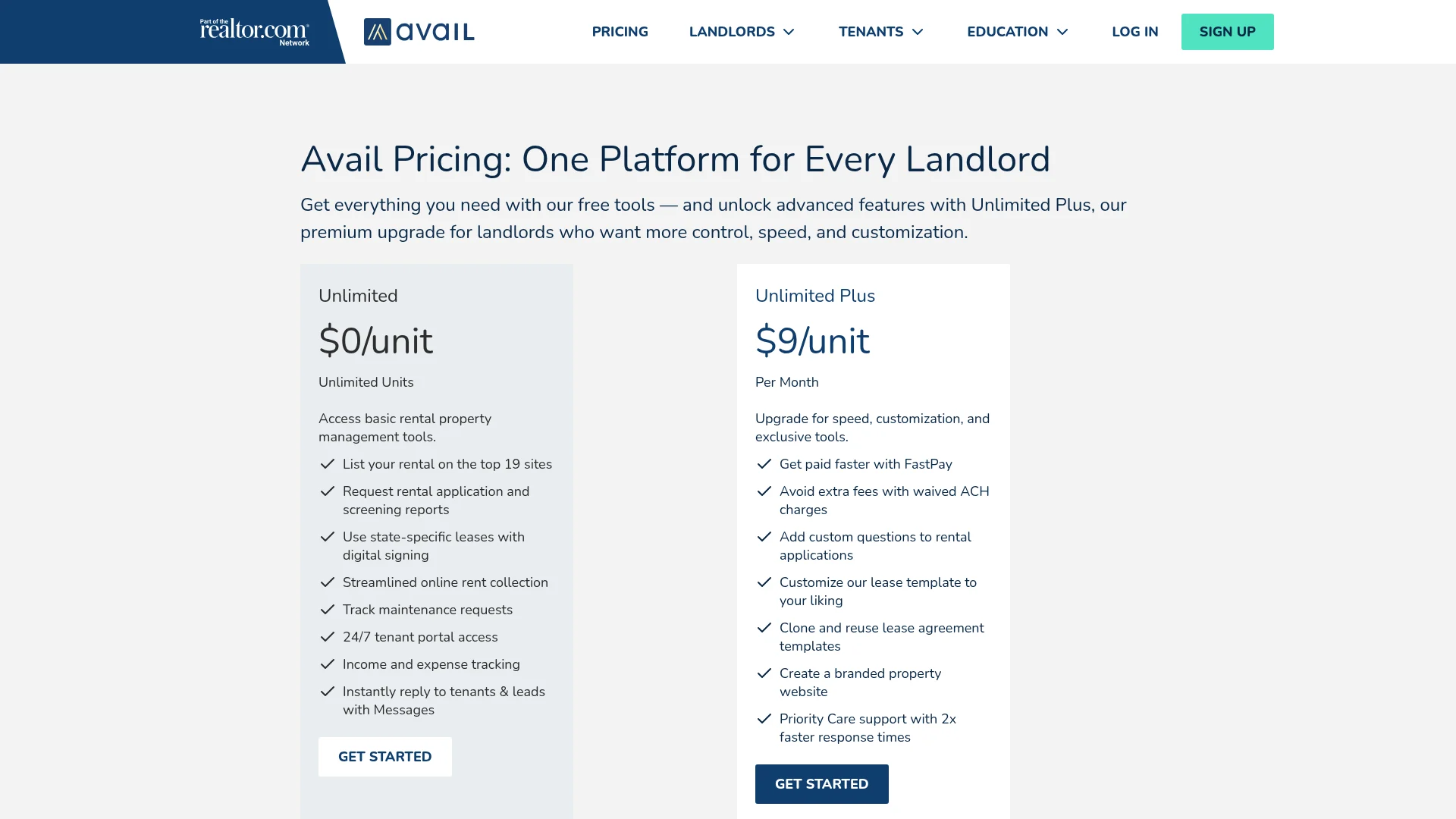
Two plans, and only one of them has a number that scales.
- Unlimited — $0 per unit, per month, with no cap on properties or units. Listings, applications, TransUnion screening, leases, e-signing, rent collection, maintenance and messaging all sit here.
- Unlimited Plus — $9 per unit, per month. Adds FastPay (next-business-day rent deposits), waives the tenant’s $2.50 ACH charge, unlocks custom application questions and lease customization, adds a branded property website, and moves you into Priority Care support with what Avail describes as 2x faster response times.
Avail publishes no annual billing option for Plus, so the yearly cost is twelve times the monthly line:
| Units | Plus per month | Plus per year | Per unit per year |
|---|---|---|---|
| 1 | $9 | $108 | $108 |
| 5 | $45 | $540 | $108 |
| 10 | $90 | $1,080 | $108 |
| 25 | $225 | $2,700 | $108 |
| 50 | $450 | $5,400 | $108 |
| 100 | $900 | $10,800 | $108 |
| 250 | $2,250 | $27,000 | $108 |
That flat $108 per unit per year is why Avail’s paid tier behaves differently from every other platform in the small-landlord tier. TenantCloud runs $180 to $600 a year for the whole portfolio. TurboTenant Pro is $199 a year for up to 10 units. Buildium Essential is $65 a month up to 20 units. At ten units Avail Plus costs more than all three, and the gap widens from there, because the price is a multiple rather than a subscription.
Does the $9 per unit pay for itself?
Usually not, and the arithmetic is worth walking through because the pricing page presents the ACH waiver as the headline reason to upgrade.
One tenant paying by bank transfer costs that tenant $2.50 a month, or $30 a year. Plus costs the landlord $108 a year for the same unit. Buying Plus to remove the fee means paying $108 to spare your tenant $30; the waiver is a gift to the renter and the landlord pays for it. Even at two ACH payments a month from the same unit it’s $60 against $108.
Avail also publishes no setting that lets a free-tier landlord absorb the $2.50 themselves. The pricing page frames the fee as the tenant’s, and the two levers that remove it are the landlord’s upgrade or the tenant enrolling in CreditBoost at $3.95 a month — more than the $2.50 it replaces for a single monthly payment. If your reason for wanting Plus is “my tenants shouldn’t pay to pay rent,” the honest comparison is $108 a unit against the $30 they’d otherwise spend, and a flat-fee competitor that lets you cover the fee at cost.
The purchase only makes sense for the other four things: FastPay, lease customization and cloning, custom application questions and the branded site. Price those, not the ACH line.
What the tenant and applicant actually pay
| Fee | Amount | Who pays |
|---|---|---|
| Rent by bank transfer (ACH) | $2.50 per payment on Unlimited; $0 on Plus | Tenant |
| Rent by credit or debit card | 3.5% of the payment, both plans | Tenant |
| Failed ACH | $15 added to the next payment | Tenant |
| CreditBoost rent reporting | $3.95 per reported month | Tenant, optional |
| Screening — any one report | $30 | Applicant by default; the landlord can cover it |
| Screening — all three reports | $55 | Same |
Avail publishes two screening prices, not a ladder: $30 for a credit, criminal or eviction report on its own, and $55 for all three together. There is no published two-report rate. TransUnion sets the figure against the listing’s location, so a state that caps application fees can land below both numbers.
Card rent is the expensive path either way: 3.5% on $1,800 is $63 a month, or $756 a year, and no subscription tier changes it. Steering tenants to bank transfer is the single largest cash decision in an Avail account.
What Avail does well
Listings reach sites the free tools don’t. Avail’s help center lists 20 partners: Realtor.com, Redfin, Apartments.com, ApartmentList, Zumper, Dwellsy, PadMapper, Rent.com, ForRent, Rentals.com, Movoto, Nextdoor and others. The pricing page says 19 and the help center says 20, which is the kind of drift you get on a product that has been maintained rather than rebuilt. Either way, Realtor.com and Redfin in the free tier is real distribution, and it is the strongest reason a first-time landlord picks Avail over a spreadsheet.
Leases are the best free feature in the category. State-specific templates reviewed by lawyers, digital signatures, and unlimited document attachments at $0. TurboTenant’s free plan builds and saves a state-specific lease but will not finalize, download or send it, so a signed lease means Essentials at $149 a year — TurboTenant “does not offer a one-time purchase for individual lease agreements” (help center, 10 November 2026). Avail doesn’t charge for the lease or the signature. Plus adds the ability to edit clauses, clone a template for the next unit and reuse it — worth $9 a unit to anyone leasing more than a couple of doors a year.
Screening happens inside the application. TransUnion credit, a nationwide criminal report drawn from roughly 700 sources, and an eviction-proceeding report are ordered from the same flow the applicant is already in. The applicant authorizes the pull, typically pays, and the reports land in your dashboard. Bundling all three at $55 is not cheap against the market — Innago runs $30–35 and DoorLoop $35 plus $10 for income verification — but it is one click and one authorization instead of a scavenger hunt. If you’d rather compare the reports themselves before committing to a listing tool, the screening services priced against each other run $25 to $55 for a complete report.
Rent collection covers the boring parts. Autopay, automated reminders, late fees with a grace period you set from one to ten days, receipts, separate charges for utilities or parking, per-property bank accounts, and a 1099-K issued to the landlord for the money Avail processed.
Maintenance and accounting connect. Tenant or landlord tickets with photos, vendor forwarding, and repair costs that flow into the accounting page — which imports everything paid inside Avail and lets you add outside expenses by hand. That’s enough to hand a CPA a clean spreadsheet in January.
Where it falls short
The price inverts at scale. At 25 units Plus costs $2,700 a year; Buildium Essential costs $780 at that size and $1,008 at 40 units with a general ledger attached. At 50 units Avail Plus is $5,400 against Rentec Direct’s Pro at $2 per unit with a $50 minimum — $100 a month at that size. The rate is $9 at one unit and $9 at 250, with no annual price and no enterprise tier, so the multiple is the product.
No mobile app. Avail’s own help article says the platform is optimised for mobile browsers and that an app is “planned for the future”; G2’s review summary still lists the missing app as the most common limitation, and Capterra reviewers in September 2025 ask for one. A landlord on a roof doesn’t want a responsive website.
Payout timing is the operational weak point. Avail’s own payment guide sets a 2pm CST cutoff for bank transfers, which then deposit three business days after withdrawal; a transfer requested after 2pm on a Friday doesn’t leave the tenant’s account until Tuesday. FastPay claims one business day, but it’s Plus-only, activation takes two to three weeks of manual review, and each tenant’s bank account has to show as FastPay Ready before it applies. A rent due date that lands on a weekend turns into an argument about whose calendar is at fault.
Support is the most consistent complaint in the review record. Trustpilot’s review summary points at difficulty reaching a live person; a February 2026 review describes two hour-long holds and unanswered callbacks before being updated to three stars after the company responded; a March 2026 review from a landlord who says they were overcharged reports the same phone silence. Priority Care, the faster line, is a Plus feature.
Accounting stops at a transaction log. Avail’s tax help says the platform can’t generate a Schedule E or Form 1040 and points landlords at a Received Payments CSV; income and expense tracking exists, but it is categorisation and export rather than double-entry bookkeeping, reconciliation or depreciation. Growing portfolios bolt on Stessa, Baselane or QuickBooks, and then pay Avail for the payment plumbing anyway.
Zillow isn’t on the current partner list. Avail’s 20-site list omits Zillow, Trulia and HotPads; a separate help article says Zillow-group syndication requires a paid listing in a growing number of states and localities, arranged through Zillow’s own Feed Connect program. If Zillow leads matter in your market, confirm that before you switch.
Lease renewals and amendments are clunky. Reviewers on Capterra and G2 single out renewal workflows and the amendment button as the spots where a clean interface stops being clean.
Avail by portfolio size
1–5 units. Take the free plan and don’t think hard about it. Five leases, five tenants, a state-specific lease and e-signature included, where TurboTenant needs a $149-a-year Essentials subscription before it will send one, and rent collection at $0. The $2.50 per payment lands on tenants — about $12.50 a month across five doors — so tell them at signing rather than letting them discover it at the payment screen.
6–25 units. The free plan still works and still costs $0. Plus becomes a judgment call rather than a calculation: at 10 units it’s $1,080 a year for FastPay, custom questions, clonable leases and a branded site, against $199 for TurboTenant’s paid tier and $350 for TenantCloud’s Growth plan, both of which include stronger accounting. Buy Plus for speed and lease control, not for value.
26–50 units. The math stops working. $2,700 to $5,400 a year buys a portfolio that needs reconciliation, owner reporting and a real chart of accounts — the Buildium Essential tier at $65–$84 a month, or Rentec Direct’s Pro at $2 per unit with a $50 minimum, both do the accounting Avail doesn’t. Keep Avail only if leasing velocity matters more than the books.
50–250 units. Avail isn’t built for this band and its pricing says so: $450 to $2,250 a month for a platform whose reporting stops at a transaction log and whose API isn’t published. At 250 units the subscription is $27,000 a year, which is enterprise software money for a platform that ships no app. Move up, not sideways.
What Reddit and review sites actually say
The scores disagree more than usual, and the disagreement is instructive rather than contradictory.
Capterra: 4.6/5 from 276 reviews, 92% of them positive, last updated September 2026. G2: 4.8/5 from 153 reviews, 89% of them five-star. Trustpilot: 3.7 average with a 3.5 TrustScore from 426 reviews as of 4 November 2026 — 60% five-star, 18% one-star, and 64 reviews in the last twelve months. G2’s volume is invited B2B reviewers who signed up and stayed; Trustpilot is self-selected and fills with the people whose payout went sideways.
The praise is consistent about ease of use. A five-year Capterra reviewer lists “the ease Avail gives from listing the property EVERYWHERE” as the first thing they like; a September 2025 Capterra reviewer calls the platform “so easy and helpful for a reasonable cost”. A G2 reviewer running a small business calls the dashboard “intuitive, all-in-one” and credits it with ending the routine of bouncing between separate tools for each task.
The complaints cluster on money movement and price. The March 2026 Trustpilot review mentioned above puts the per-unit charge at $9 and says customer service “used to be great”; a landlord with 10 properties and five years on the platform writes in late 2026 that Avail is a “weak product” with “horrible” support. On r/Landlord, a June 2026 thread about online rent payments (1u9q1id) collects the operational version of the same story: withdrawals that skip weekends and federal holidays, FastPay averaging three to four days rather than one, an NSF return that took seven days to surface, and a $16 return fee on the tenant’s side against the $15 Avail documents.
Two cautions before you weigh any of it. Older threads quote $5 and $7 per unit — those are price history, not current pricing, and they’re the reason long-tenured users sound angrier than new ones. And the $55 screening bundle is a friction point your invoice never shows: applicants meet that number before they apply, and it is the first thing they compare with the listing down the street.
Alternatives at the same job
| Platform | Landlord cost (verified 4 Nov 2026) | Where it beats Avail |
|---|---|---|
| Avail | $0, or $9/unit/month | Leases and listings free at any size |
| TurboTenant | Free; paid from $199/yr | Mobile app, real accounting on paid tiers, phone support from Essentials |
| TenantCloud | $15–$50/month billed annually | Flat annual price; lease caps instead of per-unit pricing |
| Buildium | $65–$84/month | General ledger, owner statements, trust accounting |
| Rentec Direct | $25/month flat Starter; Pro $2/unit, $50 minimum | Predictable price, real accounting, screening included |
| Innago | $0 to the landlord | Cheaper screening, leases and payments without a subscription |
For the free-versus-free comparison, our TurboTenant review prices the other side of the same trade — TurboTenant charges $149 a year before it will send a lease and includes a real app; Avail gives the lease away and has no app. Above ten units, the DoorLoop review covers the platform that wins on interface and loses on a $199 monthly minimum, and our cost calculator runs Avail’s $2.50 and Plus lines against your own unit count and payment mix.
Gotchas other reviews skip
The screening price isn’t on the pricing page. Avail’s pricing page says application fees “vary by location” and leaves it there. The actual numbers — $30 for any single report, $55 for all three — live in Avail’s help-center article on application fees, which also notes that TransUnion sets the price by listing location and that sales tax is added where required. Three applicants on one vacancy is $165 of someone else’s money before you’ve made a decision, and it’s the fee most likely to cost you a good renter to a $35 competitor down the street.
Avail issues the 1099-K. Rent processed through Avail is reported to you on a 1099-K, which is the payment-processor form, not the rental-income form. If your CPA files Schedule E from your own records, expect a reconciliation step every January and download the Received Payments CSV from the Reports page rather than reconstructing the year from bank deposits.
FastPay has a waiting period. Activation review takes two to three weeks, and each tenant’s bank connection has to be re-verified to FastPay Ready. Buying Plus the week before the first rent run buys you the fee waiver and nothing else.
The price has moved before. Capterra reviews from 2021 quote $5 a month and r/Landlord threads from 2023 quote $7 per unit; the current page is $9. Avail has raised the per-unit rate under Realtor.com ownership (Move, Inc. acquired the company in December 2020) more than once, and there’s no annual lock to protect you from the next one.
The domain changed in March 2026. avail.co now redirects permanently to avail.com, and the help center moved with it: support.avail.co forwards to support.avail.com, and the old /hc/en-us/articles/<id> article links now return a 404 because articles sit at /article/<slug>. Root-domain bookmarks still resolve; article permalinks saved out of other reviews don’t. Old screenshots elsewhere show a pricing page that no longer exists.
Verdict
Verdict: 4.0/5.
Best fit: 1–10 units, self-managed, where the landlord wants a real lease, real screening and rent collection without a subscription. The free tier is the most generous front half of the rental cycle in the category — TurboTenant matches the $0 price but charges $149 a year before it will send a lease, and nothing else gives away state-specific templates with e-signing. At $0, the only cost is your tenants’ $2.50.
Second look: 10–25 units where FastPay or lease customization is worth $108 a unit a year. It can be, if late deposits cost you more than that in stress — but compare it to TenantCloud at $350 a year or TurboTenant Pro at $199 first, because both include the accounting Avail never built.
Skip it: past 25 units, where the per-unit multiple costs more than a general ledger, and anywhere the books are the reason you’re buying software. Avail collects the rent; the Schedule E, the owner statement and the trust account stay with your accountant or your next platform.
The honest summary: the best free landlord platform, attached to the most expensive paid tier in its own price bracket. Our true-cost calculator models the $2.50 and the $9 against your actual portfolio.
FAQ
Is Avail really free for landlords?
Yes. Unlimited costs $0 per unit per month, properties and units are uncapped, and there is nothing to cancel. It includes listings on 20 rental sites, applications, TransUnion screening, state-specific leases with e-signing, online rent collection, maintenance tickets and income and expense tracking. Avail earns money from the applicant-paid screening reports, the tenant’s $2.50 bank-transfer fee, the optional CreditBoost reporting, and Unlimited Plus.
How much does Avail cost per unit?
$9 per unit per month on Unlimited Plus, which is $108 per unit per year, with no annual discount published. The free Unlimited plan is $0 per unit at any size. At 10 units Plus is $1,080 a year; at 25 units it’s $2,700; at 50 units it’s $5,400. Tenants pay $2.50 per ACH payment on the free plan and nothing on Plus; card payments carry 3.5% on both.
Who pays for tenant screening on Avail?
The applicant by default, and the landlord can choose to cover it at order time. Prices are $30 for any single report and $55 for all three, which bundle TransUnion credit, a nationwide criminal record search and a nationwide eviction report. Avail doesn’t publish a two-report rate. The pricing page lists none of those figures — they’re in the help-center article on application fees.
Does Avail report rent payments to credit bureaus?
Yes, through CreditBoost, which reports on-time payments to TransUnion. It costs the tenant $3.95 per reported month, added to their rent, and it’s opt-in on the tenant’s side. Landlords can’t enroll a tenant unilaterally, so it’s a perk to mention at lease signing rather than a screening tool.
Is Avail good for a landlord with 20 or more units?
It works, but it’s the wrong spend. At 20 units Plus is $2,160 a year and still has no general ledger, owner statements or trust accounting; Buildium Essential costs $780 at that size, Rentec Direct’s Pro at $2 per unit is $480 on the same count, and TenantCloud Growth is $350 on annual billing. Avail’s free tier remains useful for leasing and screening as a supplement, but not as the system of record past roughly 25 units.