TenantCloud Review: The $15 Entry Price and What It Caps (2026)
TenantCloud costs $15–$50 a month by lease count, with tenants paying the transaction fees. What the lease caps and Starter limits mean at 5, 10 and 30 units. Verified Nov 2026.

TenantCloud is the cheapest paid platform in property management that still behaves like a platform, and the review turns on two numbers: $15 a month for Starter and a cap of 10 leases on that same plan. Pricing is measured in leases, not units — properties are unlimited everywhere — so a landlord with one lease per unit hits the Starter ceiling at 11 units, and the fix is Growth at $29.17 a month billed annually, not a fee shock. The fees tenants pay undercut the free tools; the compromises sit in accounting depth and support. Every figure below was read from TenantCloud’s own pricing page and help center on 4 November 2026.
TurboTenant acquired TenantCloud on 18 August 2026; existing TenantCloud accounts are being migrated to TurboTenant and the old account goes read-only afterwards; every price below was unchanged when re-read on 10 November 2026.
Disclosure: Landlord Method doesn’t earn a commission from TenantCloud — its affiliate program is not live on this site. Pricing comes from TenantCloud’s own pages.
Quick answer
| The deal (prices verified 4 Nov 2026) | |
|---|---|
| Ownership (verified 10 Nov 2026) | Acquired by TurboTenant on 18 Aug 2026; existing accounts migrate to TurboTenant, TenantCloud read-only afterwards |
| Plans and prices | Starter $25 monthly or $180/yr ($15/mo); Growth $35 / $350/yr ($29.17/mo); Pro $60 / $600/yr ($50/mo); Business custom, from $100/mo |
| Billing terms | Annual is billed upfront and saves about 40% on Starter, about 17% on Growth and Pro; every plan starts with a 14-day trial |
| Portfolio fit | Unlimited properties and units on all plans; the caps are on active leases — 10 Starter, 30 Growth, 60 Pro |
| Strongest features | Rent collection, listings and applications, maintenance, e-signatures with no per-document charge, tenant portal |
| Main tradeoffs | Lease caps force upgrades at 11, 31 and 61 leases; bank reconciliation and tax reports sit on Pro; support is plan-dependent and thinly documented |
| Who it fits | Landlords up to about 10 leases who want a real platform under $25 a month |
| Who should skip it | Anyone past 60 leases, or anyone whose books are the reason they’re buying software |
What TenantCloud actually costs
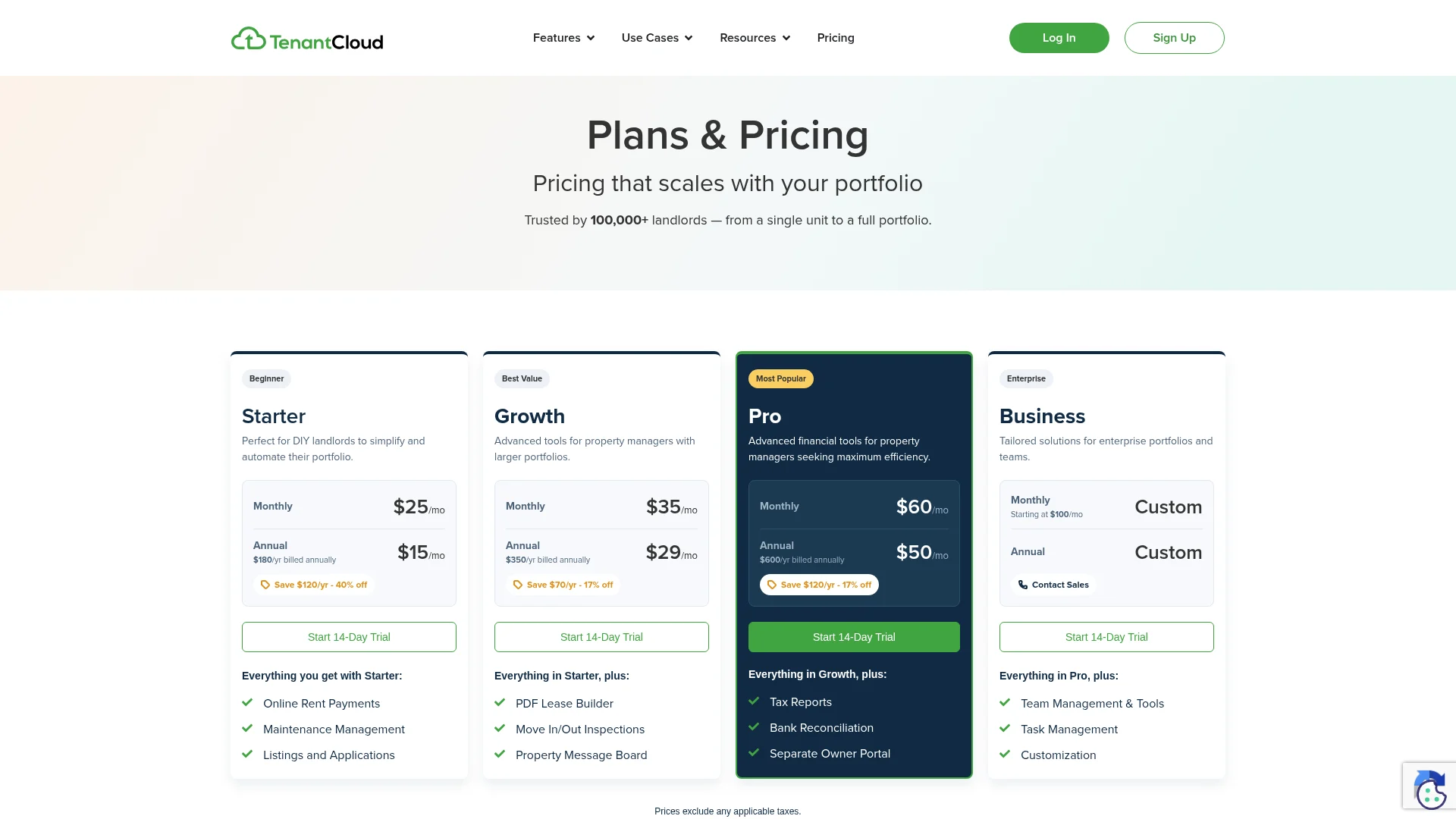
Four plans on tenantcloud.com/pricing (4 Nov 2026):
- Starter — $25 month-to-month, or $180 billed annually ($15 a month). Rent payments, maintenance, listings and applications. Capped at 10 leases.
- Growth — $35 month-to-month, or $350 billed annually ($29.17 a month). Adds the PDF lease builder, inspections and the message board. Capped at 30 leases.
- Pro — $60 month-to-month, or $600 billed annually ($50 a month). Adds tax reports, bank reconciliation and a separate owner portal. Capped at 60 leases.
- Business — custom, starting at $100 a month. Adds team management, task management and customization; lease limits and support are negotiated.
Every plan carries a 14-day trial; prices exclude applicable taxes. Properties and units are unlimited on all four plans.
One wrinkle: in the page’s annual view the Starter card shows $18.00 a month, while the comparison block shows $25 monthly and $180 annual — the signup link’s starter_18_annual slug reads like a grandfathered tier. Confirm the number at checkout.
The cap is on leases, not units
| Plan | Annual price | Monthly price | Lease cap | Storage | Bank accounts |
|---|---|---|---|---|---|
| Starter | $180/yr | $25 | 10 | 1 GB | 1 |
| Growth | $350/yr | $35 | 30 | 10 GB | 3 |
| Pro | $600/yr | $60 | 60 | 25 GB | 9 |
| Business | Custom | From $100 | Custom | Custom | Custom |
That’s the structural difference from every per-unit competitor: a fourplex on one lease counts as one lease; four single-family rentals count as four. Multi-unit buildings are the cheapest thing to run here.
True-cost examples
At one lease per unit, the annual-billed subscription works out to $15 a month per lease up to 10, $11.67 per lease at the top of Growth’s band, and $10 or less per lease across Pro’s:
| Units (1 lease each) | Plan | Annual subscription | Per lease per year |
|---|---|---|---|
| 5 | Starter | $180 | $36 |
| 10 | Starter | $180 | $18 |
| 11 | Growth | $350 | $31.82 |
| 30 | Growth | $350 | $11.67 |
| 50 | Pro | $600 | $12 |
| 60 | Pro | $600 | $10 |
| 100 | Business | from $1,200 | from $12 |
Two comparisons land the point. A five-unit landlord pays TenantCloud $180 a year; DoorLoop’s entry plan carries a $199 monthly minimum — $2,388 a year before fees, roughly 13 times more. TurboTenant is $0 for the same five units, and free is hard to beat until the books matter. Annual billing is a 12-month commitment; monthly exists on all three published tiers and is the right setting for a first quarter.
Fees beyond the subscription
The subscription is not the whole bill, but it’s close — because by default the tenant pays the transaction fees. Online Payments runs on Stripe, and the help center states it plainly: “All fees are paid by the tenant” (article 11909591, 10 Aug 2026). Landlords can absorb costs via a settings change arranged with support (article 11909453, 11 Jun 2026).
| Fee | Amount | Who pays |
|---|---|---|
| ACH bank payment | $1.95 Starter / $1.75 Growth / $1.50 Pro / custom Business | Tenant |
| Credit or debit card, incl. Apple Pay and Google Pay | 3.5% + 30¢ | Tenant |
| Tenant ACH with rent reporting enrolled | $0 (rent reporting costs the tenant $4.95/month) | Tenant |
| Tenant screening — Essential Full Check (TransUnion) | $39 | Landlord or applicant, chosen at order time |
| Income & Employment verification (Snappt) | +$10 per report | Whoever orders it |
| E-signatures | Included, no per-document charge | — |
On a $1,800 rent payment, a card costs the tenant $66 — 3.5% is $63 plus the 30¢ — while ACH costs $1.50–$1.95. Steering tenants to ACH is worth real money, and the rent-reporting carrot ($0 ACH for tenants enrolled at $4.95 a month) is a rare honest nudge in the category.
Screening runs through TransUnion with Snappt handling income verification: the Essential Full Check is $39, income verification an additional $10, and the landlord chooses who pays at order time — applicants can absorb the cost, keeping the landlord’s invoice at the subscription price. Landlord-paid orders carry a five-day hold on your card, charged only for completed reports.
Onboarding is the one fee-shaped blank: the pricing FAQ says support and data-migration help “depend on your plan,” with no published price for either. Ask before the trial ends, not after.
What the TurboTenant acquisition changes
Verified 10 November 2026. Everything above still holds: the four plans, the lease caps and the tenant-paid fees were re-read unchanged.
What existing customers pay. Migration does not reprice anyone. The transition FAQ answers “What plan am I on after the migration, and will I be charged?” with: “Your migrated account starts on the TurboTenant Pro plan, honoring your previous subscription through TenantCloud at no further charge.” The longer guide puts it shorter: “Your current subscription plan will remain in place. Same plan, same price.”
Size that against TurboTenant Pro’s list price, which is banded by unit count rather than flat: $199 a year at 1–10 units, $399 at 11–30, $699 at 31–60 and $999 at 61+. A TenantCloud Pro subscriber at 31–60 leases paid $600 and lands on a $699 list plan at $0 extra; a five-lease Starter customer paid $180 and lands on a $199 plan. Neither help center article says how long the honored price lasts or what the account is charged at the next renewal.
What moves and what stays behind. Transferred automatically: property and tenant information, bank account and payment method details, payment history, and documents — “Documents such as lease documents, and notices, renters insurance records, both Sure-purchased and manually added.” Not transferred: “The following did not transfer and remains accessible in your read-only TenantCloud account” — screening reports and past applications, maintenance requests, message history.
Read-only keeps those items visible; it does not keep them usable. Download the screening reports and applications you might need for a future dispute, and export maintenance and message history, before the switch completes. Two mechanics worth knowing from the guide: only the most recently added payment method migrates, and you should not set up the TurboTenant side yourself — “Please do not create a TurboTenant account until you receive an email from TurboTenant to set your password.”
ACH fees change shape. If you covered ACH fees for tenants on TenantCloud, they arrived as a separate charge on your card. On TurboTenant: “ACH fees are deducted directly from the rent deposit you receive, rather than billed separately.” The FAQ names the symptom that follows: “This may make your deposit amount appear lower than expected, but everything is accounted for.” A $1,800 rent that used to land as $1,800 plus a separate fee now lands as $1,800 minus the fee. Nothing is missing; the deduction moved inside the deposit.
Screening: $45, paid by the applicant. TenantCloud’s TransUnion check was $39, ordered by either side. On TurboTenant: “Note: Screening costs may differ. TurboTenant’s all-inclusive application and screening is $45, paid by the applicant.” The pricing page currently shows that $45 in its “For Pro Landlords” renter block and $55 in the “Free” one; migrated accounts start on Pro, so $45 is the figure that applies to them. Prior screening does not follow you: “No, screening data will not be migrated.”
If you are buying today. TenantCloud still sells all four plans, the pricing page still carries trial calls to action, and the signup flow at app.tenantcloud.com still loads and runs — with no acquisition notice on the marketing site, the pricing page or the signup form. There is no public statement of what happens to a new TenantCloud contract: no end-of-sale date, no redirect, no announcement. What is public is the direction of travel, and the product now follows TurboTenant’s roadmap. For the price without that ambiguity, our TenantCloud alternatives guide sorts the migration paths and prices each one at your lease count.
What TenantCloud does well
Rent collection is the core: recurring invoices, automated reminders, late fees set once, receipts, payments that post to the ledger automatically. The tenant-side economics — $1.50–$1.95 ACH against $2–$2.50 at TurboTenant, Avail and Innago — are the best in the small-landlord tier.
Leasing. State-specific lease templates reviewed by attorneys, e-signature included on every plan with no per-document charge, and the PDF lease builder on Growth and above. Applications, screening and e-signing run in one flow where most sub-$25 platforms stitch three vendors together.
Listings and applications. Vacancies syndicate to rental sites, applications are built in, screening integrates at order time — the spreadsheet-plus-Zillow-plus-DocuSign stack replaced for $15 a month.
Maintenance. Tenant-submitted requests with photos, vendor assignment and status tracking. A landlord running 17 units of mixed residential, commercial and industrial space on r/Landlord called the maintenance setup “one of the strongest I’ve seen” after five years on the platform.
Accounting — with a plan gate. Income and expense tracking exists on every plan; bank reconciliation and tax reports sit on Pro — the most consequential gate in the lineup. A Starter or Growth subscriber keeps books manually or pays $50 a month; TurboTenant makes the same trade at $199 a year.
Where it falls short
The lease caps are real walls. At 11 leases the bill jumps from $180 to $350 a year; at 61 it jumps to $600. Neither jump adds functionality — it’s the same platform, metered. Multi-unit buildings under one lease each dodge this; scattered single-family homes walk straight into it. Business pricing from $100 a month is the only answer above 60.
Accounting depth. The recurring complaint across Capterra and G2 reviews is bookkeeping friction: one Capterra reviewer calls accounting and reconciliation “a little funky,” another turned off the QuickBooks Online integration as “too disruptive to my books,” and G2 reviewers report payments processed one at a time and a reconciliation tab that “isn’t a huge help.” GetApp reviewers add that the QuickBooks integration carries an extra fee. Individual reports, not universal outcomes — but they cluster on exactly the workflows a growing landlord needs.
Support is plan-dependent and hard to pin down. The pricing FAQ says email and in-app chat availability “may vary by plan,” with priority assistance on higher tiers — and no published statement of what Starter gets. Sentiment runs from Capterra’s 4.2 customer-service rating to a September 2025 review calling onboarding and new-customer support “quite terrible.” You’re buying support quality you can’t fully see until the trial.
Payment reliability complaints. G2 and Trustpilot reviewers describe bank accounts rejected without clear reason, payouts slower than stated, and a chargeback that pulled rent back out of a landlord’s account — attributed sentiment, clustered on the platform’s most important function.
No open API on the published plans — TenantCloud’s own Buildium comparison concedes the point — and custom team permissions wait for Business.
Fit by portfolio size
1–10 leases. This is the fit. Starter at $180 a year is the cheapest full platform on the market, and the tenant-paid fees beat the free tools. Against TurboTenant’s free tier — the direct alternative — TenantCloud costs $180 and buys application management, stronger maintenance tooling and cheaper transaction fees; TurboTenant costs $0 and buys the widest listing reach. Both are reasonable; see the TurboTenant review for the free side of that trade.
11–30 leases. Growth at $350 a year, $11.67 per lease at the top of the band. This is where the platform earns its keep — and where the accounting complaints start to matter, because nobody managing 25 leases keeps books by hand, and bank reconciliation waits on Pro. The comparison set changes here too: Buildium Essential at $65 a month ($780 a year) costs more than double but carries no lease cap and deeper accounting; the small-landlord pillar prices that trade across five vendors.
31–60 leases. Pro at $600 a year unlocks reconciliation and tax reports. Against Buildium Essential’s uncapped $780, Pro is cheaper and adds the owner portal, but Buildium’s accounting depth is a different class. The DoorLoop review covers the third option, which loses this band on price: a $199 monthly minimum is $2,388 a year against $600.
60+ leases. Business starts at $100 a month — $1,200 a year minimum, custom above — for team tools and customization. Above roughly 100 units, purpose-built managers with open APIs are the better spend; TenantCloud’s own comparison page concedes that point.
What Reddit and review sites actually say
Review scores first, with dates: Capterra 4.3/5 from 451 reviews, 86% positive sentiment, “frequent technical glitches” the leading negative theme; G2 4.4/5 from about 300 reviews; Trustpilot 3.8/5 from 177 reviews as of 4 November 2026 — 62% five-star, 15% one-star, and up from the 3.4 a competitor’s October 2026 review cites. Trustpilot’s recent-review summary praises ease of use and support responsiveness while flagging navigation, payment speed and fee tracking.
The praise, attributed: a 17-unit mixed-use landlord on r/Landlord (thread 1k027m3) with five-plus years on the platform credits TenantCloud with handling portfolios “most of the other companies are unable, or just refuse, to cater to,” calls the maintenance setup “one of the strongest I’ve seen,” and notes developers act on user feedback. A January 2026 Capterra reviewer managing 10 properties calls applications, screening and deposits “as easy as it can be.”
The complaints, also attributed: an r/Landlord thread (1o88cwa) reports an applicant-paid income verification charge landlords couldn’t opt out of — one commenter puts it at $12 per applicant on Starter against the $10 the help center documents, and calls the support response dismissive; another in the same thread disputes that framing, saying they charge applicants directly and pay screening themselves. A Starter user in r/USPropertyManagement (1sui2si) says features moved behind higher tiers, reports $25 local application-fee caps against $40–50 screening bundles, and complains the site changes without notice.
Two cautions. Historical sentiment is not current product — the angriest old threads predate the Stripe migration and the current four-plan lineup, and 2022 fee schedules don’t describe 2026 pricing. And treat any page citing Trustpilot at 3.4 as stale; the profile was claimed in September 2026 and the score has moved since.
Verdict
Best fit: landlords and small operators with roughly 10 leases or fewer, and portfolios that run through multi-unit leases rather than scattered doors. At $180 a year TenantCloud is the cheapest credible platform in the category, the tenant-paid fees undercut every free tool, and the 14-day trial answers the support question before it costs anything.
Second look: 11–60 leases, where the math stays attractive but Pro’s accounting gate and the documented bookkeeping friction start to compete with Buildium’s uncapped, deeper alternative at $65 a month.
Skip it: above 60 leases, where Business pricing meets better-built competitors; and anyone whose primary requirement is clean books — the reconciliation complaints are the most consistent signal in the review record, and Pro’s reconciliation tools are the fix for a problem the plan gate itself creates.
The honest summary: the right price, an adequate platform, and a ceiling you’ll hit in accounting rather than features — at lease 11, 31 or 61. Our cost calculator prices TenantCloud’s tiers at your exact lease count, tenant-paid lines included.
One qualifier, dated 10 November 2026. If you are already on TenantCloud, the paragraphs above still describe your account: you are being migrated to TurboTenant Pro with the subscription honored at no further charge, and the accounting gate at lease 31 remains the wall you were always going to hit. If you are starting today, Starter at $180 is still the cheapest lease-capped platform on the market, but a new contract now points at a vendor whose existing base is being moved onto its owner’s platform, and nobody has published what that contract includes at renewal. Price TurboTenant into the decision before you commit: Pro lists at $199 a year at 1–10 units and $699 at 31–60, and it already includes the Schedule E reporting TenantCloud reserves for its $50-a-month plan.
FAQ
Is TenantCloud legitimate?
Yes. TenantCloud LLC has operated since 2015, claims more than 100,000 landlords, and holds a claimed Trustpilot profile at 3.8/5 from 177 reviews as of November 2026. Payments run through Stripe; screening through TransUnion and Snappt. Legitimate is not flawless: the documented weaknesses are accounting friction and plan-dependent support, not fraud or instability.
How much does TenantCloud cost per month?
Starter is $25 month-to-month or $180 a year ($15 a month); Growth is $35 or $350 ($29.17); Pro is $60 or $600 ($50); Business starts at $100 a month, custom above. Tenants pay the transaction fees by default — $1.50–$1.95 per ACH payment depending on plan, 3.5% plus 30¢ on cards — so a landlord’s cash cost starts at the subscription. Five leases: $15 a month on annual billing, $25 without the commitment.
What are the different TenantCloud pricing plans?
Four, as of 4 November 2026. Starter ($25 monthly / $180 annually; 10 leases, 1 GB storage, 1 bank account) covers rent collection, maintenance, listings and applications. Growth ($35 / $350; 30 leases) adds the lease builder, inspections and the message board. Pro ($60 / $600; 60 leases) adds tax reports, bank reconciliation and an owner portal. Business (from $100 a month; custom limits) adds team and task management plus customization. Properties and units are unlimited throughout.
Is TenantCloud good for a small landlord?
For most, yes — with one structural check. The caps count leases, not units: a landlord of scattered single-family homes maxes out Starter at 10, while a landlord with four units on one lease has six leases of headroom. Under the cap, Starter at $15 a month is the cheapest full platform available and beats the free tools on transaction fees. Need bank reconciliation before lease 31? You’re buying Pro at $50 a month — at which point Buildium Essential at $65 uncapped deserves a comparison.
Who pays the fees on TenantCloud — the landlord or the tenant?
Tenants do by default: ACH is $1.95, $1.75 or $1.50 per payment on Starter, Growth and Pro; cards are 3.5% plus 30¢; a tenant enrolled in rent reporting ($4.95 a month, their cost) pays $0 on ACH. Landlords can absorb the fees via a settings change arranged with support. Screening is the split case — the $39 Full Check and $10 income verification go to whoever the landlord assigns at order time.
What happened to TenantCloud?
TurboTenant acquired TenantCloud on 18 August 2026; the purchase price was not disclosed. TenantCloud accounts are being migrated to TurboTenant automatically, each one starting on TurboTenant Pro with the previous TenantCloud subscription honored at no further charge. The TenantCloud account stays open in read-only mode, where past listings, applications, screening reports, maintenance requests and messages remain viewable but nothing new can be added.
Should I sign up for TenantCloud or TurboTenant in 2026?
Pick by plan shape, not by vendor: since August 2026 they share an owner and a roadmap. TurboTenant’s free tier costs nothing and syndicates listings furthest, with $55 applicant screening; TenantCloud Starter costs $180 a year, caps at 10 leases, and adds built-in application management with cheaper tenant ACH. Past that the two diverge, so price the tier you would actually buy. TenantCloud Growth covers 11–30 leases for $350 a year and has no tax reports; TurboTenant is free at that size, or $399 a year for Pro if you want its accounting tools. Tax reporting itself sits on TenantCloud Pro — $600 a year for up to 60 leases — against TurboTenant Pro at $699 for 31–60 units. TurboTenant Pro is an optional upgrade at any size, not something the unit count forces on you.