Baselane vs Stessa: Two Ways to Be Free for Landlords (2026)
Baselane is a bank with software attached; Stessa is a ledger with banking attached. Both free tiers compared fee by fee, verified on vendor pages Nov 2026.

Baselane and Stessa are both free to landlords, and both make their money from the same two parties: your tenants and your bank balance. Baselane is a bank with bookkeeping attached — Core is $0 because deposits and card interchange fund it. Stessa is a ledger with banking attached — Essentials is $0 because the company wants you on Manage at $144 a year. That difference decides almost everything below: which one fits depends less on features than on whether you’re willing to move your money. Every price here is read off each vendor’s own pages on 3 November 2026.
Disclosure: Landlord Method doesn’t earn a commission from either company — neither runs an affiliate program we’ve been approved for. The links below are plain links, and the prices are read off each vendor’s own pages.
Quick answer: the two platforms at a glance
| Baselane | Stessa | |
|---|---|---|
| Free tier | Core: $0, unlimited properties | Essentials: $0, unlimited properties |
| Paid tier | Smart: $20/mo billed annually — $240/yr flat, one door or one hundred | Manage: $12/mo annual ($144/yr), $15 monthly; Pro: $28/mo annual ($336/yr), $35 monthly |
| Where the company earns | Interest and card interchange on deposits, via Thread Bank | Subscriptions (Stessa is owned by Roofstock) |
| Rent by ACH | $2 to an outside bank — landlord’s choice who pays; $0 into a Baselane account | $2 to an outside bank — resident pays; $0 into Stessa Cash Management |
| Rent by card | 3.49%, tenant pays | 3%, tenant pays |
| Tenant screening | From $24.99, applicant-paid; landlord can’t cover it | $29 credit or background, $49 full package via RentPrep; either side can pay |
| Schedule E report | Free on Core | Manage and up — $144/yr |
| Leases and e-sign | Lease creation is legacy users only | Unlimited state leases from Manage; 1 e-sign/mo (7 on Pro) |
| Maintenance tracking | Not offered | All plans |
| Listing syndication | Not offered | Included, Zillow syndication |
| Savings APY | Up to 2.63%, tiered, +0.35% with rent collection | Up to 2.02% (3.49% on Pro), tiered |
| Outbound wire | $15, waived at $50,000 combined balance | $5 |
| Debit card cash back | 1% | 1.1% |
The line that decides most portfolios: both platforms waive tenant payment fees only when rent lands in their own banking product, so “free rent collection” on either one quietly means banking with them. The difference is what happens after that. Baselane pays you to consolidate (2.63% APY, 1% cash back, free Schedule E) and then constrains how you move money — a $15 wire, transfer caps, and a fee schedule that assumes your cash sits with them. Stessa never asks for your money and then constrains what the software does — Schedule E locked behind $144 a year, five receipt scans a month, one e-signature a month on Manage.
The price of free on both
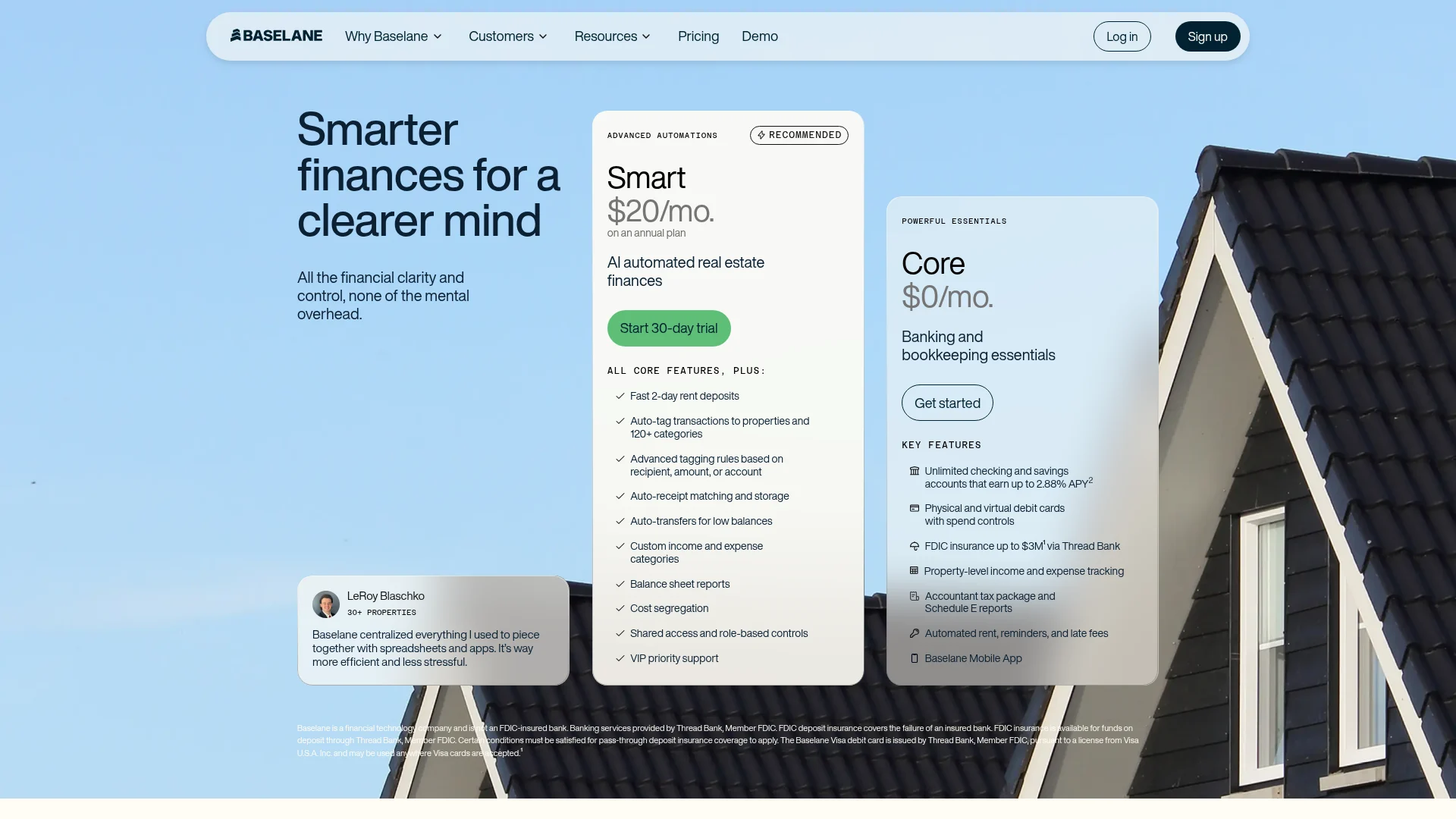
Baselane’s full fee schedule is published on its pricing page, and most of it is zeros. Account opening, monthly maintenance, minimum balance, inactivity, ATM use in the 55,000-machine Allpoint network, standard ACH, incoming wires, mobile check deposit: all $0. The lines that aren’t zero are the ones a landlord meets paying vendors: same-day ACH at 1% capped at $15, an outbound domestic wire at $15 (waived once your combined Baselane balance is $50,000 or more), $2 per mailed check, $15 per checkbook of 80.
The tenant side is where Baselane earns. ACH rent to an outside bank costs $2 per payment — you choose whether you or the tenant absorbs it, and it disappears entirely when rent deposits into a Baselane account. Cards run 3.49% on every plan, tenant-paid, unwaivable. Applicants pay from $24.99 for a basic screening package (application, ID verification, Equifax credit report), plus $5 for criminal, $10 for eviction, and $10 for income verification — and Baselane’s own help center confirms the landlord cannot cover or waive the application fee. Two smaller tenant-side lines most comparisons skip: rent reporting to credit bureaus at $5 a month, and split rent payments through its Livble feature at $30 or more a month for the tenant.
Stessa’s free plan carries no transaction fees the landlord ever sees. Its rent-collection help page is blunt about it: landlords never pay fees on successful rent payments. Residents pay $2 per ACH transaction to an external bank and 3% per card or debit transaction — and nothing at all on ACH payments that land in a Stessa Cash Management account. The costs live in the subscription wall instead: Schedule E reports, unlimited state-compliant leases, e-signatures, accelerated rent payments and priority chat all start at Manage, $12 a month billed annually. Receipt scanning is capped at five per month even on paid Manage; unlimited needs Pro at $28 a month. Outbound wires from Cash Management cost $5, no balance waiver games.
Both companies bank through the same partner — Thread Bank, Member FDIC, with pass-through insurance advertised up to $3 million per entity — so the safety story doesn’t separate them. What separates them is who pays for the software: Baselane’s margin comes off your float, Stessa’s off your invoice.
What $1,800 a month in rent actually costs
Fee structures only mean something per door. Price a single tenancy at $1,800 a month, the way a tenant actually pays:
| Cost line on one $1,800/mo tenancy | Baselane | Stessa |
|---|---|---|
| Tenant pays by ACH, into their own banking product | $0 | $0 |
| Tenant pays by ACH, to your outside bank | $24 | $24 |
| Tenant pays by credit card | $753.84 | $648.00 |
| Screening: three applicants, basic package | $74.97 | $87 (3 × $29 credit-only) or $147 (full package) |
| Landlord’s paid tier, one year | $0 (Core) | $0 (Essentials) |
| Landlord’s paid tier, one year, accounting unlocked | $240 (Smart) | $144 (Manage) |
| One outbound wire | $15, free above $50k balance | $5 |
Two lines decide it. The card gap is the tenant’s problem but it lands on your renewals: on one $1,800 tenancy, a card-paying tenant hands Baselane $105.84 more a year than Stessa would charge — worth a lease-clause nudge toward autopay either way. The accounting gap is yours: Baselane includes Schedule E reports on the free Core plan, while Stessa charges $144 a year for the same document. Stessa’s counter is that its paid plan is cheaper than Baselane’s at every portfolio size, because Smart is $240 whether you own two doors or fifty and Manage is $144 — and Stessa’s higher tiers buy features Baselane only sells as banking convenience.
Banking: Baselane’s home field
Baselane’s banking is the most differentiated thing either product offers, and it’s built for landlords specifically. You open unlimited checking and savings accounts — one per property, one for security deposits, one for reserves — without visiting a branch, each with its own virtual account number and optionally its own Visa debit card with spend controls. Checking balances earn nothing; savings earn tiered APY, 1.20% under $10,000 rising to 2.63% at $50,000 or more, plus a 0.35% boost when you collect rent through the platform (read off Baselane’s APY page on 3 November 2026). Bookkeeping is a side effect of the banking: every transaction arrives pre-tagged to a property, so categorization happens by construction rather than by feed.
The constraints are real and worth reading before you commit cash. Wire out and it’s $15 unless you keep $50,000 combined. A BiggerPockets thread from a landlord mid-renovation describes hitting $10,000–20,000 daily and $50,000 monthly transfer caps on a standard checking tier while trying to pay a roofing contractor — Baselane’s support head eventually replied on the thread confirming new accounts start on a standard tier with defined limits and a review process for raises. And r/Landlord carries a thread titled “Baselane Account Frozen Without Notice” describing a closure for “suspicious activity” with a 30–60 day check-disbursement wait for the funds. Fintech deposit accounts carry operational risk your local bank doesn’t; that’s the price of the APY.
Stessa’s Cash Management is a competent but shallower version of the same idea: one account rather than unlimited property-specific ones, up to 2.02% APY on free plans (3.49% on Pro, tiered by balance, rates effective 17 September 2026), 1.1% cash back on the debit card, and $5 wires. Its user base’s banking complaints are milder but exist — Trustpilot reviewers and r/realestateinvesting posters describe slow rent settlement (“5 days for rent to show up and another 5 days to transfer it out”) and a Cash Management account with no bill-pay or automatic ACH out.
Azibo was the third landlord-banking option, the one that attached rent collection to the business account. It has closed and pointed users at TurboTenant, so the Azibo comparison is now a record of what it offered rather than a live choice — which leaves this a two-way decision.
Bookkeeping: Stessa’s home field
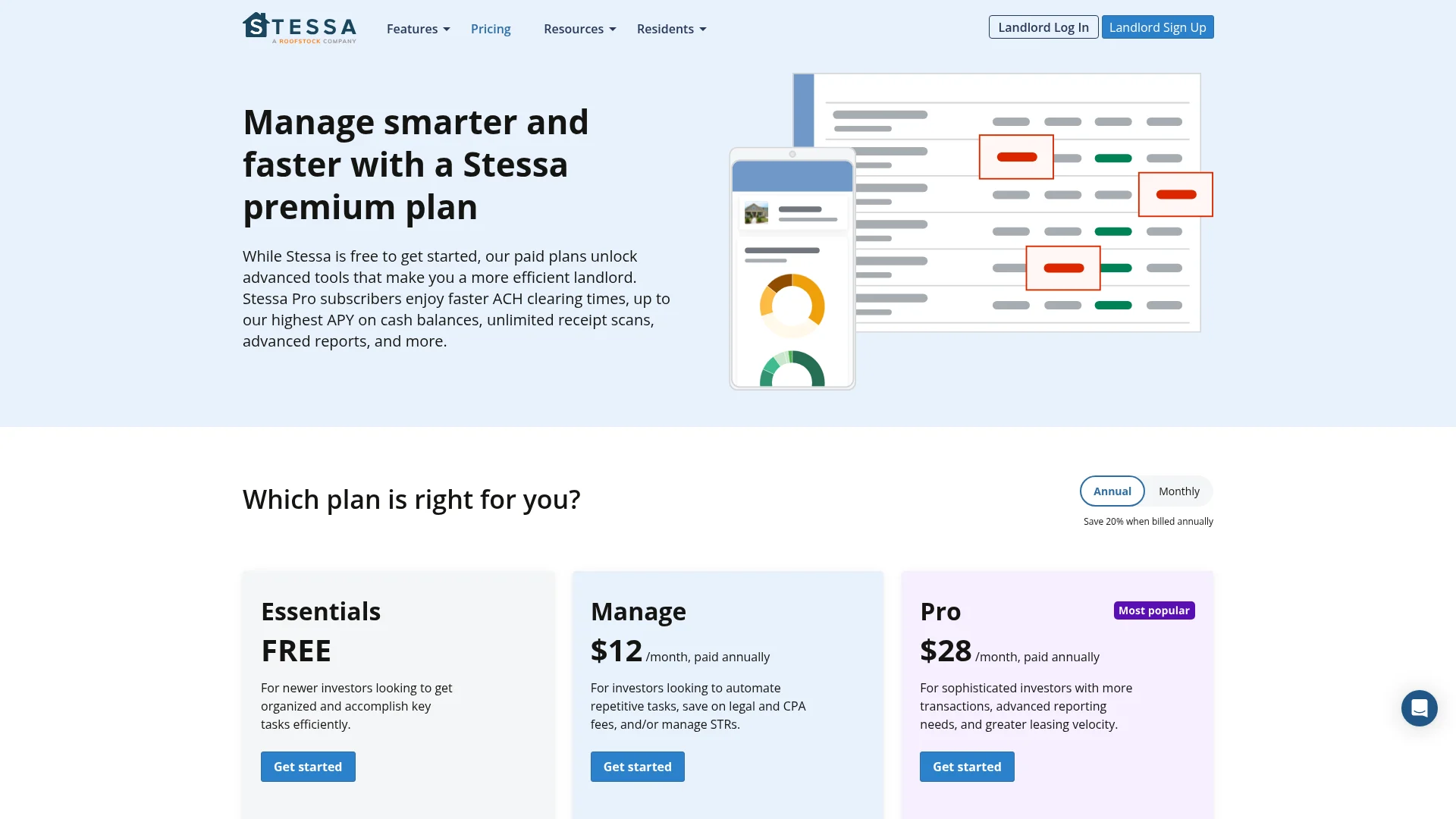
Stessa earns its reputation on the ledger, not the bank. Connect your existing checking, savings and credit cards, and Stessa imports and auto-categorizes transactions against IRS Schedule E line items, rolls them into income statements, net cash flow, cash-on-cash return and NOI by property or portfolio, and packages the year-end output in a Tax Center a CPA can read without translation. The dashboard and portfolio analytics are the most polished in the free tier of this category. The catch is the aggregator: Stessa imports through third-party feeds (long Yodlee, recently MoneyKit per its own community), and its forum has run threads titled “External bank connection problems [2025]” in which paying Pro customers report connections broken for two months or more, with manual CSV import as the suggested workaround. One bookkeeper on the forum says she instructs clients to disconnect bank feeds entirely and enter transactions by hand.
Baselane’s bookkeeping is good rather than great, and it is free where it counts. Schedule E reports and an accountant tax package ship on Core at $0 — the single sharpest fact in this comparison, given Stessa charges $144 a year for the same report. Smart ($240/yr) adds auto-tagging to properties and 120+ real-estate categories, custom tagging rules, receipt matching, balance sheets and cost segregation. Baselane also auto-generates 1099-K and 1099-INT forms; Stessa leaves 1099s to you. Where Baselane trails is depth and polish: reporting is thinner, there’s no budgeting or pro-forma tooling, and the categorization only shines if transactions actually flow through Baselane’s bank. Stessa’s tax package is the better artifact; Baselane’s is the better price.
Leasing and maintenance: Stessa’s, by default
This is where the “all-in-one” claims on both marketing pages need footnotes, and Baselane’s own comparison page supplies the honest one: lease creation and e-signing are marked “Legacy users only.” New Baselane users can upload and store signed leases and order screening, but cannot generate leases in the product. There’s no maintenance tracking at all, and no listing syndication — Baselane does not market your vacancy, period. It’s a financial platform, and the faster you evaluate it as one, the less disappointing it is.
Stessa runs the fuller front office: vacancy advertising with Zillow syndication, applications, screening through RentPrep ($29 for a credit or background report, $49 for the complete package, payable by either side), maintenance requests and tracking on every plan including free Essentials, and state-compliant lease templates — at cost on Essentials, unlimited included from Manage, with DocuSign e-signature capped at one document a month on Manage and seven on Pro. It’s still not a full property management system — no owner statements, no trust accounting, lighter on day-to-day tenant operations than the dedicated tools — but against Baselane it’s the only one of the two that handles a vacancy.
Unit-count fit: the flat-price exception
Everything else on this site prices software per door, because Buildium and DoorLoop make unit count the pricing axis. These two don’t: Baselane is $0 (or $240 on Smart) whether you have 2 units or 50, and Stessa is flat and unlimited on properties at every tier. That’s why they dominate the free/cheap searches.
Where unit count actually matters is structure. Baselane issues unlimited checking and savings accounts per property — and per entity — under one login, at no extra cost at any tier: an account per unit for deposits, a savings account for reserves, clean separation if you run two LLCs, and the books stay separated because the money does. Stessa’s equivalent is portfolios: Essentials and Manage hold one portfolio, and unlimited portfolios require Pro at $28 a month ($336/yr) — Stessa’s own pricing table confirms the cap. A landlord tracking multiple entities or wanting reports per LLC pays $336 a year on Stessa where Baselane costs nothing but account setup. Below ten doors none of this matters; between twenty and fifty, it’s the second-biggest differentiator after the Schedule E line.
Above roughly 50 units both tools thin out — neither does owner statements, trust accounting or a general ledger, and neither is built for managing other people’s properties. They’re owner-occupier and small-investor tools, priced like it.
What Reddit actually says
The honest read of community sentiment has to start with a disclosure problem: Baselane’s affiliate program seeds referral codes through r/Landlord and r/realestateinvesting, and in one r/realestateinvesting expense-tracking thread a user asked outright whether the uniformly positive replies were paid. Weight the praise accordingly — and note that the pattern of the genuine praise and the genuine complaints still tells a consistent story.
The genuine Baselane praise is about consolidation. The most useful testimonial isn’t a five-star review, it’s the r/Landlord landlord who moved from Stessa to Baselane and explained the accounting trigger: “With Stessa, I had to sign up for a one month subscription to get certain reports just for tax filing.” On a r/Landlord “Baselane vs Stessa…or something else?” thread, a three-year user wrote “I use Baselane and it’s been stellar,” while another recommended it with a caveat that doubles as the product’s thesis: “Baselane is the only platform I am aware of that has a banking solution, so if that part is critical for you, then they are the best choice. If you are more interested in background check/screening and rent collection, there are other options that are better/more affordable.”
The genuine Baselane complaints are about the bank being the product. The same r/Landlord threads contain “I don’t love that they try to force you into using their banking but I just work around that” and, more sharply, a long-time user’s verdict that the platform was “half baked, extremely buggy, unreliable and disorganized” with support that answers quickly and fixes slowly. The account-freeze and transfer-cap threads above complete that picture.
The genuine Stessa complaints cluster on bank feeds and support. Its own community forum’s bank-connection threads are the damning ones precisely because they’re on Stessa’s property, from paying Pro customers, some reporting months of broken imports. Trustpilot reviews repeat the same two notes — connections that break and lose history on reconnect, support that answers in days if at all — alongside genuine fans for whom the Schedule E workflow “changed the game.” One r/realestateinvesting commenter’s advice is the cleanest summary on either side: good software for accounting, “strongly discourage opening a bank account with them and keeping your money there” (comment on “If you’re considering Stessa - be aware,” May 2025).
Read together: Baselane’s reviews are arguments about banking, Stessa’s are arguments about syncing. Those are the two failure modes, and you’re choosing which one you’d rather live with.
FAQ
Is Baselane or Stessa actually free?
Both are $0 to the landlord, verified against each vendor’s pricing pages on 3 November 2026. The difference is the funding model: Baselane earns on deposits and card interchange through Thread Bank, so its free tier pushes you toward holding cash with it; Stessa earns on subscriptions, so its free tier gates the features (Schedule E, unlimited leases, e-signatures) that make you consider Manage at $144 a year. Neither charges the landlord payment fees; tenants pay $2 per ACH to an outside bank on both, plus 3.49% (Baselane) or 3% (Stessa) on cards.
Which one is better for taxes and Schedule E?
Baselane on price, Stessa on quality. Baselane generates Schedule E reports and an accountant tax package on the free Core plan and auto-issues 1099-K and 1099-INT forms. Stessa locks Schedule E behind the $144-a-year Manage plan, but its Tax Center output — income statement, cash flow report, Schedule E and supporting documents in one package — is the more cohesive artifact, and its portfolio reporting (SREO, budgeting, pro-forma) needs Pro. If a CPA bills by the hour of cleanup, Stessa’s package can be worth its subscription; if you just need a Schedule E and a ledger, Baselane’s is free.
Do I have to move my banking to use either one?
No on both, but free rent collection is only free through their accounts on both, too. Rent deposited into Baselane banking or Stessa Cash Management carries no ACH fee; rent to your outside bank costs $2 per payment on each platform. The asymmetry is in how hard each pulls: Baselane’s whole bookkeeping model works best when transactions flow through its accounts, while Stessa is designed to sit on top of your existing bank — with the bank-feed reliability issues that implies.
Which one should a landlord with 1–5 units pick?
If your problem is books and taxes, Stessa Essentials: connect your current bank, get a clean dashboard and upgrade to Manage only when you need Schedule E or leases — the paid plan costs less than Baselane Smart. If your problem is money management — separating deposits per property, earning 2.63% on reserves, paying contractors by check or ACH — Baselane Core, and read its transfer limits first. If your problem is finding and screening tenants, neither: the TurboTenant free plan syndicates listings and runs $55 applicant-paid screening at $0, which is the strongest free front office in the category. And if you have staff, owners, or trust accounting in your future, both are stops on the way to Buildium at $65 a month — price the destination before the stop.
The verdict
Pick Stessa if you want to keep your bank. Its free Essentials plan is the best pure bookkeeping deal in the category: unlimited properties, auto-categorized feeds, a polished dashboard, maintenance tracking and screening included at $0, with the upgrade path ($144/yr Manage) priced below anything Baselane sells. Accept that you’re buying its known weakness — third-party bank feeds that break, support that responds in days — and that the year-end tax package, its best feature, costs the subscription.
Pick Baselane if you’re willing to make it your bank. Core at $0 with a free Schedule E, unlimited property-specific accounts, 2.63% APY on reserves and 1% cash back is a genuinely strong financial stack for a landlord with $10,000 or more sitting idle. Read the constraints first: $15 wires below a $50,000 balance, tiered transfer caps on new accounts, and no leasing, listings or maintenance — it won’t run a vacancy.
Treat both as financial tools, not management tools, and be honest about the stop. For a 1–5 unit landlord the sequence that repeats across Reddit is spreadsheet, then one of these two, then a paid platform the day ownership or accounting complexity arrives. When that day comes, our comparison of the best property management software for small landlords prices what Rentec Direct at $25 flat and Buildium Essential at $65 actually cost at your unit count, and Buildium vs AppFolio covers the crossover past 50 doors.
Run your own numbers first — the cost calculator prices both of these alongside every paid competitor at your exact unit count, tenant fee lines included.