TenantCloud Alternatives After the TurboTenant Acquisition (2026)
TurboTenant bought TenantCloud in August 2026 and is migrating accounts automatically. Eight alternatives priced and compared by migration path, verified Nov 2026.

TurboTenant acquired TenantCloud on August 18, 2026, and existing TenantCloud accounts are being moved onto TurboTenant automatically — so the decision is no longer “stay or switch” but “accept the migration or choose your own destination.” If you’d rather choose, three picks cover most portfolios: Innago for a free replacement with the cheapest tenant fees, RentRedi at $144 a year flat for portfolios that keep growing, and Rentec Direct for landlords who paid for software because of the books. Prices read from the vendor’s pages on November 10, 2026.
Disclosure: Landlord Method doesn’t earn a commission from any platform in this guide — none of these affiliate programs is live on this site. Prices and fees below come from the vendors’ own pages, each dated to the day it was read.
Quick answer: which alternative fits which landlord
| Pick | What it costs the landlord | Why it fits a displaced TenantCloud user | |
|---|---|---|---|
| Best free alternative | Innago | $0, unlimited units | Same $0 model as TurboTenant, the same $2 tenant ACH, cheaper screening ($30–35 vs $45–55), phone support included, no upgrade ladder |
| Best for 10–50 units | RentRedi | $144/yr flat, any unit count | TenantCloud’s lease caps force upgrades at 11, 31 and 61 leases; RentRedi’s price never moves |
| Best for accounting | Rentec Direct (below 34 units), Buildium (from 34) | $25–$100/mo; $65/mo+ | Double-entry books at Rentec; full ledger, trust accounting and owner statements at Buildium — the depth TenantCloud locks behind Pro at $600/yr. Rentec’s $2.50-per-unit PM tier passes Buildium’s $84 at 34 units |
| Cheapest migration | The automatic TurboTenant migration itself | $0 — existing plan honored | TurboTenant’s transition guide honors your TenantCloud subscription on TurboTenant Pro at no further charge; among exits, Innago costs $0 and Rentec includes free setup |
Why landlords are looking at alternatives in 2026
TurboTenant announced the TenantCloud acquisition on August 18, 2026, terms undisclosed (ACCESS Newswire; ColoradoBiz, August 21, 2026). TenantCloud had been owned since 2021 by PropertyTek, the company behind ShowMojo and Tenant Turner (BizWest, August 18, 2026). TenantCloud is the absorbed brand, not the surviving one: TurboTenant’s transition guide walks existing landlords into TurboTenant accounts.
Per TurboTenant’s transition FAQ (read November 10, 2026), property and tenant records, bank accounts, payment methods, payment history and lease documents transfer. Screening reports, past applications, maintenance requests and message history do not — they stay view-only in TenantCloud. The migrated account starts on TurboTenant Pro with your previous subscription honored “at no further charge,” and ACH fees TenantCloud invoiced separately are deducted from each rent payout instead — the deposit looks smaller, nothing is missing.
For many users it’s a quiet upgrade: TurboTenant Pro includes the accounting suite — Schedule E export, automatic bank import — that TenantCloud gates behind its $600-a-year Pro plan, at your current price. But the non-transferring parts are the ones an operation with history relies on, and nothing published says what you’ll pay when the honor period ends; TurboTenant bills in unit bands, so a 30-lease landlord sits in Pro’s $399 band if it lapses. TenantCloud still sells all four plans at the old prices — Starter $180, Growth $350, Pro $600 a year, Business from $100 a month — with no acquisition notice anywhere, so nobody can say what a contract signed today buys.
Our TenantCloud review covers the platform as it was; the TurboTenant review covers where the migration takes everyone.
The best TenantCloud alternatives
TurboTenant: the sister product you’re already being moved to
TurboTenant is not an escape from the acquisition — it is the acquisition. It earns an entry on price: the migration is the cheapest move available. Free: $0 to the landlord, unlimited units, tenants pay $2 per ACH and 3.49% on cards, applicants pay $55 for screening on Free and $45 on paid plans — the page shows both, in different blocks (read November 10, 2026). Pro runs $199 a year for 1–10 units, $399 for 11–30, $699 for 31–60 and $999 for 61+, annual-only, and unlocks Schedule E and Form 8825 export, bank import and the ACH waiver (TurboTenant’s fee article, November 10, 2026). Deposits land in 2–4 business days; the Free tier’s reported 5–10-day payouts are its most-cited complaint, thin listing reach the other. Our TurboTenant review documents where free breaks.
RentRedi: the flat bill for growing portfolios
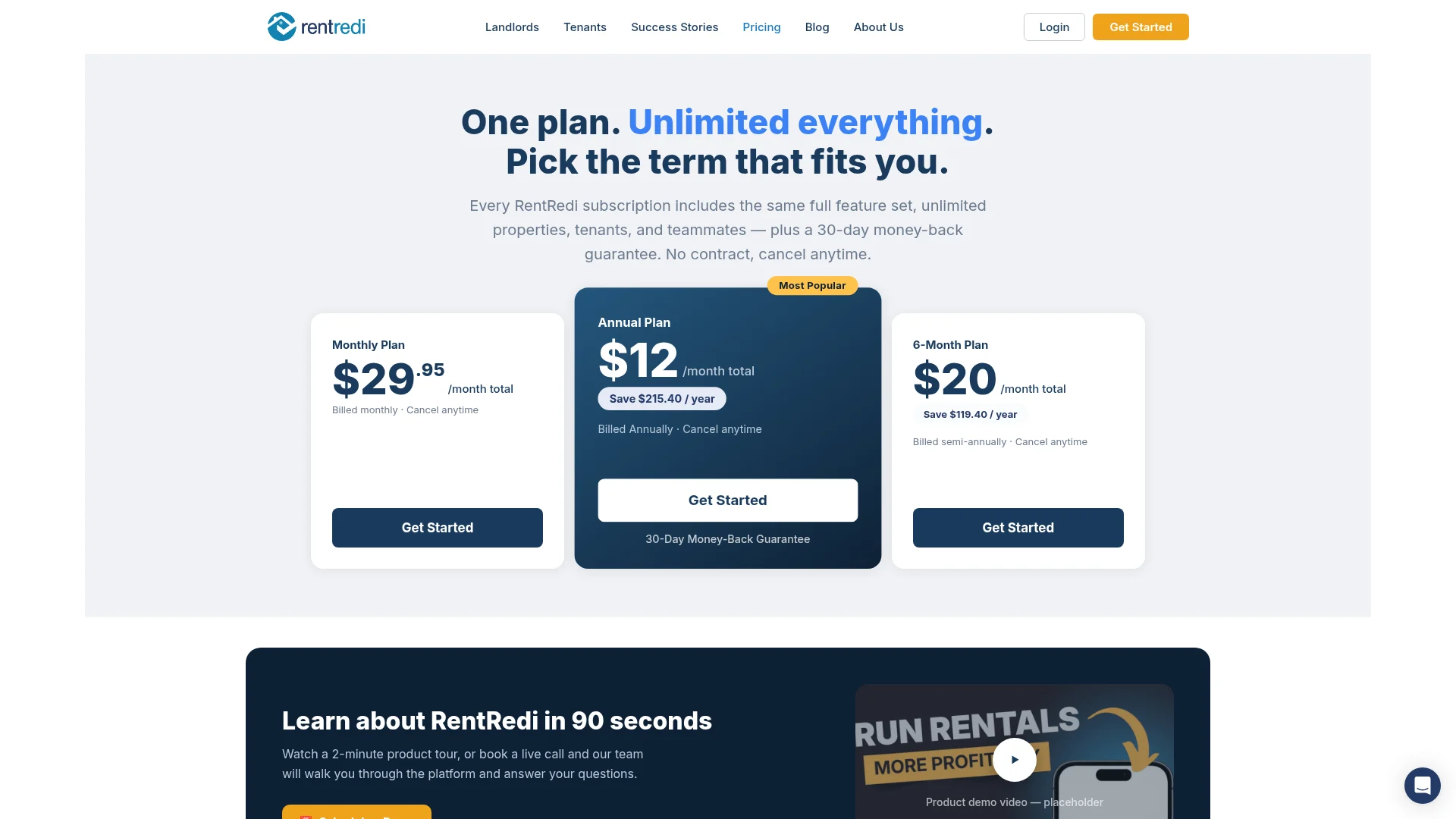
One plan, three billing terms: $12 a month billed annually ($144 a year), $20 on a 6-month term, or $29.95 monthly — flat at 1 unit or 100 (RentRedi’s pricing page, November 10, 2026). Tenants pay $1 per ACH, the lowest here, or 3.1% plus 30¢ on cards; applicants pay $39.99 for TransUnion screening; payouts run 2–3 days (fee schedule, read November 4, 2026). This is the answer for a lease count creeping toward TenantCloud’s next cap: the ladder — $180 at 10 leases, $350 at 11, $600 at 31, Business above 60 — punishes growth, while RentRedi’s bill never moves, even past a hundred doors. Trade-offs: no native lease builder, thin reporting, Latchel maintenance coordination priced separately (plans start at $25 a month plus a per-unit fee), and 2025–2026 Reddit threads about diverted deposits after account takeovers — individual accounts, not a verified pattern. Our RentRedi vs TurboTenant comparison prices both at every unit count.
Innago: the free one with the cheapest tenant fees
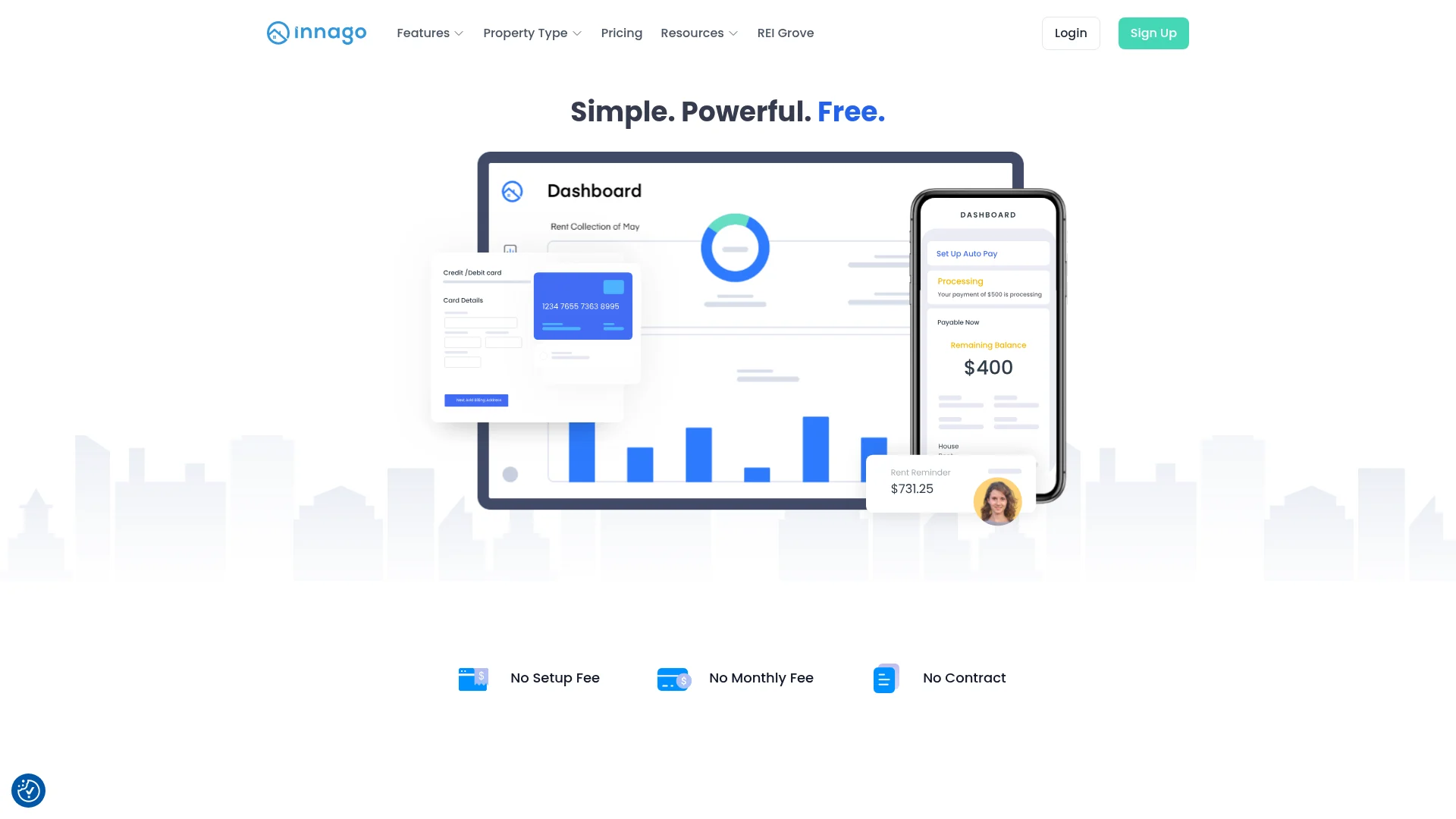
Innago costs landlords nothing — no subscription, setup fee, contract, unit cap or paid tier to be upsold into (innago.com, November 10, 2026). Tenants pay $2 per ACH or 2.99% on cards; applicants pay $30–35 for screening plus $10 for income verification. Support is phone, email and chat on weekdays; Capterra sits at 4.9 across 539 reviews (November 2, 2026), the highest here. It’s the least disruptive free option: portal, tenant app, e-signed leases, maintenance tickets, QuickBooks sync, no upgrade decision. What you give up: bookkeeping depth — no reconciliation, no trust accounting, no clean ledger PDFs — and payout holds, with first payments, new funding sources and post-failure payments sitting three days against the FAQ’s promise of 1–2. Our Innago review has the full math.
Avail: the leasing workflow pick
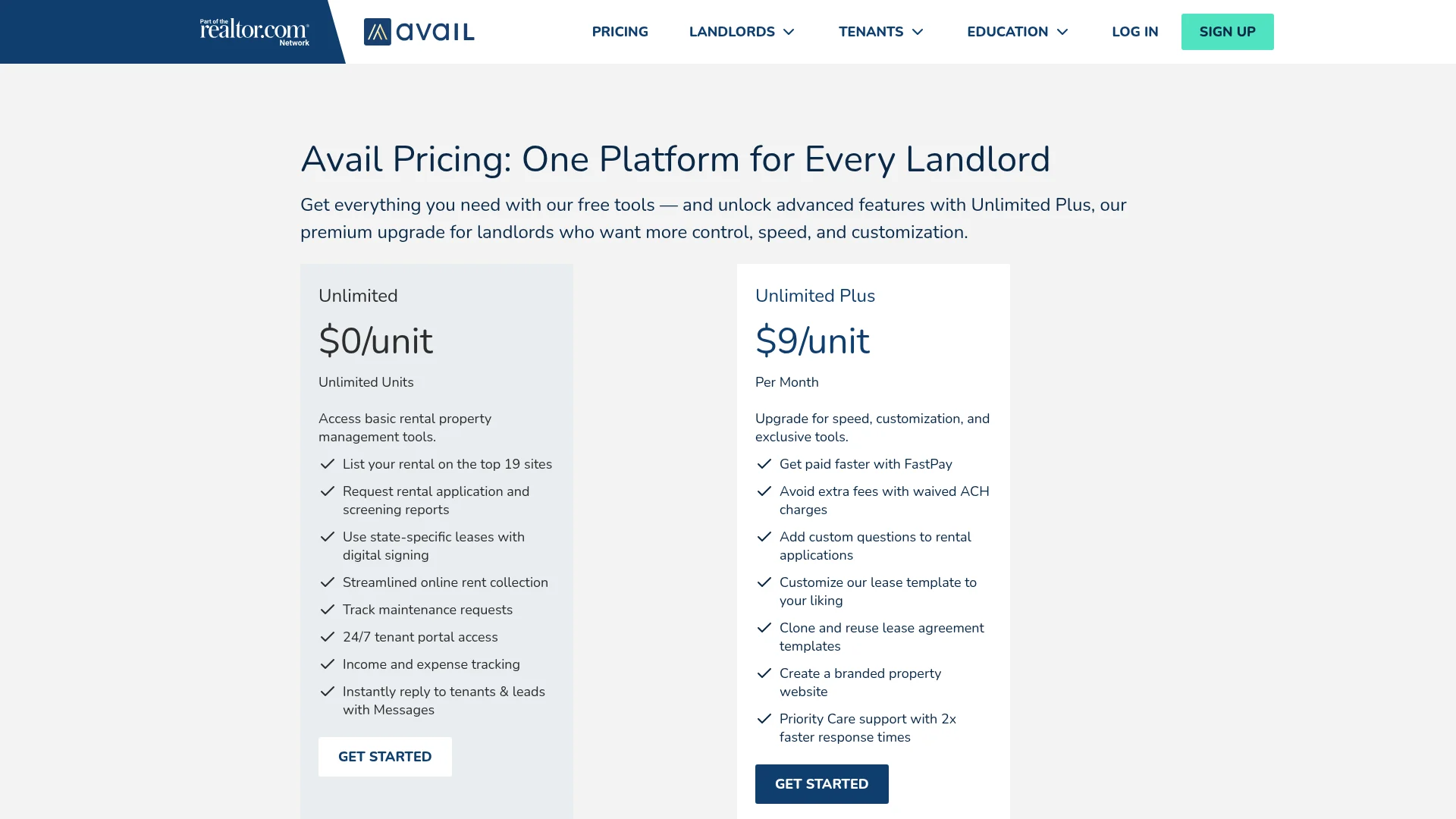
Avail, part of Realtor.com Rentals, is $0 per unit with lawyer-reviewed state-specific leases, syndication, applications and screening included; Unlimited Plus runs $9 per unit per month and waives the tenant’s $2.50 ACH fee (avail.com/pricing, November 10, 2026). It fits the TenantCloud landlord whose core complaint was leasing paperwork — the lease templates are the best in this price range, included rather than metered. It fits worst if accounting is why you pay: Avail is the thinnest of the eight on the books, and its direction since the Realtor.com deal runs toward listing reach. Best at 1–10 units. Our Avail review details the screening tiers.
Buildium: the step up for real books
Buildium Essential starts at $65 a month for up to 20 units, $84 from unit 21; Growth is $202 to 50 units, $265 from 51. Incoming bank payments cost the landlord $2.35/$1.35 unless shifted to tenants, and Growth-and-above plans require paid, unpriced onboarding (buildium.com calculator, November 10, 2026). This is the exit for the TenantCloud user who hit the Pro gate — reconciliation and tax reports at $600 a year — and wants what that money was pretending to buy: a full general ledger, native trust accounting, owner statements and 1099 e-filing on one platform. Below 20 units it’s hard to defend; from 20 up it’s the benchmark. Our Buildium review has the complete fee stack; our Buildium alternatives guide covers exits from that platform.
Rentec Direct: the accounting answer
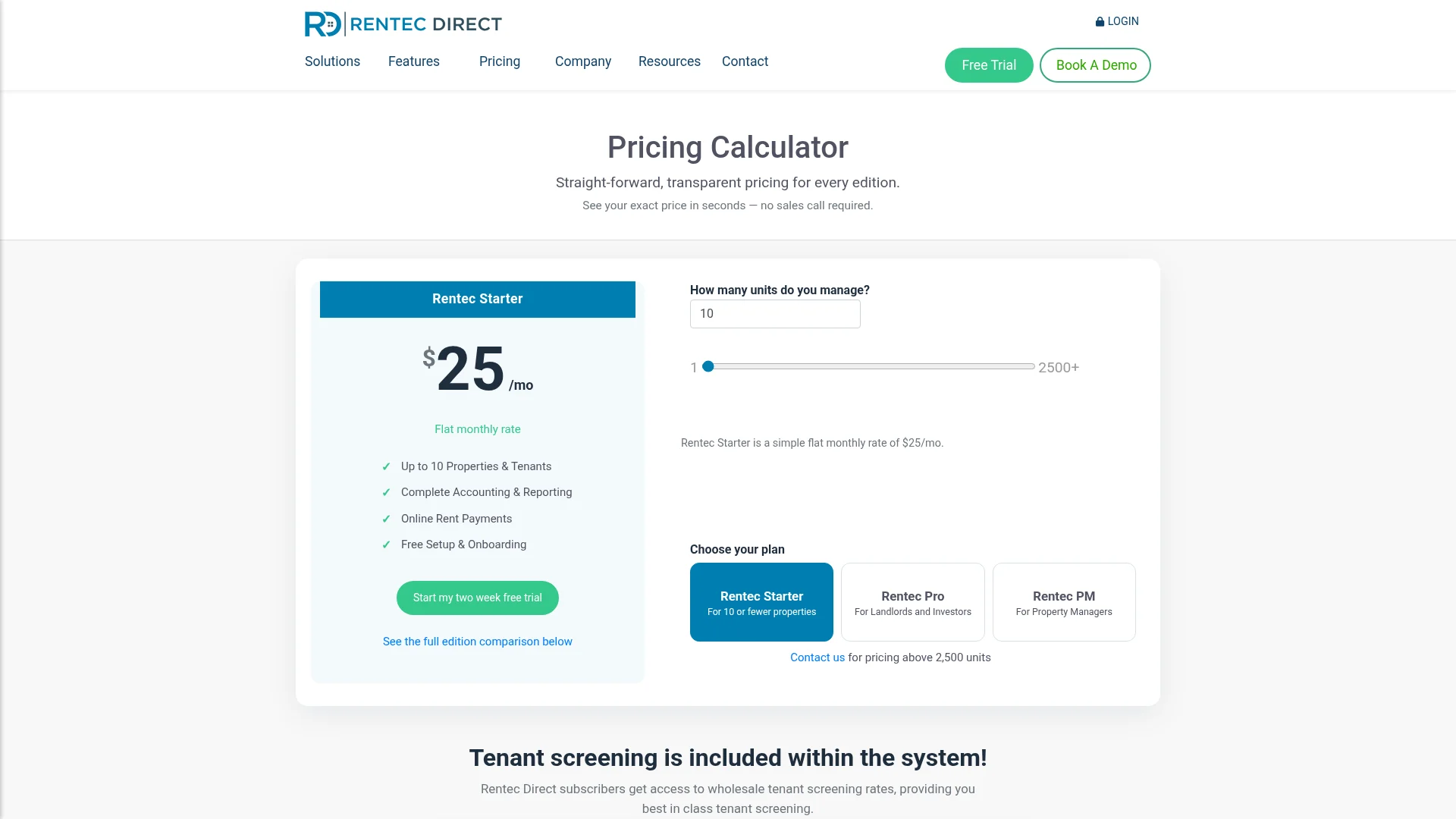
Starter is $25 flat for up to 10 properties with complete double-entry accounting. Pro and PM both start at $50 a month and price by unit from there — $80 at 40 properties on Pro, what its calculator returned on November 10, 2026 — and PM at $2.50 per unit adds trust accounting and owner ACH (rentecdirect.com, November 10, 2026). Setup and onboarding are free on every plan. Rentec is the cheapest real accounting in the category for a TenantCloud user whose books live in a spreadsheet; the interface looks a decade older than it is. Migration note: the Starter cap counts properties, not leases.
Baselane: free books with a banking catch
Baselane Core is $0 with unlimited properties and includes Schedule E reports free — the one free tier here that produces the tax document without a paid upgrade. Smart is $20 a month billed annually ($240/year flat). Tenants pay $2–$5 per ACH to an outside bank, $0 when rent lands in a Baselane account; cards run 3.49%, tenant-paid; screening starts at $24.99 (baselane.com, November 10, 2026). The catch is structural: free rent collection works best when you bank with Baselane, a fintech deposit product with transfer caps, a $15 outbound wire below a $50,000 balance, and documented cases of accounts frozen for 30–60 days. If tax reports were the reason you paid, Core is free accounting — read those constraints first.
DoorLoop: the full platform for 40+ doors
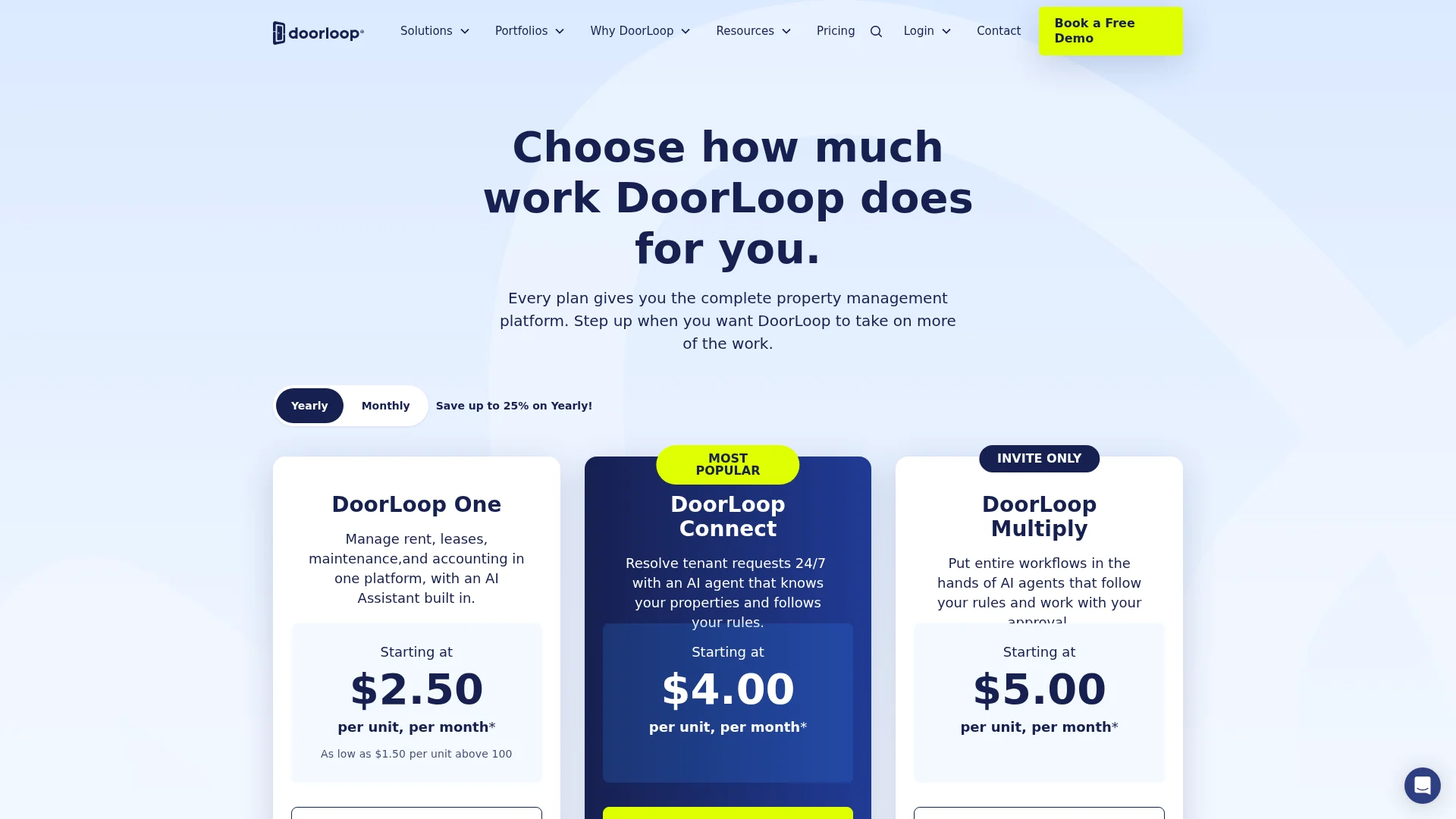
DoorLoop One starts at $2.50 per unit per month on annual billing, dropping to $1.50 above 100 units (doorloop.com/pricing, November 10, 2026) — our DoorLoop pricing page works the bands out to a yearly invoice. The plan cards stopped publishing a minimum spend on November 9, 2026 (“Minimum spend and units apply. Contact us for details”); the last published figure was $199 a month, where the floor sits below roughly 80 units. Every plan carries the same platform — accounting, leasing, maintenance, portals, unlimited users; tenant-paid ACH is $1.50. So it’s wrong for a 5-unit escapee and right for a 50-unit landlord who wants one modern system instead of TenantCloud’s plan ladder. Cancellation runs through a chatbot and a form — export first — and its 3.7 Trustpilot score (277 reviews, November 4, 2026) trails this field.
TenantCloud vs the alternatives
| Platform | Landlord’s price | Tenant pays per ACH | Accounting depth | Migration from TenantCloud |
|---|---|---|---|---|
| TenantCloud (incumbent) | $180–$600/yr by lease count; Business from $100/mo (10 Nov 2026) | $1.50–$1.95 | Basic until Pro ($600/yr) adds reconciliation and tax reports | Being migrated to TurboTenant automatically; read-only after |
| TurboTenant | $0; Pro $199–$999/yr by unit band | $2 (waived on Pro) | Schedule E export on Pro only | Automatic; plan honored at no charge; screening history stays behind |
| RentRedi | $144/yr flat | $1 | Light — no double-entry ledger | Manual: upload leases, re-enter properties |
| Innago | $0 | $2 | Expense tracking, QuickBooks sync | Manual setup; no bulk import |
| Avail | $0/unit; Plus $9/unit/mo | $2.50 (waived on Plus) | Thinnest of the eight | Manual; lawyer-reviewed leases restart your documents |
| Buildium | $65 to 20 units, $84 from 21; Growth $202 to 50, $265 from 51 | $2.35/$1.35 landlord-paid default | Full ledger, trust accounting, owner statements | Export reports; paid onboarding at Growth+ |
| Rentec Direct | $25 flat to 10 properties; Pro/PM from $50 (Pro $2/unit) | $2 landlord-paid on Starter | Double-entry books; trust accounting on PM | Free setup on every plan |
| Baselane | $0; Smart $240/yr flat | $2–$5 (or $0 into Baselane bank) | Free Schedule E on Core; banking-based books | Manual; banking move optional but incentivized |
| DoorLoop | $2.50/unit; minimum unpriced since 9 Nov 2026 (last published $199/mo) | $1.50 tenant-paid | Trust accounting included | Manual; cancellation (when leaving DoorLoop) is not self-service |
Migrate to TurboTenant, or leave entirely
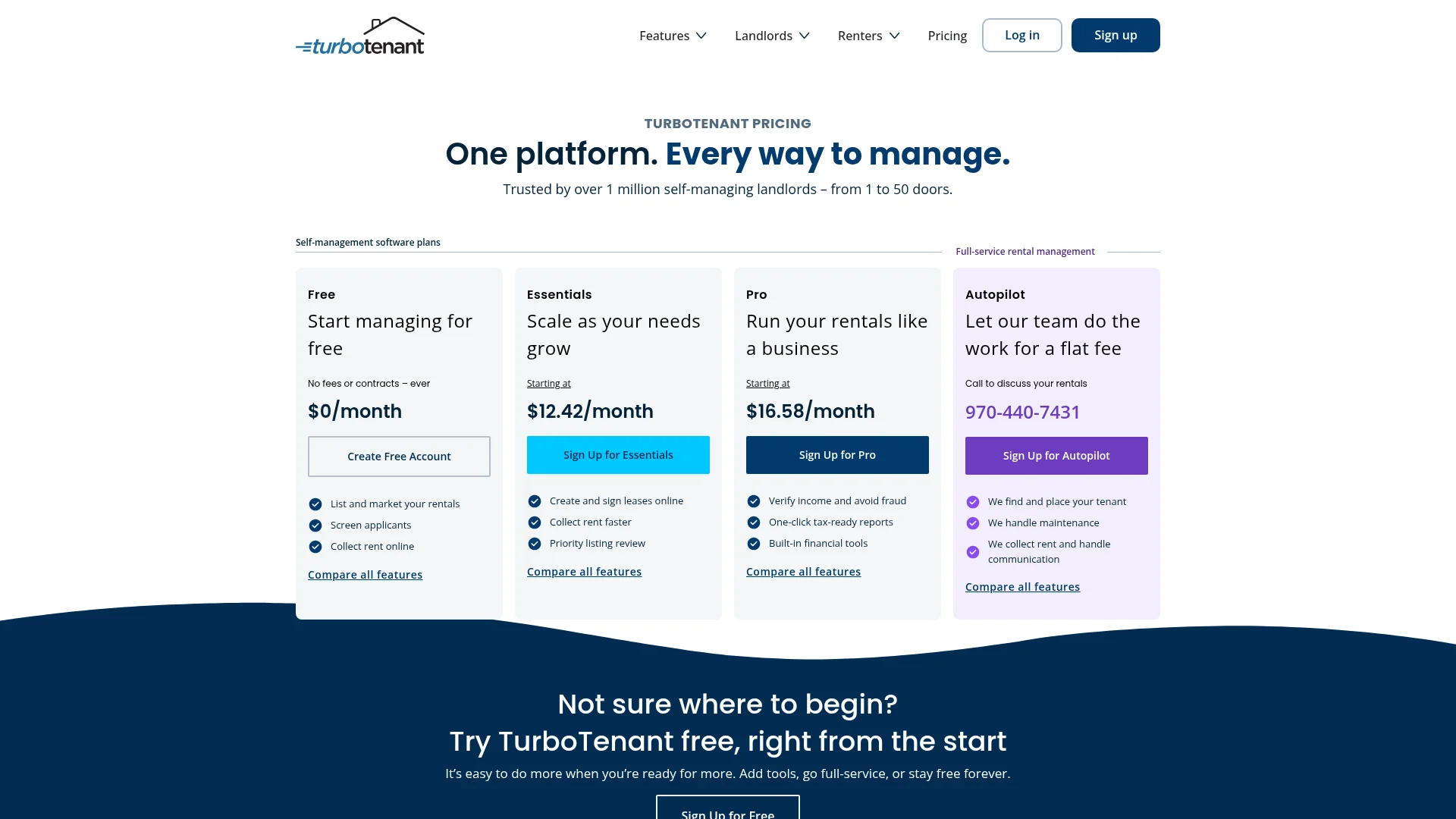
Staying — letting the automatic migration run — puts you on TurboTenant Pro at your honored TenantCloud price, with the accounting suite unlocked: Schedule E and Form 8825 export, bank import, the tenant ACH fee waived. Pro lists at $199 a year for 1–10 units, $399 for 11–30, $699 for 31–60 and $999 for 61+, and Essentials at $149/$199/$299/$349 on the same bands (verified November 10, 2026). A TenantCloud Pro customer with 31–60 leases pays $600 today and lands on a plan listing at $699 — a raise only if the honor lapses. A Starter user with 10 leases lands on the $199 tier while paying $180.
Leave instead if you’re above 60 leases, where Business starts at $100 a month and TurboTenant’s Pro band tops out at $999 — price both. Or if you were on TenantCloud for accounting depth that Starter and Growth never delivered; Rentec, Buildium and Baselane all do books better at comparable money. Or if you want a vendor whose roadmap answers to landlords rather than to a consolidation strategy.
Migrating off TenantCloud
Export first. TenantCloud’s help center and its pricing FAQ both document exporting leases, transactions, reports and documents before closing an account (read November 10, 2026). Run it while the account is fully active — after the migration email it is read-only, and your export window depends on TurboTenant’s goodwill. Payment history matters most: it’s the record your CPA and a small-claims judge may both ask for.
Then rebuild. None of the seven publishes a TenantCloud-specific import tool: Innago, Avail and RentRedi expect manual setup from your export, Rentec includes free setup help on every plan, and Buildium sells onboarding at Growth and above. Budget an evening per 10 doors.
Check four things before you switch: your active-lease count (TenantCloud caps leases, not units — alternatives may count differently); which tenants are on autopay and when the next charge runs; whether a renewal falls inside your switch window; and what your annual plan still owes you — TenantCloud bills annually upfront and no alternative advertises a prorated credit. One more from TurboTenant’s warnings: don’t create a TurboTenant account yourself before the welcome email; it can break the data transfer.
FAQ
Did TurboTenant buy TenantCloud?
Yes — announced August 18, 2026, with financial terms undisclosed (ACCESS Newswire; ColoradoBiz, August 21, 2026). TurboTenant had previously acquired REI Hub and Azibo. Existing accounts are being transitioned, after which TenantCloud is a read-only archive for historical data.
Is TenantCloud still supported?
As of November 10, 2026, yes: the pricing page is live at $180/$350/$600 a year for Starter/Growth/Pro and still takes new trials, with no acquisition notice anywhere. Existing accounts are being migrated to TurboTenant and go read-only after transfer, and nothing public says what a contract signed today is worth once that completes. The TurboTenant review covers what migrated users land on.
What are the best free TenantCloud alternatives?
Innago, TurboTenant and Avail are all $0 to the landlord. Innago has the cheapest tenant-side costs ($2 ACH, $30–35 screening), TurboTenant the widest listing reach — and the migration is already happening to it — and Avail the best included leases ($2.50 tenant ACH). All three are weak on accounting.
What’s the cheapest TenantCloud alternative?
On the landlord’s invoice: TurboTenant Free or Innago at $0. The cheapest paid alternative is Rentec Direct Starter at $25 a month flat (up to 10 properties) with real double-entry accounting, or RentRedi at $144 a year flat with no unit cap. TenantCloud’s own $180 Starter annual plan remains the cheapest paid full platform, for now.
Which alternative is best for a small portfolio?
One to ten: Innago for free operations, Avail for leasing paperwork, Rentec Starter at $25 when books matter. Ten to fifty: RentRedi’s flat $144 removes the upgrade anxiety; Rentec’s PM tier stays the accounting pick below 34 units, Buildium above. Our small-landlord software comparison prices all of these at your exact unit count.
The verdict
The migration is the decision. If TurboTenant Pro at your honored price covers what TenantCloud covered, letting it run costs a weekend of setup and nothing else — export everything first. If the consolidation is why you’re leaving, Innago is the cleanest free exit, RentRedi the cleanest flat-priced one, and Rentec Direct the one that finally buys real books.