TurboTenant vs Avail: Both $0, Two Different Bills (2026)
Avail's $0 plan includes leases TurboTenant's free tier can't send. TurboTenant Pro's $199 flat beats Avail Plus from two units up. Full 3- and 10-unit math, 10 Nov 2026.

Both platforms cost the landlord $0 on paper. What separates them is what the free tier lets you finish. Pick Avail if your year includes signing a lease: Unlimited includes state-specific leases, e-signing and screening from $30 a report at $0 a month (avail.com/pricing, 10 November 2026), where TurboTenant’s free tier can build a lease but cannot finalize or send one without a paid plan starting at $149. Pick TurboTenant if you’ll pay for anything, or manage more than five doors: Pro bills $199 a year flat to ten units, waives the tenant’s $2 bank-transfer fee, and runs $334 all-in at ten units against $465 for Avail’s free plan.
Disclosure: Landlord Method doesn’t earn a commission from TurboTenant or Avail — no affiliate program for either is live on this site. Every price below comes from the vendors’ own pricing and help-center pages, read on 10 November 2026.
Quick comparison
| TurboTenant | Avail | |
|---|---|---|
| Landlord’s bill (10 Nov 2026) | Free $0. Essentials $149–$349/yr, Pro $199–$999/yr, annual only | Unlimited $0/unit, no cap. Plus $9/unit/mo, billed monthly |
| Free tier finishes | Listing, screening, rent, maintenance — no sendable lease | The whole cycle, lease and e-sign included |
| Listing syndication | 26 sites incl. Realtor.com, Redfin, Craigslist; no Zillow | 19 sites incl. Realtor.com, Zumper, Rent.com; no Zillow |
| Paid listing boost | Boost Marketing, a paid-plan feature | Promoted Listings, an add-on priced by market |
| Screening | $55 on Free, $45 on paid; Pro adds custom questions | $30 any single report, $55 all three |
| Leases and e-signature | Build free; sending needs Essentials or Pro | Included on both plans |
| Maintenance | Requests, tracking, Maintenance AI | Tickets, photo uploads, vendor forwarding |
| Accounting | Manual on Free; Schedule E and P&L on Pro only | Income and expense log, CSV only |
| Mobile app | Landlord and tenant apps | None — mobile browser |
| ACH payout | 5–7 days; 2–4 expedited on paid plans | 3 days; next business day on Plus |
| Phone support | Essentials and Pro | All plans |
Pricing compared
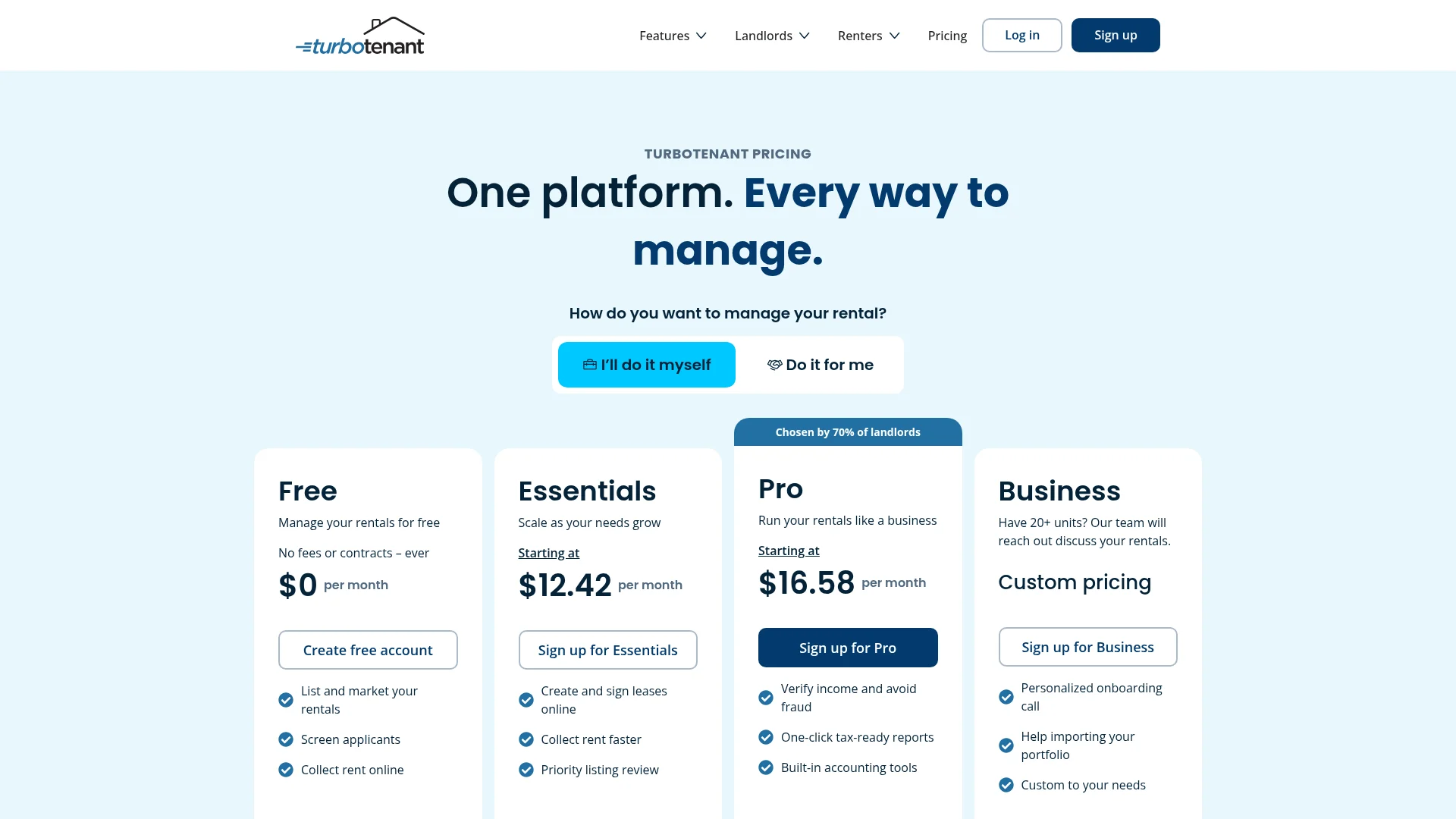
TurboTenant prices by band; Avail prices by the unit, and the shapes barely overlap. TurboTenant’s paid plans bill annually only, and its help center publishes the ladder outright: Essentials $149/yr at 1–10 units, $199 at 11–30, $299 at 31–60, $349 at 61+; Pro $199, $399, $699, $999. The “$12.42/month” on its pricing page is $149 divided by twelve — a monthly equivalent, not a billing option. At 20 units a custom-priced Business tier takes over, and the company also sells services: tenant placement at $1,500 one-time per vacancy, and Fully Managed Autopilot at $250 a month plus $100 for each additional unit — figures from its help center article dated 29 September 2026, since the pricing page quotes Autopilot by phone.
Avail runs two plans and no bands: Unlimited at $0 per unit with no ceiling on units, and Unlimited Plus at $9 per unit per month — $108 per unit per year, billed monthly, no annual discount published.
The other half of both invoices is paid by tenants and applicants, because both companies make money there. On TurboTenant, renters pay $2 per ACH payment on Free and Essentials (waived on Pro) and 3.49% on cards on every plan; applicants pay $55 to be screened on Free and $45 on paid. On Avail, tenants pay $2.50 per bank transfer on Unlimited (waived on Plus) and 3.5% on cards on both plans; applicants pay $30 for one report or $55 for all three. Both fee schedules are laid out in full in our TurboTenant review and our Avail review.
Worked example: $1,500 rent per unit, every tenant paying by bank transfer twelve times a year, one turnover with three applicants screened, one lease signed. Free tiers first:
| Annual cost line | TurboTenant Free | Avail Unlimited |
|---|---|---|
| Landlord subscription | $0 | $0 |
| Tenant ACH fees, 3 units (36 payments) | $72 | $90 |
| Tenant ACH fees, 10 units (120 payments) | $240 | $300 |
| Screening (3 applicants) | $165 | $165 |
| State-specific lease | Not available | Included |
| All-in, 3 units | $237, and no lease | $255 |
| All-in, 10 units | $405, and no lease | $465 |
Then the paid plans:
| Annual cost line | TurboTenant Essentials | TurboTenant Pro | Avail Plus |
|---|---|---|---|
| Subscription, 3 units | $149 | $199 | $324 |
| Subscription, 10 units | $149 | $199 | $1,080 |
| Tenant ACH, 3 units (36 payments) | $72 | $0 | $0 |
| Tenant ACH, 10 units (120 payments) | $240 | $0 | $0 |
| Screening, 3 applicants | $135 | $135 | $165 |
| State-specific lease | Included | Included | Included |
| All-in, 3 units | $356 | $334 | $489 |
| All-in, 10 units | $524 | $334 | $1,245 |
Four things fall out of those tables.
At three units, Avail’s free plan is the cheapest complete year — $255 against TurboTenant Pro’s $334 — because the lease is included and the tenant fees land on only 36 payments. TurboTenant Free’s $237 doesn’t count: you can list, screen and collect on it, but a landlord with a lease to sign can’t finish the year there.
At ten units, TurboTenant Pro is cheaper than Avail’s free plan. Pro’s $334 is the same number at three units and at ten, because the ACH fee is waived and the subscription doesn’t move inside the 1–10 band. Avail Unlimited hits $465 on tenant fees alone. The crossover is around six units: at $30 a unit a year in tenant ACH fees against Pro’s fixed $199, Avail’s free plan stays ahead until five doors and loses from six to ten. Then TurboTenant’s band jump to $399 hands two units back — at eleven and twelve units Avail Unlimited is again the cheaper all-in year, before Pro retakes the lead at thirteen and holds it into the sixties.
Avail Plus is the expensive way to be patient. $9 per unit per month is $1,080 at ten units and $2,700 at twenty-five, for FastPay, clause editing and custom application questions. TurboTenant Pro at $199 with waived ACH fees and $45 screening costs $334 against Avail Plus’s $1,245 at ten units — a $911 gap. Plus is worth pricing only for the speed, not the arithmetic.
Cards are a wash and neither is waivable. 3.49% at TurboTenant against 3.5% at Avail is $52.35 versus $52.50 on a $1,500 payment, on every plan from both companies. The steering decision that actually moves money is bank transfer versus card, and it’s worth more than either subscription.
Listing and tenant-finding compared
TurboTenant casts the wider net; Avail publishes the shorter list and sells placement on it. TurboTenant’s help center names 26 advertising partners — Realtor.com, Redfin, Apartments.com, Craigslist, Zumper, Rentler, Rent.com, Dwellsy and more — plus SpareRoom for room rentals. The list comes with caveats the marketing pages skip: Apartments.com only accepts properties with fewer than five units through TurboTenant, and TurboTenant can push at most eight actively marketed listings per account there. TurboTenant also does not publish self-managed listings to Zillow at all; leads can arrive labelled “Zillow Group” because a partner like HotPads or Trulia picked the listing up.
Speed differs by plan and by nothing else. Free listings sit up to 48 hours in TurboTenant’s internal review before going to partners, which is why a vacancy takes three to four days to appear across the web. Boost Marketing — a paid-plan feature, not a per-listing fee — moves the listing to the front of that queue, cutting the wait to two or three days.
Avail syndicates to 19 sites, including Realtor.com, Redfin, Zumper, PadMapper, Rent.com, ApartmentGuide and Rentler, and its listings can carry an “Apply Now” button on Realtor.com that lands the application back in Avail. What the free plan doesn’t buy is prominence: Promoted Listings, Avail’s paid add-on, buys placement at the top of partner search results across the Realtor.com and Zumper networks, priced by market rather than published. The claim attached to it — up to 10x reach — is Avail’s own marketing, and there is no independent number behind it.
Neither list includes Zillow. If your market looks on Zillow, both tools need a listing posted there separately — TurboTenant’s HotPads and Trulia reach is the closest either comes.
Screening compared
Both run TransUnion reports, both default the fee to the applicant, and both can absorb it. The difference is the price ladder and what sits in front of it.
TurboTenant bundles credit, criminal and eviction at $55 on Free and $45 on any paid tier, with automatic pre-screeners and fraud detection ahead of the paid report. Custom pre-screener questions and income verification are Pro-only. The fee is non-refundable once reports run, and the landlord can choose to cover it — through “Screen a Tenant,” which orders a screening report without the full application, at a price TurboTenant sets and won’t let you change. Three applicants for one vacancy costs $165 on Free, $135 on paid.
Avail sells the same three reports as a bundle for $55, or any single one for $30, with no published two-report price. TransUnion sets the figure against the listing’s location, so state caps on application fees can push it below both numbers. Reports are non-refundable once generated, but a rejected applicant can share them with other Avail landlords free for 30 days — a softener TurboTenant doesn’t advertise. Landlords can pay instead of the applicant here too.
Per screening decision the free tiers tie at $165, and the paid comparison goes TurboTenant’s way at $135 against $165. Where Avail wins is the shallow pull: $30 for a credit report alone is the cheapest real report in the pair, which is the right buy when you’re re-screening a known quantity rather than vetting a stranger — three of those cost $90 instead of $165. If you’d rather not tie screening to a management platform at all, the standalone services are priced per report, from SmartMove’s $25 basic to $55 for a full bundle.
Leases, e-signature, and state forms
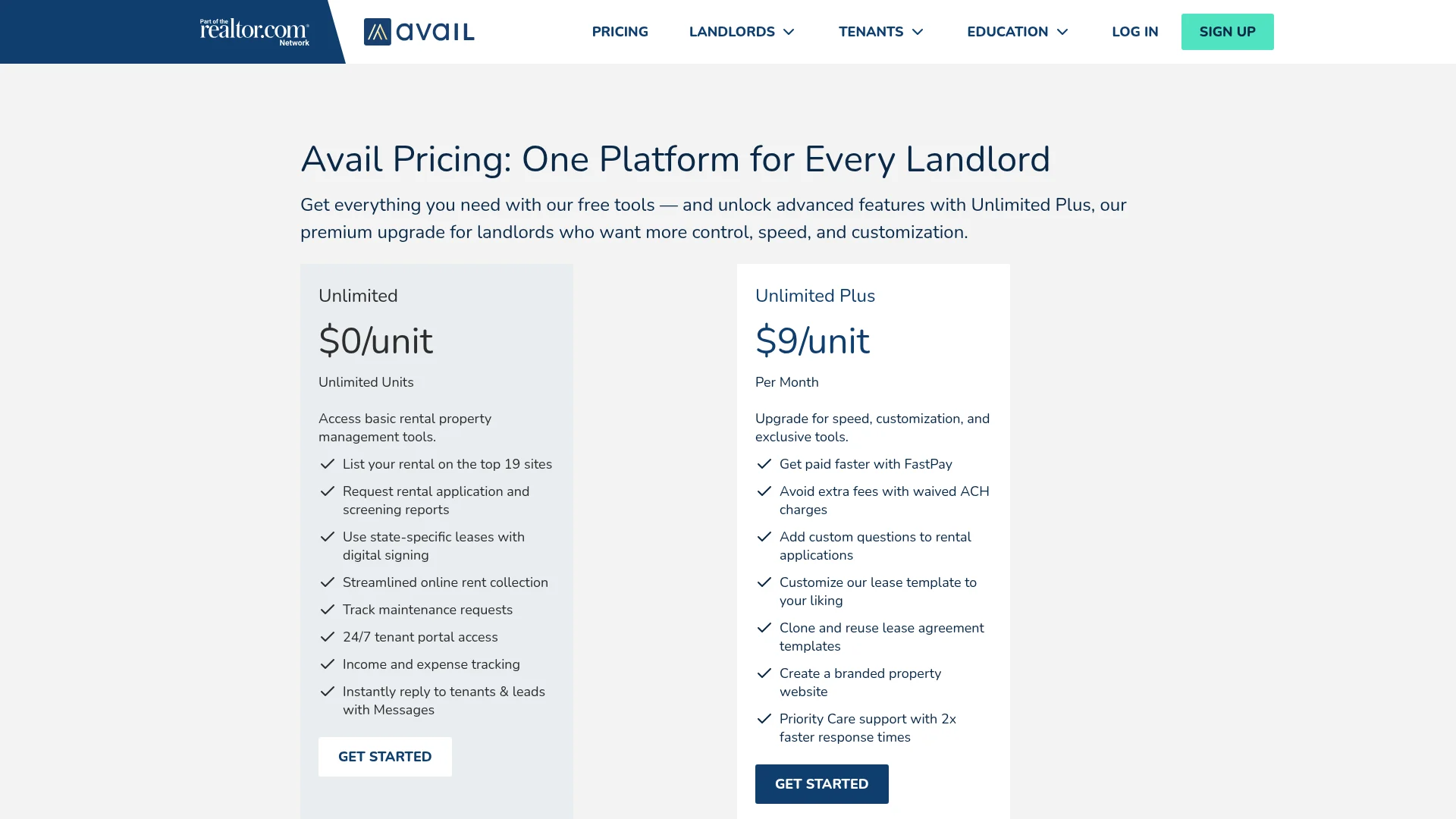
This is the biggest gap between the two free tiers, and it is not the gap most comparison pages describe. Avail generates state-specific, lawyer-reviewed lease templates with digital signatures, locally-generated clauses and disclosures, unlimited attachments and PDF output at $0, on both plans. Plus adds clause editing and the ability to clone a template for the next unit.
TurboTenant’s lease builder also covers all 50 states and is genuinely good — but on the free plan you can build and save a lease, not finalize, download or send it. Two help-center articles are explicit: finalizing, downloading the PDF or sending for e-signature requires an active Essentials or Pro subscription starting at $149 a year, and TurboTenant “does not offer a one-time purchase for individual lease agreements” (help center, 10 November 2026). Paid plans include unlimited leases, addendums and e-signatures, plus the Landlord Forms Pack — 32 forms, $199 if bought alone.
TurboTenant builds and saves a state-specific lease on Free, but finalizing, downloading or sending it for e-signature needs Essentials ($149 a year to ten units) or Pro — the help center states TurboTenant “does not offer a one-time purchase for individual lease agreements” (read 10 November 2026). Worth knowing if you’ve read a per-lease price here or elsewhere: its lease marketing pages still advertise a per-lease price; the help center says it does not offer one. The help center is the operational document and the pricing page’s plan table no longer lists a lease line, so treat a lease on the free plan as unavailable rather than purchasable — and treat any comparison, including our own older pages, that quotes a per-lease price as out of date. Either way the practical answer is the same: a TurboTenant landlord who signs a lease is buying Essentials at $149 or Pro at $199.
The flip side is workflow. TurboTenant carries the application, screening, lease, e-signature and autopay enrollment in one thread, and its tenant app handles signing — relevant for a tenant who won’t sit at a desktop. Avail has no app; signatures run through a mobile browser.
Where each one breaks
TurboTenant breaks at eleven units, and on the books. Cross from ten units to eleven and Pro doubles from $199 to $399 for identical software, the same cliff our RentRedi comparison flags. Every paid tier bills as one annual lump; there is no monthly option. Accounting below Pro is manual expense logging and a rent roll, and even Pro’s Schedule E/Form 8825 export is the ceiling — no owner statements or disbursements at any tier. Free-plan payouts run 5–7 business days, phone support starts at Essentials, and the $55 applicant toll on Free is the most expensive screening fee in the category.
Avail breaks on arithmetic and on accounting. $9 per unit per month is $108 per unit per year whether you have one unit or two hundred and fifty: $2,700 a year at 25 units, $5,400 at 50, with no annual lock and no enterprise tier. At 25 units that is more than Buildium’s Essential plan, which includes a general ledger. Avail’s books stop at a transaction log: income and expense tracking with Schedule E-style categories and CSV downloads, but no Schedule E summary, no reconciliation, no depreciation. There’s no mobile app — its help center calls one “planned for the future” — and FastPay, the next-business-day payout that justifies Plus, needs two to three weeks of manual review plus a Plaid-connected bank account on the tenant’s side before it works at all.
Verdict by landlord type
1–3 units, solo, budget zero. Avail’s free plan. The lease TurboTenant’s free tier can’t send is included, screening starts at $30, and deposits land in three business days instead of five to seven. Tell tenants about the $2.50 per payment at signing — roughly $30 a year each, and theirs, not yours.
6–25 units, growing. TurboTenant Pro. Between six and ten units it beats Avail’s free plan on all-in cost, and it beats Avail Plus by roughly $900 a year at ten. You get waived tenant ACH fees, $45 screening, phone support and real Schedule E reporting. One caution: the eleven-unit cliff lifts Pro to $399 and Essentials to $199, which makes Avail’s free plan cheaper again for exactly two units — eleven and twelve — before Pro retakes the lead from thirteen.
House-hacking one unit with a long-term tenant. Avail free, unless you never sign another lease. One tenant paying $2.50 twelve times a year costs them $30; your invoice is $0 and the lease is included. If the tenant pays by card, both platforms charge about 3.5% and the decision comes down to the app you’d rather use — TurboTenant has one, Avail doesn’t.
High-turnover portfolios — student rentals, mid-term, furnished. TurboTenant paid. At $45 a screen against Avail’s $55 bundle, six applicants a month saves $720 a year on screening alone, before unlimited leases and the pre-screeners that filter applicants before they pay anything.
Landlords whose tenants won’t pay per-payment fees. TurboTenant, and only on Pro. Pro waives the $2 ACH fee outright; on Free and Essentials the landlord can cover it in settings, about $24 per unit per year. Avail waives its $2.50 only on Plus at $108 a unit, which rarely pencils at small counts.
When neither is the answer. If a partner, lender or CPA needs owner statements, trust accounting or a general ledger, both tools top out — our small-landlord comparison prices what comes next. If the books rather than the tenancy are the problem, the free ledgers in our free-software roundup do accounting neither of these finishes. And if you’re still weighing TurboTenant against RentRedi or a flat-fee tool, that comparison is the one to read next.
Run your own numbers before you switch — the cost calculator prices both platforms at your unit count and payment mix.
FAQ
How does TurboTenant make their money?
By reselling what the free plan generates. Its own FAQ is blunt about it: “TurboTenant makes money by collecting and keeping the screening fee… since we buy them in bulk, at a cheaper rate than the average landlord, we can make a little bit off each report.” That is the $55 applicants pay on Free ($45 on paid). Add the $2 tenant ACH fee on Free and Essentials, the unwaivable 3.49% on cards, subscriptions at $149 to $999 a year, the $199 Landlord Forms Pack, and services: $1,500 tenant placement per vacancy, and Fully Managed Autopilot at $250 a month plus $100 per extra unit. The landlord’s invoice is genuinely $0; the margin sits on the tenant side, plus anyone who needs a lease sent.
What payment methods does TurboTenant accept?
Bank transfer and credit or debit cards, processed through Stripe. ACH costs the tenant $2 per payment on Free and Essentials and is waived on Pro — and a landlord can choose to absorb it — with deposits in 5–7 business days, or 2–4 on paid plans for eligible payments under $10,000. Cards carry 3.49% on every plan and deposit in 1–3 business days. Tenants manage their own payment methods; landlords cannot add or change them.
Is the Avail rental application legit?
Yes. The application is free; the reports behind it are TransUnion credit, a nationwide criminal search and a nationwide eviction report, ordered with the applicant’s authorization. Pricing is $30 for any single report and $55 for all three, set by TransUnion against the listing’s location, non-refundable once generated — but shareable with other Avail landlords free for 30 days, so a rejected applicant doesn’t lose the money entirely. The caution is price: $55 sits at the expensive end of the market, and it is charged before you have decided anything about the applicant.
Is TurboTenant safe for renters?
The rails are the real thing: Stripe processes payments, TransUnion supplies screening with the applicant’s authorization, and renters control their own payment methods and reports. What renters complain about is cost and patience, not safety — the $2 ACH fee, 3.49% on cards, and a 5–7 business day deposit window on free-tier landlords. Non-refundable screening fees are the sharpest edge: an applicant who doesn’t get the unit has paid for reports.
Does TurboTenant include a lease on the free plan?
No. You can build and save a lease on Free, but finalizing it, downloading the PDF or sending it for e-signature requires Essentials ($149 a year to ten units) or Pro ($199), and TurboTenant’s help center says it doesn’t sell a one-time lease — even though its lease marketing page still advertises a per-lease price its help center says does not exist. Avail includes state-specific leases with e-signing on its free plan, which is the single largest difference between the two $0 tiers.
TurboTenant vs Avail: which is actually cheaper?
At three units, Avail free: $255 all-in for the year against $334 on TurboTenant Pro, because the lease is free and there are only 36 tenant payments to fee. At ten units, TurboTenant Pro: $334 against $465 on Avail’s free plan and $1,245 on Avail Plus. Avail’s free plan is the cheaper complete year from one to five units; TurboTenant Pro wins six to ten, loses eleven and twelve to the band jump, and wins again from thirteen.