Landlord Studio vs Rentec Direct: Which Fits Your Portfolio? (2026)
Landlord Studio vs Rentec Direct: real prices at 10 to 100 units, built-in accounting vs Xero sync, mobile logging and screening, checked 10 November 2026.
Landlord Studio wins on price at every portfolio size from ten units up, and it’s the better fit for a self-managing landlord of roughly 10 to 50 units who does the bookkeeping from a phone and hands a CPA a Schedule E in one export. Rentec Direct wins for 50 to 250 units, or for anyone managing property on behalf of owners, where the value is keeping the books inside one system: a double-entry ledger, trust accounting on the PM plan, 1099 e-filing, and a phone number that a person answers. At 100 units, Landlord Studio Pro costs $131.40 a month against Rentec Pro’s $200. Prices checked 10 November 2026.
Disclosure: Landlord Method doesn’t earn a commission from Landlord Studio or Rentec Direct — neither affiliate program is live on this site. Every price below comes from the two vendors’ own pricing pages and calculators, read on 10 November 2026.
The two platforms at a glance
| Landlord Studio | Rentec Direct | |
|---|---|---|
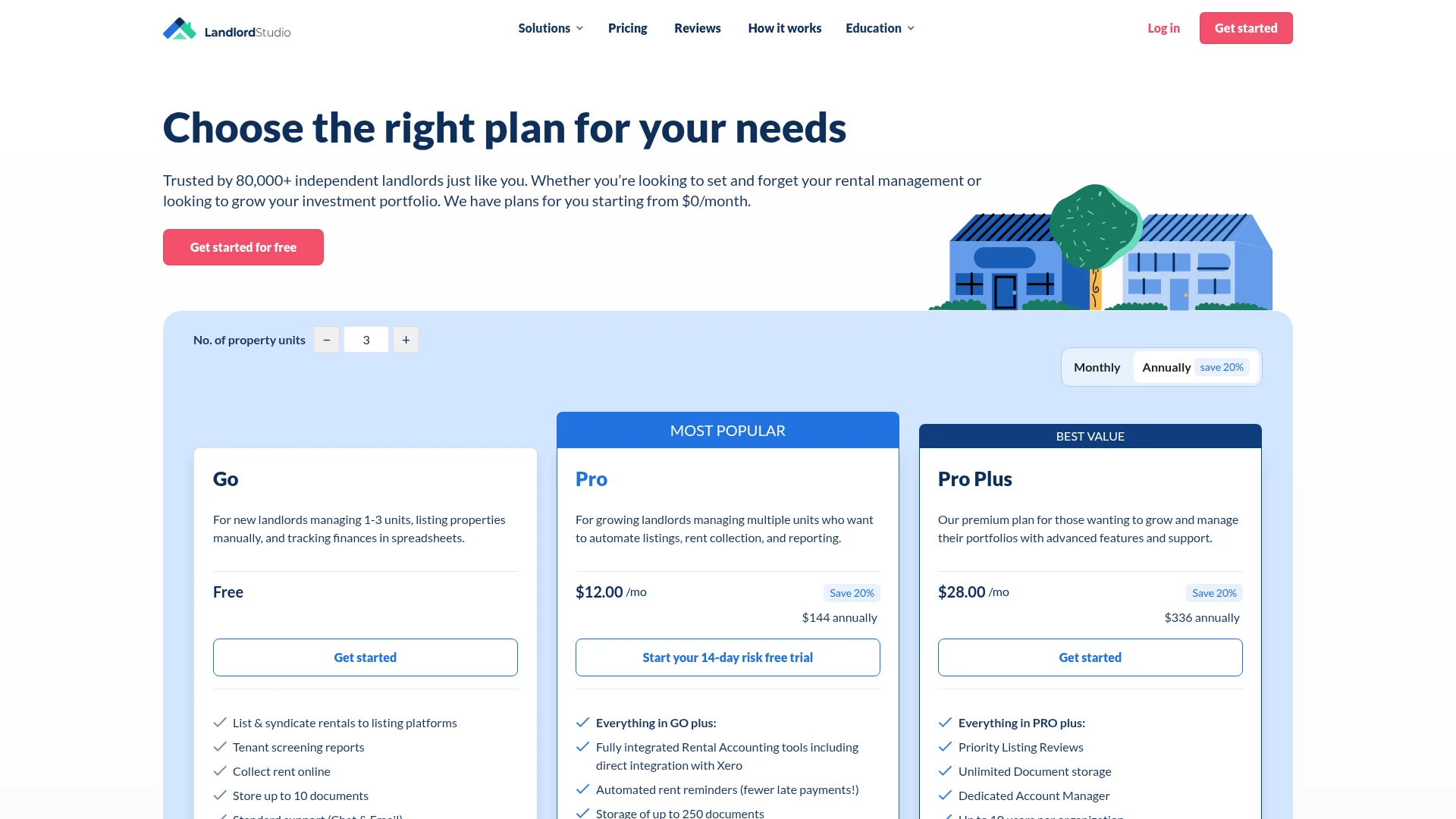
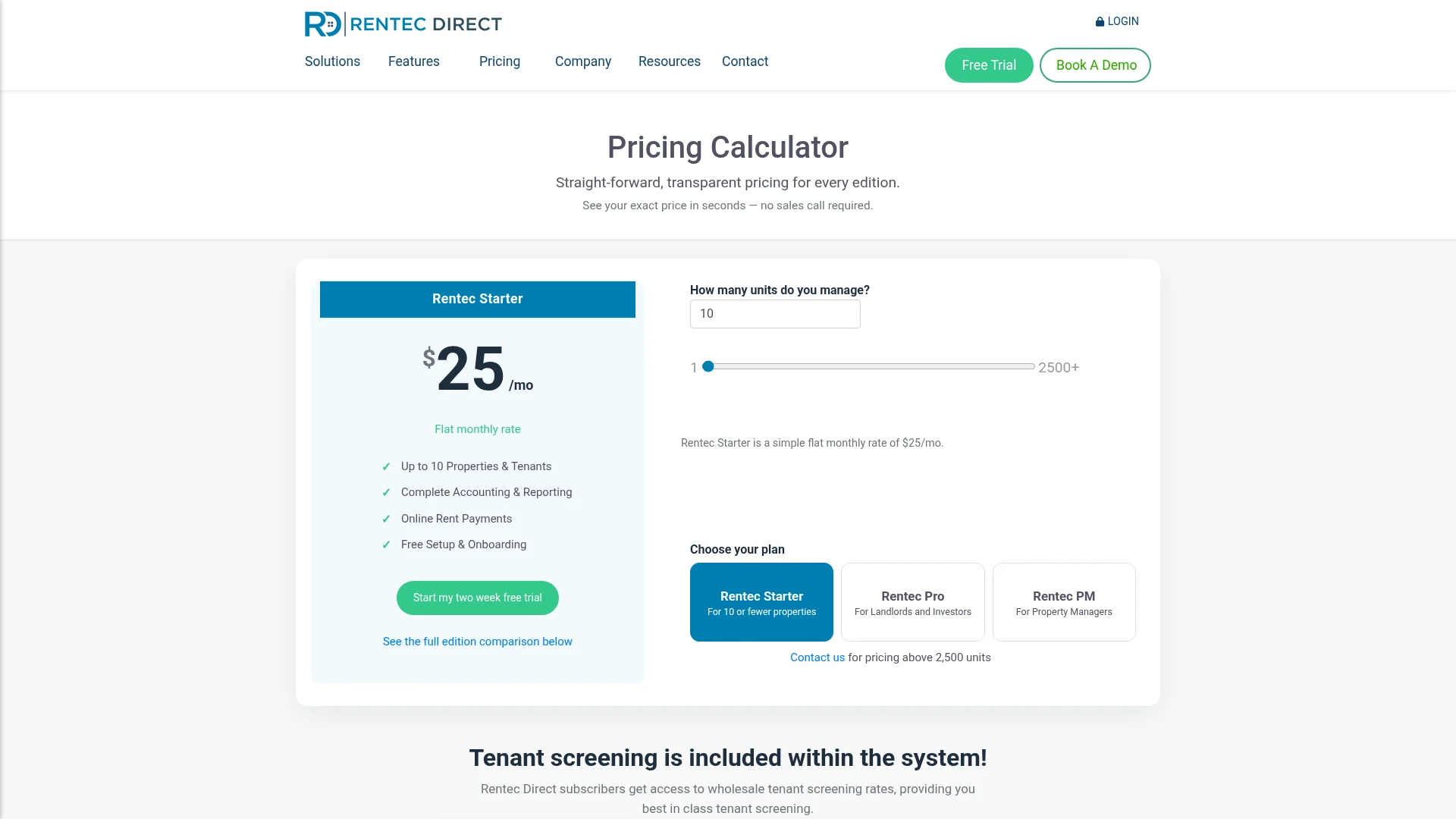
| Price structure | Free Go plan to 3 units; Pro $15/mo plus $1.20 per extra unit ($12/mo and $1.00 per extra unit billed annually); Pro Plus $35/mo ($28 annual) | Starter $25/mo flat to 10 properties and 10 tenants; Pro max($50, $2.00 × units); PM max($50, $2.50 × units); 10% off annual |
| Accounting depth | Property-level income and expense tracking, 20+ reports, Schedule E and profit-and-loss by property or unit; double-entry books come through the Xero sync | Full general ledger with bank reconciliation, Schedule-E tax reports, 1099 e-filing on Pro and PM, trust accounting and owner portal on PM |
| Bookkeeping handoff | Two-way Xero sync and accountant access on Pro; CSV and PDF exports | QuickBooks sync on Pro and PM; 1099-MISC and 1099-NEC e-filing through Nelco, billed separately by Nelco |
| Bank feeds | Automated feeds through Plaid with suggested matches and receipt scanning on Pro; up to 20 feeds on Pro Plus | Automatic bank transaction sync on Pro and PM |
| Mobile logging | iOS and Android landlord apps with receipt capture; tenant app for payments and maintenance requests | Mobile app on every edition; Resident Connect tenant app; the desktop app is where the accounting work happens |
| Listings & screening | Free syndication to Zillow, Trulia, HotPads and Zumper on every plan; TransUnion report from $45, which the applicant can pay | Syndication to Zillow, Trulia and Apartments.com; screening $10–$18 on Pro and PM ($14.95–$29.45 on Starter) |
| Rent collection | Online rent collection on every plan, including free Go | Free incoming ACH on Pro and PM (one per property per month, then $0.50); $2 per payment on Starter |
| Maintenance | Maintenance jobs with photos, tracked against the property; tenant requests through the portal or app | Work order tracking on every edition; dedicated marketing and maintenance manager roles on PM |
| Support | Chat and email; priority on Pro, dedicated account manager on Pro Plus | Unlimited US-based phone support, free one-on-one onboarding, free live training webinars |
Pricing compared by unit count
Both vendors publish their numbers, which already separates them from most of this category. Landlord Studio includes 3 units in every paid plan and charges per extra unit; Rentec Direct is flat to 10 units and then per-unit with a $50 monthly floor on Pro and PM.
| Units | Rentec Starter | Rentec Pro monthly / annual | Rentec PM monthly / annual | Landlord Studio Pro monthly / annual |
|---|---|---|---|---|
| 10 | $25 flat | $50 / $45 | $50 / $45 | $23.40 / $19.00 |
| 25 | Not available | $50 / $45 | $62.50 / $56.25 | $41.40 / $34.00 |
| 50 | Not available | $100 / $90 | $125 / $112.50 | $71.40 / $59.00 |
| 100 | Not available | $200 / $180 | $250 / $225 | $131.40 / $109.00 |
| 250 | Not available | $500 / $450 | $625 / $562.50 | $311.40 / $259.00 |
Three things in that table decide more arguments than any feature list.
Landlord Studio is cheaper at every count from 10 up. Rentec’s $2.00 per-unit rate runs about 67% above Landlord Studio’s $1.20, and the gap widens on annual billing, where Landlord Studio’s extra-unit rate drops to $1.00 and Rentec’s only takes 10% off. At 100 units billed annually that is $1,308 a year against $2,160 — a difference of $852, or about $8.50 per door per year.
Rentec’s floor binds until 25 units. Pro’s minimum is $50, so a 15-unit landlord pays what a 25-unit one pays, and the $2.00 rate only starts to bite above 25. The same floor makes PM identical to Pro until 21 units, so a small management operation gets trust accounting without a bigger subscription. Under 11 units, Starter’s flat $25 is the cheapest Rentec option, but Landlord Studio Pro still undercuts it at $23.40 month-to-month, and Go is free to three units.
Starter has a tenant cap, not just a property cap. Ten properties, ten tenants, three user accounts, one ACH deposit account. Ten single-family rentals fit. Ten units across six buildings with a waiting list does not.
Two wrinkles worth budgeting around. Rentec’s edition pages still publish figures its calculator no longer agrees with: the features page says the software starts at $45 a month and the PM page says $55, while the calculator returns $25 for Starter and a $50 floor on Pro and PM. The calculator is the live number. And payment processing is a separate line on both: Rentec Pro and PM include one incoming ACH per active property per month and charge $0.50 for excess, Starter charges $2.00 a payment, and its optional cash payment network carries a one-time $200 setup on Pro and PM. Landlord Studio collects rent online on every plan including free Go. Neither charges a setup fee, and both offer a two-week trial — Landlord Studio’s is 14 days of Pro with no card.
Accounting and taxes compared
This is the axis the two companies are built around, and the one the comparison-farm pages reduce to a row of checkmarks.
Rentec keeps the books in the system. Pro and PM carry a full general ledger with bank reconciliation and income and expense tracking by property, tenant and owner, and a report library including rent roll, balance sheet and operating statements. Tax preparation is built in: Schedule-E tax reports use the categories that populate the federal form, and 1099-MISC and 1099-NEC forms e-file from your vendor and owner data through Nelco, which bills separately for the filing. The PM plan adds trust accounting that follows state real estate board rules, an owner portal, and ACH payments to owners — the toolkit of a management company rather than a hobby ledger.
Landlord Studio treats its accounting as the front end and delegates the ledger. On Pro, accounts connect through Plaid and transactions arrive for coding against the right property, with receipt scanning on the phone and suggested matches for repeat costs. The report set is tax-shaped: Schedule E, profit and loss by property or unit, contractor totals for 1099s and a mileage log, shareable with your accountant or exportable in a click, inside a library of 20+ reports. The two-way Xero sync on Pro is the serious bookkeeping option: transactions move both directions, so Xero can stay the system of record and your CPA can work where they already work.
QuickBooks is where the two part company. Rentec syncs with it on Pro and PM. Landlord Studio does not sync with QuickBooks — its own comparison table treats QuickBooks as a “set up yourself” option and points Pro users at Xero instead. So the accounting decision reduces to three questions:
- If your CPA works in QuickBooks, Rentec’s built-in ledger and export path fit without a second subscription.
- If your CPA works in Xero, Landlord Studio’s two-way sync is the cleanest connection in this price range.
- If you manage money for other owners, trust accounting decides it: Rentec PM has it, Landlord Studio does not offer it at any price.
Both produce a Schedule E on their paid tiers, so neither makes you rebuild the year from bank statements. The difference is what surrounds the form: Rentec pairs it with 1099 e-filing inside the same ledger; Landlord Studio pairs it with property-level reports and accountant access the same day your CPA asks for them.
Mobile and day-to-day logging
Landlord Studio started as a tool its founder built for his own rental — Charles Chan put something together, listed it on the app store, and formed a small team with co-founder Logan Ransley when thousands of other landlords wanted the same thing. That origin still shows in the daily workflow, and the company behind it, Landlord Studio Limited, is a New Zealand one. Income and expenses are logged against a property in a few taps, receipts are photographed and attached, bank feed matches get confirmed rather than typed, and tenants are messaged in the same place the payment landed. The phone does the daily capture; the reports and the Xero sync do the accounting.
Rentec Direct ships a mobile app on every edition, and its Resident Connect app lets tenants pay and report maintenance from a phone. But the desktop application is where Rentec’s center of gravity sits, and its support model matches: unlimited US-based phone support, free one-on-one onboarding and free live training webinars, staffed from the company’s office in Grants Pass, Oregon. It is a heavier-touch setup aimed at operators running real portfolios.
The honest trade-off: if your week is thirty small transactions across scattered properties, Landlord Studio’s capture speed is the thing you’ll notice every day. If your week is owner disbursements, trust reconciliations and a move-out pipeline, none of that lives gracefully in a phone app on either platform, and Rentec’s desktop depth is the better match.
Listings, screening, tenant portal
Both platforms treat leasing as a checkbox rather than a growth engine, and both are weaker here than the listing-first tools. If filling vacancies is your bottleneck, our Avail review and TurboTenant review cover software that syndicates broadly and screens for free.
Landlord Studio syndicates to Zillow, Trulia, HotPads and Zumper on every plan, including free Go, with listing reviews taking 48 hours on Go, 24 on Pro and 12 on Pro Plus. Screening is a TransUnion credit, criminal and eviction check from $45 a report, results in about 30 minutes, and the applicant can pay it — which makes screening free to the landlord where local law allows.
Rentec Direct publishes vacancies to Zillow, Trulia and Apartments.com, and its screening is the better wholesale deal for landlords who pay the fee themselves: $10 to $18 a package on Pro and PM (basic criminal through credit-plus-eviction), against $14.95 to $29.45 on Starter. Every edition gets a tenant portal for payments and maintenance requests; Pro and PM add a free professional property website, which Starter does not. On PM, owners get their own portal with statements and ACH disbursements.
Net: Landlord Studio’s funnel is slightly wider (four syndication targets, applicant-paid screening, faster review tiers as you pay more); Rentec’s per-report screening is cheaper and its PM plan is the only one of the two with real owner-facing tooling.
Verdict by landlord type
10 to 50 units, self-managing, accounting-first: Landlord Studio Pro, billed annually. It costs less than Rentec Pro across the band — $19 versus $45 a month at 10 units, $59 versus $90 at 50 — the mobile capture fits how a hands-on landlord actually works, and the one-click Schedule E plus two-way Xero sync covers tax season without a second subscription. Start on free Go; if three units run cleanly, Pro is the same interface with automation switched on.
10 to 50 units, but you want the books in one system and a human on the phone: Rentec. At ten properties or fewer, Starter’s flat $25 buys a complete ledger, free setup and onboarding, and unlimited US-based phone support for $1.60 a month more than Landlord Studio Pro. Above that, Pro’s per-unit rate is the price of not maintaining a separate accounting stack.
50 to 250 units: price still favors Landlord Studio, but price stops deciding. At 100 units on annual billing, Landlord Studio Pro runs $1,308 a year against Rentec Pro’s $2,160 — roughly 40% cheaper, and both sit far below the entry cost of Buildium or AppFolio at that size (our Buildium vs AppFolio comparison shows where the full-service platforms land). Rentec earns its premium in specific situations: you manage for other owners and need trust accounting, owner portals and ACH disbursements; your accountant lives in QuickBooks; you run high screening volume at wholesale rates; or you rely on live phone support on the first of the month. In the r/PropertyManagement threads where 100-plus-door operators compare platforms, one commenter recommends Rentec Direct for a 200-property portfolio and growing — that is the audience it keeps.
Whichever you pick, migrate at a year boundary so each tax year’s books come out of one system. That advice costs nothing now and saves a reconstruction later.
FAQ
Which is cheaper, Landlord Studio or Rentec Direct?
Landlord Studio, at every unit count from 10 up. Checked 10 November 2026: at 10 units, Landlord Studio Pro is $23.40 month-to-month ($19 billed annually) against Rentec Starter’s flat $25 or Rentec Pro’s $50; at 100 units it’s $131.40 against $200 monthly, or $109 against $180 billed annually. The gap comes from Rentec’s $2.00 per-unit rate and $50 floor against Landlord Studio’s $1.20 ($1.00 annual) per extra unit. Rentec’s $25 Starter is competitive only under ten properties.
Do either of them help with taxes?
Both, on the paid tiers. Rentec Direct includes Schedule-E tax reports inside its general ledger, plus 1099-MISC and 1099-NEC e-filing through Nelco on Pro and PM, with Nelco billing separately for filings. Landlord Studio Pro produces a Schedule E, profit and loss by property or unit, contractor totals for 1099s and a mileage log, shareable with an accountant or exportable in PDF or CSV. Neither files your personal return; both prepare the numbers your preparer files.
Does Landlord Studio integrate with Xero?
Yes — a native two-way sync on the Pro plan ($12 a month billed annually), so transactions and categorizations move in both directions and Xero can stay your system of record. Landlord Studio does not sync with QuickBooks; you export CSV or PDF reports and your bookkeeper imports them. If QuickBooks is the fixed point of your workflow, Rentec Direct’s sync fits it better.
Is there a free trial?
Both, without a sales call: Rentec Direct offers a two-week free trial on every edition, and Landlord Studio offers 14 days of Pro with no credit card. Landlord Studio also keeps a permanent free Go plan for up to three units; Rentec has no free tier.
Who owns Landlord Studio?
Landlord Studio is a privately held New Zealand company, co-founded by Charles Chan and Logan Ransley. Chan built the first version to track his own rental property, put it on the app store, and grew it into Landlord Studio after other landlords asked for access. The company says it is used by more than 80,000 landlords.
What are the alternatives to these two?
For free tiers that handle listings and screening better than either, see our TurboTenant review and best free property management software guide. For full-service platforms with trust accounting and owner statements in the same neighborhood, compare Buildium ($65 and up) and AppFolio in our Buildium alternatives guide. For a shortlist by portfolio size, start with the best property management software for small landlords.