Buildium Review: What It Really Costs a Small Landlord (2026)
Buildium starts at $65 a month, but 20 units paying by bank cost $112. Full fee stack and unit math at 10, 20, 41, 50 and 100 doors, verified 5 Nov 2026.

Buildium is property management software built around trust accounting: a ledger that tracks money by property and by owner, owner statements drawn from it, bank reconciliation, and 1099 e-filing through Nelco. It fits a landlord or small manager with roughly 20 or more doors who has to hand somebody an owner statement each month. Plans start at $65 a month (Buildium’s pricing page, 5 November 2026), which covers 20 units on Essential. Two things move that number: per-payment fees, and onboarding, which is mandatory and unpriced once you reach Growth.
Disclosure: Landlord Method doesn’t earn a commission from Buildium — its affiliate program is not live on this site. Every price below comes from Buildium’s own calculator and pages, read on 5 November 2026.
Quick answer
| The deal (verified 5 Nov 2026) | |
|---|---|
| Plans | Essential $65/mo, Growth $202/mo, Premium $420/mo; 14-day trial, no card |
| What Growth adds | Live phone support, $1 eSignatures, enhanced screening, inspections included, 10 free bank accounts |
| What Premium adds | Open API, unlimited eSignatures, incoming EFT free for a year, priority support |
| Unit bands | Essential is sold from 1 to 40 units: $65 to 20, $84 from 21 to 40. Growth starts at 41 units ($202) and costs $265 at 100 |
| Payment fees | Incoming EFT $2.35 Essential, $1.35 Growth, $0.60 Premium after a free year; outgoing EFT $0.99; cards 2.99% |
| Onboarding | Required for every new Growth and Premium customer; the price isn’t published |
| Biggest compromise | The two largest line items — onboarding and card fees — are the two you can’t see on the pricing page |
What Buildium costs at your portfolio size
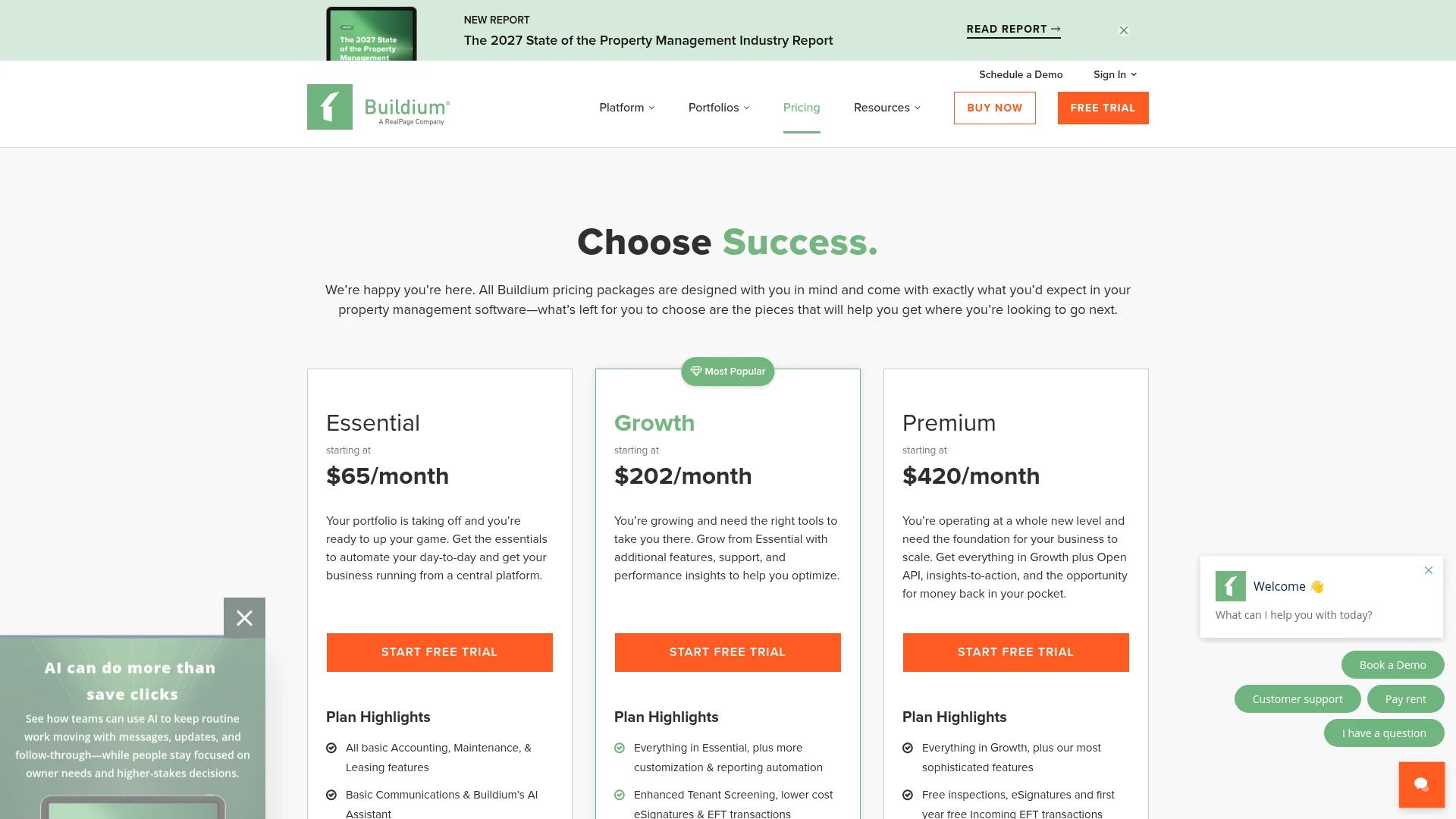
Buildium publishes three starting prices and hides the rest behind a calculator. I ran that calculator at each unit count below on 5 November 2026, monthly billing, one tenant per unit paying by bank transfer.
| Units | Plan | Subscription | Incoming EFT | Monthly total | Annual |
|---|---|---|---|---|---|
| 10 | Essential | $65 | $23.50 | $88.50 | $1,062 |
| 20 | Essential | $65 | $47.00 | $112.00 | $1,344 |
| 41 | Growth | $202 | $55.35 | $257.35 | $3,088 |
| 50 | Growth | $202 | $67.50 | $269.50 | $3,234 |
| 100 | Growth | $265 | $135.00 | $400.00 | $4,800 |
Essential has two price bands. It runs $65 a month to 20 units and $84 from 21 to 40. The page only advertises $65, which is why so many comparisons quote a price that stops applying at unit 21. At 40 units the subscription is $1,008 a year.
The 41st unit is the cliff. Essential isn’t sold above 40 units, so unit 41 puts you on Growth at $202 — $118 more a month for one extra door, a 140% jump. Per door it goes backwards: $5.60 all-in at 20 units, $6.28 at 41. If you’re at 38 doors and negotiating a 42nd, run that arithmetic before you sign.
Annual billing saves 10%. Prepaid, Essential at 10 units is $702 a year ($58.50 a month) and Growth is $2,182 ($181.83). It’s a 12-month commitment, so it’s the wrong setting for a first quarter.
Two one-time items belong in year one. Each business bank account costs $99 to set up on Essential; Growth gives you 10 free. Onboarding is the other, and it has no published price. Note the date on any price you read elsewhere: list prices rose about 5% on 29 October 2026 (Essential was $62, Growth $192, Premium $400), and plenty of comparison pages still quote the old numbers.
The fee stack nobody quotes up front
| Fee | Essential | Growth | Premium |
|---|---|---|---|
| Incoming EFT | $2.35 | $1.35 | $0.60 after 12 months free |
| Outgoing EFT | $0.99 | $0.99 | $0.99 |
| Cards | 2.99% | 2.99% | 2.99% |
| eSignature (Dropbox Sign) | $5/document | $1/document | unlimited |
| Screening (TransUnion) | $17 manager-paid, $35 applicant-paid | + $20 enhanced | + $20 enhanced |
| Bank account setup | $99 each | 10 free, then $99 | 100 free, then $99 |
| Inspections (HappyCo) | $99 setup + $40–$95/mo | included; $0.40/unit after 3 years | included |
| 1099 e-filing (Nelco) | $50 per batch + $4.50 per form | same | same |
| Showings coordinator (Tenant Turner) | $25 setup + from $41/mo | setup waived, from $41/mo | same |
| Check printing (RevSpring) | $30 setup + $1.50/check | same | same |
Three of those need dollar math rather than a rate.
Rent by bank transfer. Twenty incoming EFTs at $2.35 is $47 a month, $564 a year, on top of a $780 subscription — $1,344 a year for a 20-unit portfolio. At 100 doors on Growth, $135 a month is $1,620 a year against a $3,180 subscription.
Rent by card, if you absorb it. On a $1,800 rent, 2.99% is $53.82. Twenty tenants paying by card is $1,076 a month, $12,917 a year; fifty is $2,691 a month, $32,292 a year. Nobody absorbs that twice by accident. The defensible policy is free ACH and pass the card cost — Buildium’s ePay settings let you set a convenience fee that does it, and Buildium’s own guidance points at the Visa rules and state law that govern those fees before you switch them on.
eSignatures at turnover. Twenty leases a year costs $100 on Essential and $20 on Growth — against a Growth subscription that costs $137 a month more at 20 units. Phone support and enhanced screening have to justify that gap, not the signature fees.
Accounting and trust accounting
Every transaction posts against a property, and money can be tracked in trust accounts with owner funds separate from the company’s. Owner statements come out of that same ledger, so a statement is a report on the books rather than a reconciliation exercise. Reconciliation runs on all plans, with rules on Growth. 1099-MISC for owners and 1099-NEC for vendors file electronically through Nelco at $50 per batch plus $4.50 per form; because the two forms file as separate batches, a portfolio with both pays two batch fees.
What it doesn’t do: a Schedule E. You get the ledger, property-level profit and loss, and transaction detail; the mapping is yours or your accountant’s. Buildium also keeps its own ledger rather than syncing live with QuickBooks Online — a Capterra reviewer on 28 May 2026 wrote “Does not coordinate with QuickBooks, which is essential for us” and said they stopped using the product over it. One reviewer, not a product limitation, but test the export before you commit.
A 10-unit self-manager touches little of this: no owner statements when you are the owner, no trust accounting when rent lands in your operating account. You use the rent roll, the lease ledger and the 1099s — and one handyman over $600 is cheaper to file elsewhere than to pay a $50 batch fee for.
Leasing, screening and the tenant side
Vacancies syndicate from the listing you build in Buildium, applications land in the same place, and screening runs through TransUnion at $17 when you pay or $35 when the applicant does. Enhanced screening, $20 more, is Growth and Premium only. Leases sign through Dropbox Sign at the rates above. The Resident Center adds rent reporting to the credit bureaus, amenity booking, renters insurance from $12 a month paid by the resident, and payment alternatives: PayNearMe for cash at retail locations, Obligo for deposit alternatives, Livble for split payments.
How tenants pay rent in Buildium
Tenants pay through the Resident Center by bank transfer or card, or in cash at a PayNearMe location. The pricing page publishes what each costs — $2.35, $1.35 or $0.60 per EFT by plan, 2.99% for cards — but never says who pays. That’s a setting, not a defect: ePay convenience fees let you pass the cost to the resident, and for cards you choose the payer. Set it before your first tenant logs in, because changing it later is a conversation with every tenant at once.
Where Buildium is weak
Onboarding is mandatory, unpriced and slow. Buildium’s FAQ says every new Growth or Premium customer “must use our customized Onboarding service,” and no dollar figure appears anywhere on the site. The complaints are about time: a landlord in r/PropertyManagement “paid for a full year upfront, but after more than two weeks, onboarding still hadn’t happened,” and cancelled. Another had an account manager leave mid-migration and was told they “weren’t eligible” for a replacement.
Support is tiered at the subscription price. Ticket support and Buildium Academy on every plan, live phone support only on Growth and Premium, priority support a paid add-on on Growth. The G2 review titled “Worst Customer Service Experience Ever” (8 October 2026, 0/5) describes an issue “going over 4 months now.”
Current reliability complaints are dated and specific. Two days before this review, a manager with 48 units and a decade on Buildium described two-factor authentication failing for tenants: “I had a lot of people who I had to drive and pick up checks from, forgive a lot of late fees.” A month earlier, “Do NOT use Buildium” was about a security-deposit limit stuck at $2,000 for over a week, with support “absolutely horrendous” by email and chat.
Billing surprises. A Trustpilot reviewer of more than 10 years lists work orders with “no automation,” e-sign at $1 a document and EFT at $1.35 on a tier sold as including both, and repricing “on a handful of features every 3 months or so.” One customer’s account, but the pricing page confirms those rates. The same pattern shows in inspections: an association manager posting on the day this review was written says HappyCo charges reached “$10,000 in the last 14 months” after inspections stopped being bundled — unverified, from one portfolio, and exactly what Growth’s revert to $0.40 per unit after three years sets up.
Mobile is real but thin. The app exists — 4.7 from about 4,500 App Store ratings on 5 November 2026 — and covers tasks, work orders, resident payments, contacts and photos. Accounting, reporting and reconciliation aren’t in its feature list.
Is Buildium worth it?
1–10 units: probably not. Essential at $65 runs ten doors, but you’re paying for owner statements and trust accounting you’ll never open. TurboTenant is free; TenantCloud is $180 a year and adds a real platform. Both are the honest recommendation at this size — see the TenantCloud review, or how Buildium stacks up against the rest of the small-landlord shortlist if you’re pricing five vendors at once.
10–50 units: yes, if you have owners or a bookkeeper to satisfy. This is the band where a ledger, reconciliation and owner statements stop being overhead and start replacing a spreadsheet plus a Saturday. Twenty units at $112 all-in is $5.60 a door. If you’re at 21 to 40 units, take the $84 Essential band before anyone talks you into Growth.
50–100+ units: still fits, but the reasoning changes. At 100 units Buildium is $400 a month with bank fees counted, $4 a door. AppFolio’s per-unit maths starts working around this size, which is where the crossover argument belongs rather than here — Buildium vs AppFolio runs it at every band.
Buildium vs the alternatives
AppFolio. It won’t sell below 50 units and doesn’t publish its minimum spend, so the comparison only exists above that line. Comparable accounting, a better-rated interface, onboarding reported at $400 and up.
DoorLoop. Cheaper per unit to enter, phone support on every plan, a $199 monthly minimum — more than Essential at 20 units, less than Growth at 41. The trade is accounting depth against interface polish: the DoorLoop vs Buildium comparison covers it line by line, and the DoorLoop review covers the product side.
TurboTenant and RentRedi. Built for smaller portfolios: free or near-free entry, tenant-paid fees, no trust accounting worth the name. At five doors the TurboTenant review is the place to start, and the RentRedi vs TurboTenant breakdown prices free against paid.
Buildium vs Tenant Cloud
TenantCloud is priced by lease rather than unit, tops out at $60 a month for 60 leases, and has tenants paying the transaction fees — roughly a fifth of Buildium’s cost at 50 units. It gates bank reconciliation behind Pro and has a documented ceiling in accounting depth. Buy TenantCloud if price is the constraint; buy Buildium if the books are the reason you’re shopping.
FAQ
Does Buildium run background checks?
Buildium doesn’t run the check itself. Screening is powered by TransUnion and ordered inside the platform, with the report attached to the application. It costs $17 per screening when the manager pays and $35 when the applicant pays. Enhanced screening, $20 more, is available on Growth and Premium only, so Essential subscribers get the standard check.
How much does Buildium cost for 10 units?
$65 a month on Essential, which costs the same from 1 to 20 units. Ten tenants paying by bank transfer add $23.50, so the real monthly figure is $88.50 — $1,062 a year. Prepaid annually, Essential is $702 a year, or $58.50 a month. Add $99 once for a second business bank account. Figures read from Buildium’s calculator on 5 November 2026.
Do you have to pay for Buildium onboarding?
Yes, on Growth and Premium. Buildium’s pricing FAQ states that all new customers on those plans “must use our customized Onboarding service,” which imports your data and builds a training plan. Buildium doesn’t publish the price anywhere on its site, so it arrives with the quote. Essential customers don’t have to buy it. Get the number in writing before the trial ends.
Is Buildium good for small landlords?
For 10 to 50 units, yes. It’s one of the few platforms that sells below 50 units and still keeps a real ledger, trust accounting and owner statements. Below 10 units it’s usually overkill: you pay $65 to $88 a month for reporting you won’t use, when TurboTenant is free and TenantCloud is $15 a month.
Can tenants pay rent through Buildium?
Yes. Tenants use the Resident Center or the resident app to pay by bank transfer or card, set up autopay and see their ledger; cash payments run through PayNearMe at retail locations. The fee depends on plan — $2.35, $1.35 or $0.60 per EFT, or 2.99% for cards — and whether the tenant or you pay it is a convenience-fee setting you control.
Are AppFolio and Buildium the same?
No. They keep similar ledgers and sell to different sizes. AppFolio has a 50-unit minimum and an unpublished minimum spend; Buildium starts at $65 with no minimum and caps Essential at 40 units. The companies are unrelated — Buildium is a RealPage company, AppFolio is its own public company.
Verdict
Verdict: 4/5
Buy it above 20 doors if you have owners to report to and want the books to be the software’s job. Skip it below 10 units, where TurboTenant and TenantCloud do the same work for a fifth of the money, and open an AppFolio evaluation past 80. The thing to negotiate before signing is onboarding: get the fee quoted in writing with a go-live date, and hold the eSignature and EFT rates for 24 months. Run your own unit count through the fee calculator first.